Special Offer: Use code ILOVEPLANTS for 25% off on all digital products! Shop Now →


African violets are small, fuzzy-leaved plants that can flower almost all year round on a windowsill. They have a reputation for being fussy, but they really follow a few clear rules: enough light, warmth, gentle watering that keeps the leaves dry, and a little food every time you water. Get those right and you will rarely see your violet without flowers.
Short answer: Give African violets bright, indirect light (a north or east window, or 12 to 16 hours under a grow light). Water with room-temperature water from below when the top inch is dry, and keep water off the leaves. Keep them at 65 to 80°F (18 to 27°C) with 40 to 60% humidity, feed at quarter strength with each watering, and keep them in a small pot. They are safe for cats and dogs.
In this guide
African violet care at a glance

| Need | What an African violet wants |
|---|---|
| Light | Bright, indirect; 12 to 16 hours of light a day for flowers |
| Water | Room-temperature, from below, when the top inch is dry |
| Soil | Light, airy African violet mix (about half perlite) |
| Pot | Small: about a third of the leaf spread, with drainage |
| Temperature | 65 to 80°F (18 to 27°C); about 70°F is ideal |
| Humidity | 40 to 60% |
| Feeding | Quarter-strength fertilizer with every watering |
| Pets | Non-toxic to cats and dogs (ASPCA) |
Free Plant Care Tracker: Never forget to water your African Violet again. Get it free →
How much light does an African violet need?
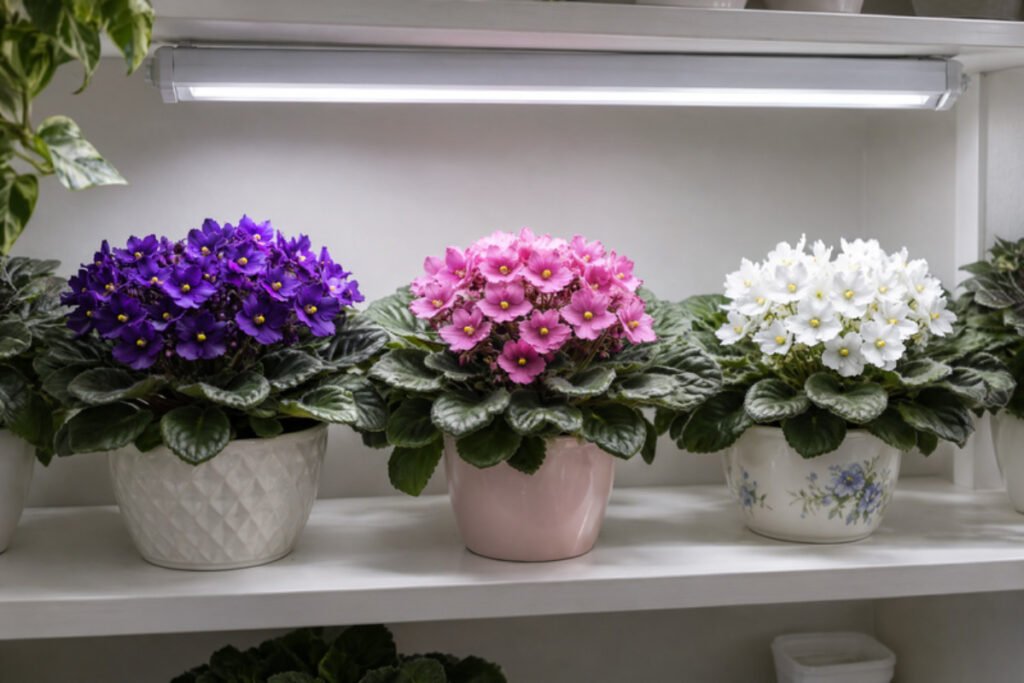
Light is the number one reason violets do or do not bloom. Give them bright, indirect light: a north or east window is ideal, or a spot set back from a sunny west or south window. University of Minnesota Extension says they need 14 to 16 hours of light and 8 to 10 hours of darkness a day to flower well, which is why so many growers use lights.
- Grow lights: LED or fluorescent tubes 4 to 8 inches above the plants for 12 to 16 hours a day work beautifully (Iowa State Extension).
- Too little light: thin, dark blue-green leaves on long stalks, and no flowers.
- Too much light: pale, bleached or yellowish leaves, often bunched tightly in the centre.
- Turn the pot a quarter turn every week so it grows evenly.
How to water African violets
African violets want soil that is moist but never soggy, and they dislike water on their leaves. Iowa State Extension notes that cold water on the leaves damages them quickly, leaving pale rings or spots. The safest methods:
- Bottom watering (easiest): stand the pot in about 1 inch of room-temperature water until the surface feels moist, usually 20 to 30 minutes, then let it drain. Do not leave it sitting in water.
- Top watering: use a narrow spout and pour under the leaves onto the soil. Water from the top now and then to flush out salts.
- Wick watering: a nylon string runs from the drainage hole into a reservoir of very dilute fertilizer, so the plant drinks as it needs. Great for busy plant parents.

Water when the top inch of soil feels dry. Always use room-temperature water, and avoid water from a softener. Rain, distilled or filtered water helps if your tap water is very hard. More in our watering guide.
Best soil and pot size
Violets need a very light, airy, well-draining mix. University of Minnesota Extension suggests half commercial African violet mix and half perlite. Choose a small pot with drainage holes: as a rule of thumb, the pot should be about one third of the width of the leaf spread. Violets bloom best when slightly snug in their pot, and an oversized pot stays wet and rots roots.
Temperature and humidity
Keep them at 65 to 80°F (18 to 27°C), with about 70°F ideal. Below 65°F they slow down and stop flowering; below 50°F leaves darken and turn mushy. Above 85°F, growth and flowering slow too. Aim for 40 to 60% humidity: grouping plants or a pebble tray (pot base above the water) helps. Keep them off cold windowsills in winter. See our temperature guide.
Fertilizing for flowers
African violets bloom best with small, regular feeds. University of Minnesota Extension recommends a mild fertilizer at one quarter of the label strength with every watering, and flushing the pot with plain water once a month to rinse out salts. A fertilizer made for African violets is easiest. Both too little and too much fertilizer can stop flowering, so stick to the weak, regular routine. Learn more in our fertilizing guide.
How to make an African violet bloom
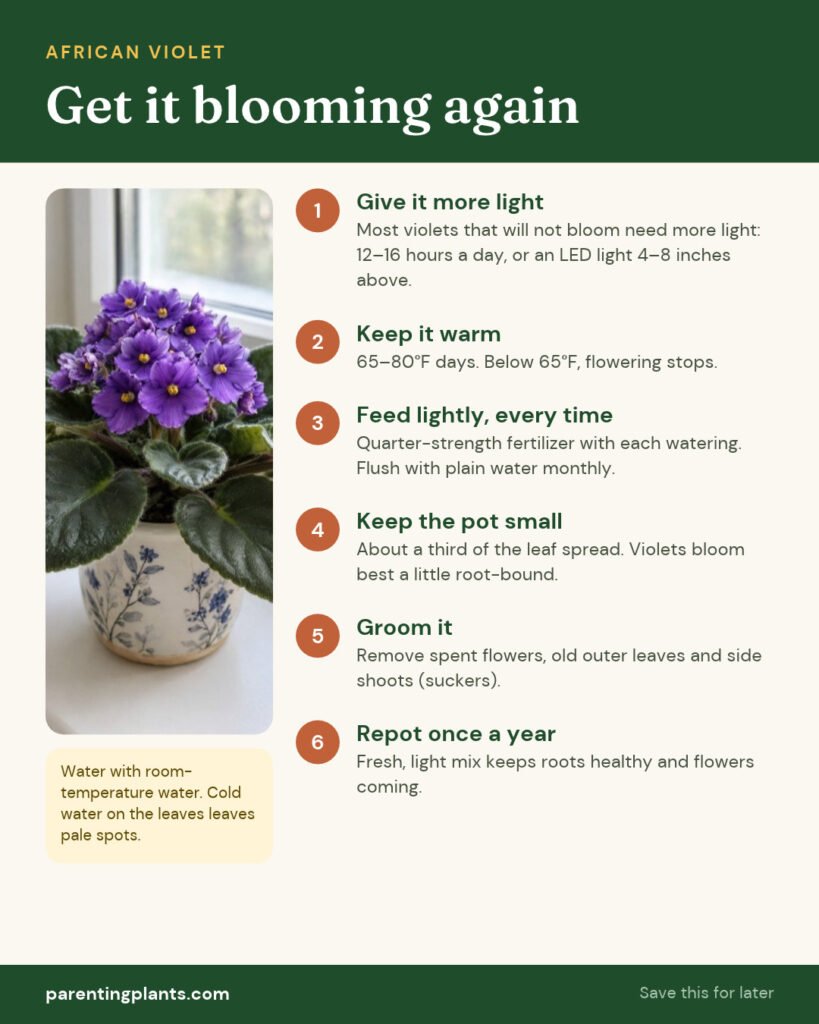
- Give it more light. This fixes most violets that will not bloom: 12 to 16 hours a day, or a grow light 4 to 8 inches above.
- Keep it warm, 65 to 80°F. Cool rooms stop flowering.
- Feed lightly with every watering at quarter strength, and flush monthly.
- Keep the pot small, about a third of the leaf spread.
- Groom it: remove spent flowers, old outer leaves and side shoots.
- Repot once a year into fresh, light mix.
Grooming and suckers
A tidy violet is a healthier, more floriferous violet. Use small scissors or tweezers to remove spent flowers and their stalks, and snap off any damaged outer leaves. Brush dust off the fuzzy leaves with a soft, dry paintbrush rather than wiping them.
Watch for suckers: small extra crowns that grow from the base or between leaves. They crowd the plant and stop it blooming. Gently twist them out with a pencil tip or tweezers once they are big enough to see, and pot them up as new plants if you like.
How to propagate an African violet from a leaf
One healthy leaf can grow a whole new plant. It takes patience, but it is very rewarding:
- Choose a firm, healthy leaf from the middle row (not the oldest outer leaves or the tiny centre ones).
- Cut the stalk at an angle, leaving about 1 to 1½ inches of stalk.
- Insert the stalk about ½ inch deep in a small pot of moist, light mix, at a slight angle.
- Cover loosely with a clear plastic bag to keep humidity high, and keep it warm in bright, indirect light.
- Tiny plantlets appear at the base in about 6 to 8 weeks.
- When the baby leaves are about the size of a coin, separate the plantlets and pot each one on its own.

Repotting and long necks
Repot once a year into fresh mix, keeping the same small pot size or going up only slightly. Older violets often lose their lower leaves and develop a bare stem, or “neck”. Iowa State Extension suggests fixing this by repotting and setting the plant lower, burying the bare neck up to the lowest leaves; it will root along the buried stem.
Common African violet problems and fixes
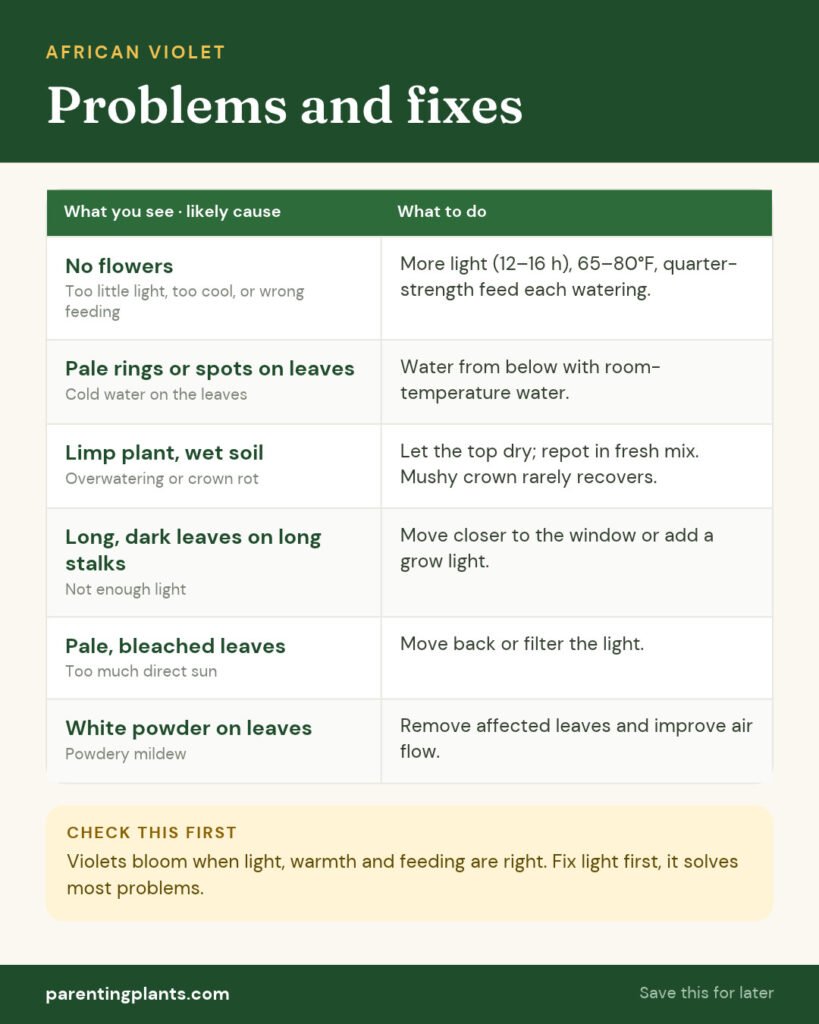
| What you see | Most likely cause | What to do |
|---|---|---|
| No flowers | Too little light, too cool, wrong feeding | 12 to 16 hours of light, 65 to 80°F, quarter-strength feed every watering |
| Pale rings or spots on leaves | Cold water on the leaves | Water from below with room-temperature water |
| Limp plant, soil wet | Overwatering or crown rot | Let the top dry; repot in fresh mix. A mushy crown rarely recovers, so root a healthy leaf |
| Long, dark leaves on long stalks | Not enough light | Move closer to the window or add a grow light |
| Pale, bleached leaves | Too much light | Move back or filter the light |
| Rusty-coloured leaves | Too much fertilizer | Flush with plain water; feed every other watering |
| White powder on leaves | Powdery mildew | Remove affected leaves; improve air flow |
| Distorted, hairy centre leaves | Mites | Isolate the plant; treat with insecticidal soap or a miticide |
More help in our guides to root rot and houseplant pests.
Are African violets safe for pets?
Yes. The ASPCA lists the African violet as non-toxic to cats and dogs, making it one of the best flowering houseplants for pet homes. Cats may still nibble the soft leaves, so a high shelf keeps the plant looking its best. See more pet-friendly houseplants or check any plant with our free Plant Toxicity Checker.
Quick action checklist
- Bright, indirect light; 12 to 16 hours a day for flowers
- Water from below with room-temperature water when the top inch is dry
- Keep water off the leaves
- Small pot and light, airy mix
- 65 to 80°F and 40 to 60% humidity
- Quarter-strength feed every watering; flush monthly
- Remove spent flowers and suckers; repot yearly
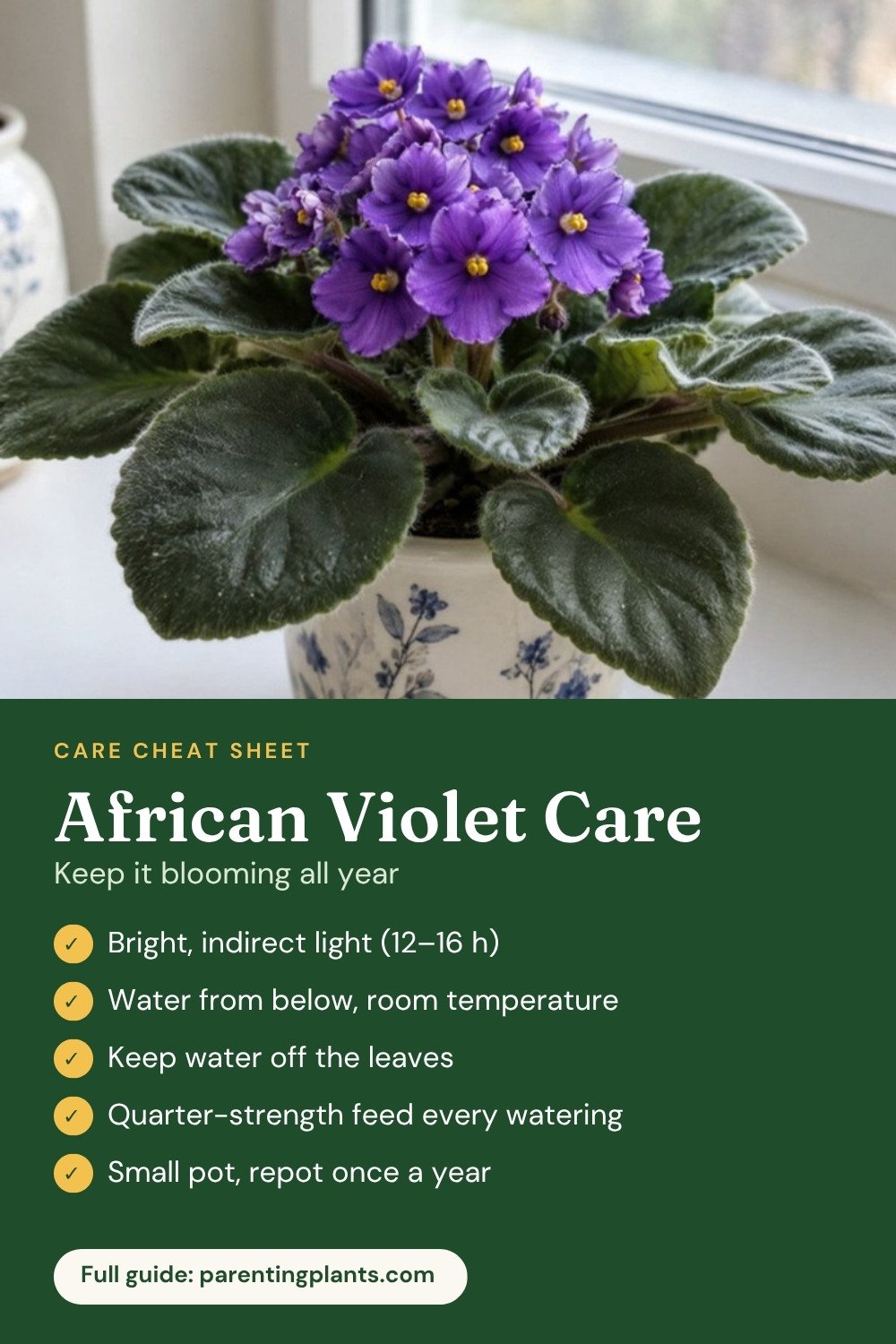
Save this for later: pin the cheat sheet below to your Pinterest plant board.
Want care for 30 popular houseplants on one page each?
Our printable Houseplant Care Cards include an African violet card plus 29 other favourites, with light, water, pet safety and quick fixes at a glance.
African violet FAQ
Why is my African violet not blooming?
Usually not enough light. Give it 12 to 16 hours of bright, indirect light a day, keep it at 65 to 80°F, feed lightly with every watering and keep it in a small pot.
How often should I water an African violet?
When the top inch of soil is dry. Water from below with room-temperature water and never leave it standing in water.
Can I get water on African violet leaves?
Avoid it. Cold water leaves pale spots, and water sitting on the leaves or crown can cause rot.
What size pot does an African violet need?
A small one, about a third of the width of the leaf spread. Violets bloom best when slightly root-bound.
How do I propagate an African violet?
Root a healthy leaf with about an inch of stalk in moist mix. Plantlets appear in about 6 to 8 weeks.
Are African violets safe for cats?
Yes. The ASPCA lists them as non-toxic to cats and dogs.
What are African violet suckers?
Small extra crowns that grow from the base. Remove them so the main plant keeps flowering.
Sources and further reading
This guide was written by Manik for Parenting Plants and checked against university extension advice. Last reviewed November 2026.
- University of Minnesota Extension: Growing African violets
- Iowa State University Extension: All about African violets
- UF/IFAS Extension: African violets
- ASPCA: African violet toxicity
Free tracker
Never forget to water your African Violet again
Track your African Violet and every other plant you own. A ready-made plant care tracker for Google Sheets and Notion that shows exactly which plants need water today, with 90 houseplants built in.
You're in!
Check your inbox, plant friend! 📩
Your free Plant Care Tracker is on its way. We've emailed you both versions, Google Sheets and Notion, plus a bonus printable 2027 plant calendar. It usually arrives within a few minutes.
Can't find it? Check your Promotions or Spam folder, and add manik@parentingplants.com to your contacts so you never miss a plant tip.


