Special Offer: Use code ILOVEPLANTS for 25% off on all digital products! Shop Now →


Dracaenas are some of the most common indoor plants in homes and offices, and for good reason: they are tall, architectural, tolerate lower light and forgive the odd missed watering. Corn plants, dragon trees, Janet Craig and ‘Lemon Lime’ are all dracaenas, and they share the same easy care. The one thing that trips people up is brown leaf tips, and this guide shows you exactly why they happen and how to stop them.
Short answer: Give dracaena bright, indirect light (it tolerates lower light) and water when the top inch of soil is dry. Use filtered or rain water if you get brown tips, because dracaenas are sensitive to fluoride. Keep it at 60 to 75°F (16 to 24°C), away from drafts, and feed monthly in spring and summer. Cut leggy canes to make it bushier. Dracaena is toxic to cats and dogs.
In this guide
Dracaena care at a glance

| Need | What dracaena wants |
|---|---|
| Light | Bright, indirect light; tolerates low light |
| Water | When the top inch is dry; room-temperature, ideally filtered or rain water |
| Soil | Fast-draining houseplant mix in a pot with holes |
| Temperature | 60 to 75°F (16 to 24°C); nights about 10°F cooler |
| Humidity | Average; raise it if the air is very dry |
| Feeding | Liquid foliage feed monthly in spring and summer |
| Size | 2 to 10 feet, depending on type |
| Pets | Toxic to cats and dogs (ASPCA) |
Free Plant Care Tracker: Never forget to water your Dracaena again. Get it free →
Popular types of dracaena
All dracaenas below need the same basic care. Clemson Cooperative Extension notes they range from 2 to 10 feet tall depending on the type.
| Type | Looks like | Good to know |
|---|---|---|
| Corn plant (D. fragrans ‘Massangeana’) | Wide, arching leaves with a yellow centre stripe on thick canes | Most common; 4 to 5 feet indoors |
| Dragon tree (D. marginata) | Thin, spiky leaves edged in red on slim canes | Tolerates low light; up to 10 feet |
| Janet Craig | Wide, glossy, dark green leaves | Excellent in lower light |
| Warneckii and ‘Lemon Lime’ | Striped leaves in white, lime or gold | Brighter light keeps stripes vivid |
| Song of India (D. reflexa) | Short, yellow-edged leaves in whorls | Bushier, slower growing |
| Lucky bamboo (D. sanderiana) | Green stalks often grown in water | See our lucky bamboo guide |
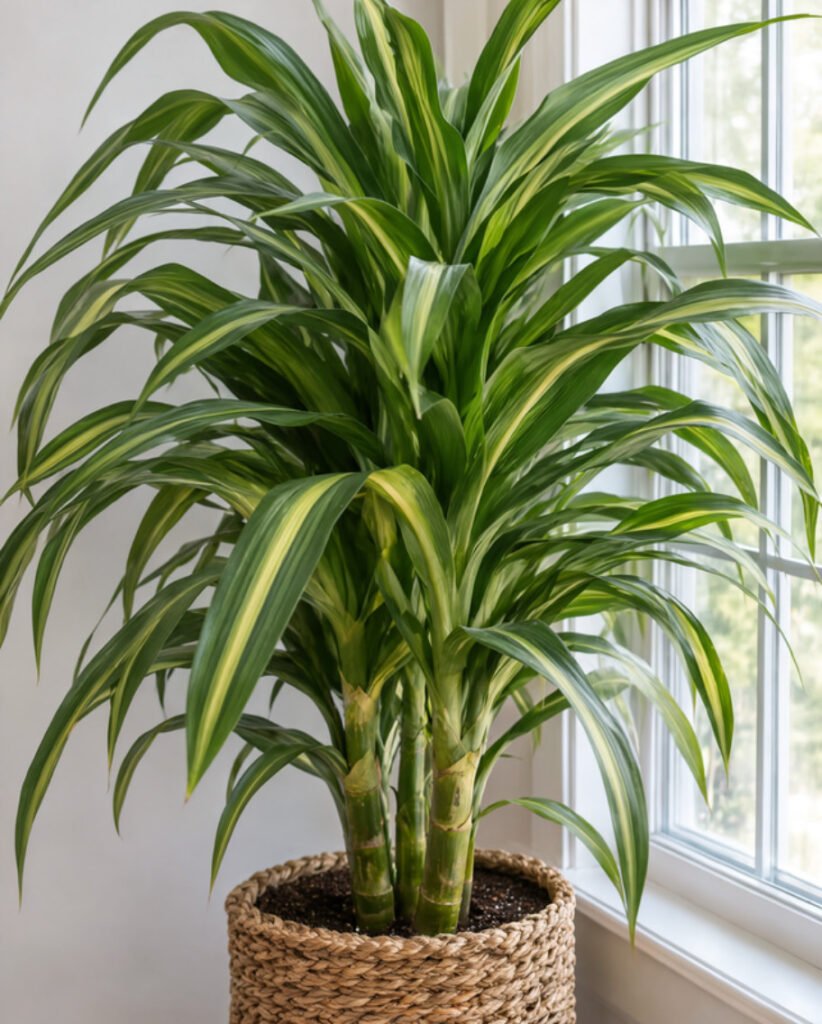
Fun fact: the snake plant has also been moved into the dracaena family by botanists, although its care is different. See our snake plant care guide.
How much light does a dracaena need?
Most dracaenas grow best in bright, indirect light, and many tolerate lower light, which is why they are so popular in offices. Clemson Extension notes that moving a plant from dim light to a brighter spot produces thicker, stronger new leaves and faster growth. Avoid direct afternoon sun, which causes pale, dry patches or streaks on the leaves. Variegated types keep their stripes best in brighter light. Check your spot with our houseplant lighting guide.
How often to water a dracaena
Let the soil dry slightly between waterings: water thoroughly once the top inch is dry, until water runs out of the drainage holes, then empty the saucer. That is often every 1 to 2 weeks in summer and every 2 to 4 weeks in winter, depending on light and pot size. Avoid cold water. Too much water is the most common way to kill a dracaena, so when in doubt, wait a few days. Our watering guide explains the finger test.
Why dracaena tips turn brown
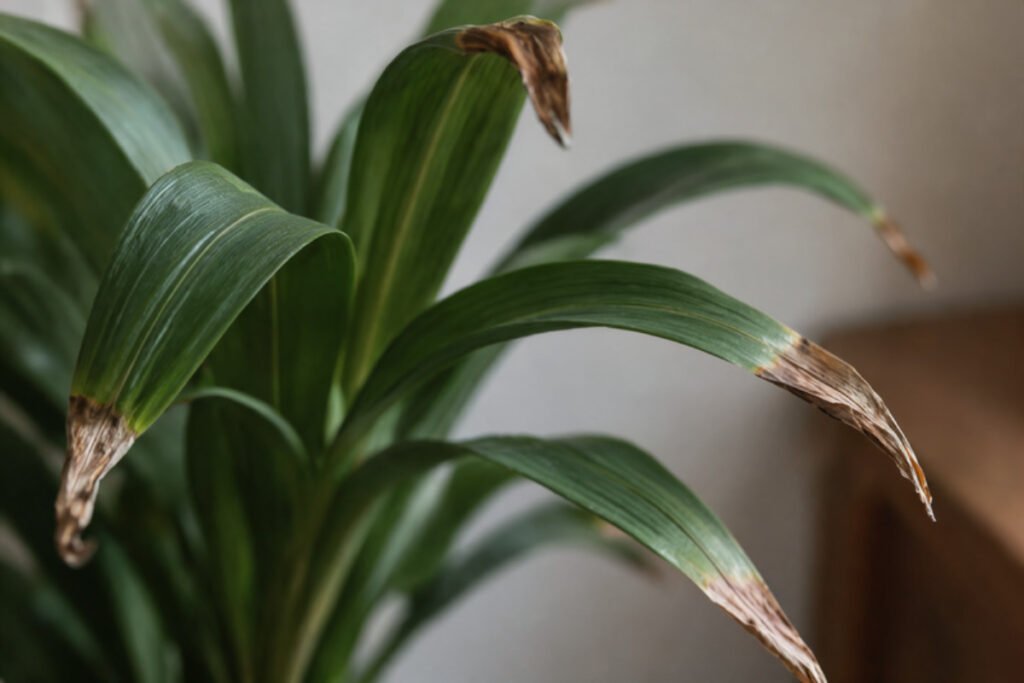
Brown, dry leaf tips are almost a dracaena trademark, and there are usually a few causes working together:
- Fluoride: Clemson Extension notes dracaenas are very sensitive to fluoride, which shows as yellow or scorched tips and edges. Water with rain, distilled or filtered water, avoid fertilizers containing superphosphate, and avoid potting mixes with a very high percentage of perlite.
- Dry air: dry tips and edges usually mean low humidity, especially near heaters in winter.
- Too much fertilizer: salts build up in the soil and burn leaf tips. Feed less and flush the pot with plain water every few months.
- Uneven watering: letting the soil swing from bone dry to soggy stresses the roots.
Brown tips will not turn green again. Trim them off with clean scissors, following the natural leaf shape and leaving a thin sliver of brown so you do not cut into healthy tissue.
Best soil and pot
A standard houseplant potting mix works, as long as it drains quickly. Keep the soil pH around 6.0 to 6.5, and always use a pot with drainage holes. Repot every 2 to 3 years in spring, moving up just one pot size. More in our potting soil guide and repotting guide.
Temperature and humidity
Dracaenas like normal room temperatures: about 60 to 75°F (16 to 24°C) by day, with nights around 10°F cooler. Keep them above 55°F. Sudden temperature changes, cold drafts and poor drainage can make many leaves drop at once. Average humidity is fine; if the air drops below 30 to 40% in winter, group plants or use a humidifier. See our humidity guide.
Fertilizing dracaena
Feed with a liquid foliage plant fertilizer once a month in spring and summer, or use slow-release pellets. Skip winter. Dracaenas are light feeders, and too much fertilizer causes burned, brown tips, so less is more. More in our fertilizing guide.
How to prune a leggy dracaena

Over time, dracaenas drop their lower leaves and become tall, bare canes with a tuft of leaves on top. That is normal, and easy to fix:
- Prune in spring or summer, when the plant is growing.
- Cut the cane at the height you want with clean, sharp pruners.
- New shoots usually sprout just below the cut within a few weeks, often 2 or 3 of them, making the plant bushier.
- Root the leafy top you removed to grow a new plant (see below).
- Keep it in bright, indirect light so new growth is strong.
- Water a little less until it regrows, because it has fewer leaves to use water.
Clemson Extension also notes that cutting back dragon tree stems is the way to force it to branch. Our pruning guide has more tips.
How to propagate dracaena
Dracaenas are easy to propagate from the pieces you prune off:
- Tip cuttings: stand the leafy top in water, or plant it in moist mix. Roots form in a few weeks.
- Cane sections: cut a bare cane into 3 to 4 inch pieces, keep track of which end was up, and press them halfway into moist mix. New shoots sprout from the buds.
- Air layering: for very tall plants, root the top while it is still attached, then cut it off.

More methods in our propagation guide.
Common dracaena problems and fixes
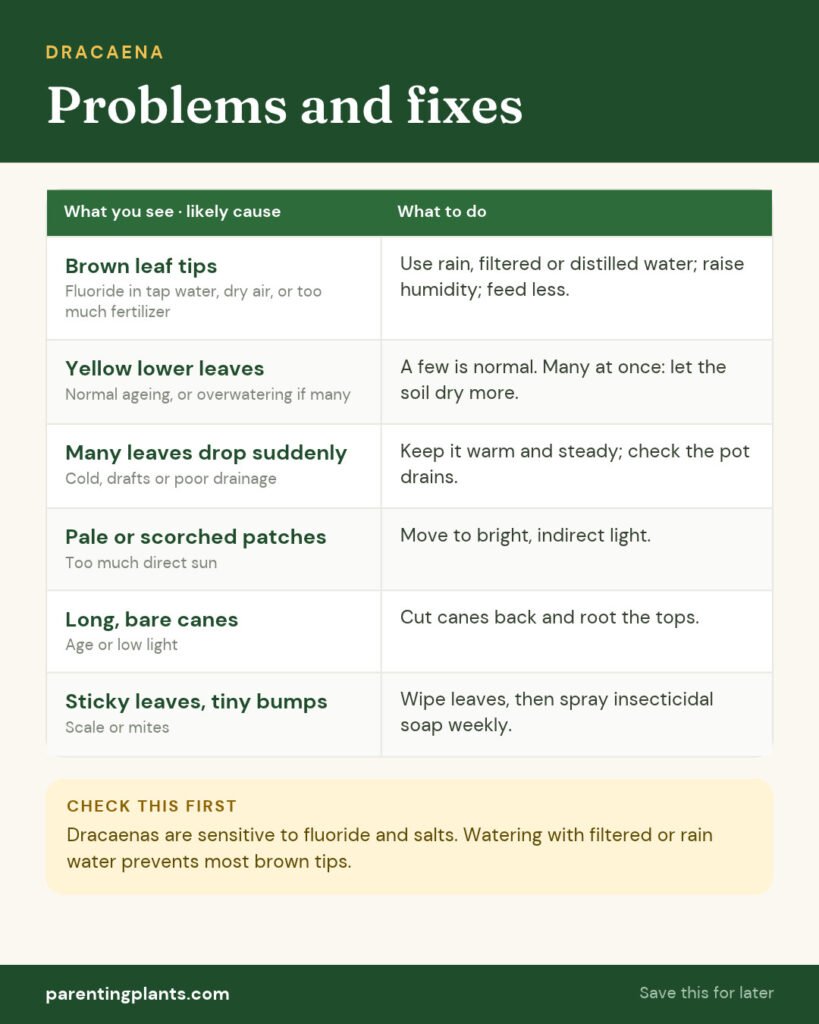
| What you see | Most likely cause | What to do |
|---|---|---|
| Brown leaf tips | Fluoride, dry air, or too much fertilizer | Use rain, filtered or distilled water; raise humidity; feed less |
| A few yellow lower leaves | Normal ageing | Remove them; nothing else to do |
| Many yellow leaves, soil wet | Overwatering or root rot | Let the soil dry; check roots and drainage |
| Many leaves drop at once | Cold, drafts or poor drainage | Keep it warm and steady; check the pot drains |
| Pale or dry patches on leaves | Too much direct sun | Move to bright, indirect light |
| Long, bare canes | Age or low light | Cut canes back and root the tops |
| Soft, mushy cane base | Root or stem rot | Cut healthy cane sections and tops to re-root; discard the rest |
| Sticky leaves, tiny bumps or webbing | Scale or spider mites | Wipe leaves; spray insecticidal soap weekly for a month |
More help in our guides to yellow leaves, root rot and houseplant pests.
Is dracaena toxic to pets?
Yes. The ASPCA lists dracaenas, including the corn plant and dragon tree, as toxic to cats and dogs. They contain saponins, which can cause vomiting, drooling, loss of appetite and depression; cats may also have dilated pupils. Keep dracaenas out of reach of pets that chew plants, and call your vet if you are worried. Check any plant with our free Plant Toxicity Checker or see our pet-friendly houseplants.
Quick action checklist
- Bright, indirect light (tolerates lower light)
- Water when the top inch is dry; empty the saucer
- Use filtered or rain water to prevent brown tips
- Keep it at 60 to 75°F, away from drafts
- Feed monthly in spring and summer, lightly
- Cut leggy canes in spring and root the tops
- Keep it away from cats and dogs
Save this for later: pin the cheat sheet below to your Pinterest plant board.

Dracaena leaves turning brown, yellow or dropping?
The Houseplant Rescue Guide matches 26 common plant problems to a clear photo, then gives you simple steps to fix each one and stop it coming back.
Dracaena FAQ
Why are the tips of my dracaena turning brown?
Usually fluoride in tap water, dry air or too much fertilizer. Water with filtered or rain water, raise humidity and feed less.
How often should I water a dracaena?
When the top inch of soil is dry, often every 1 to 2 weeks in summer and every 2 to 4 weeks in winter.
Can dracaena grow in low light?
Yes, many dracaenas tolerate low light, but they grow faster with thicker leaves in bright, indirect light.
How do I make my dracaena bushier?
Cut the canes back in spring or summer. New shoots sprout below each cut, often two or three of them.
Why are the bottom leaves of my dracaena turning yellow?
A few yellow lower leaves are normal ageing. Many at once usually means overwatering.
Is dracaena toxic to cats and dogs?
Yes. The ASPCA lists dracaena as toxic to cats and dogs; it can cause vomiting and drooling.
Can I cut the brown tips off my dracaena?
Yes. Trim along the natural leaf shape with clean scissors, leaving a thin edge of brown.
Sources and further reading
This guide was written by Manik for Parenting Plants and checked against university extension advice. Last reviewed November 2026.
- Clemson Cooperative Extension: Dracaena
- NC State Extension Plant Toolbox: Dracaena fragrans (corn plant)
- ASPCA: Corn plant (dracaena) toxicity
Free tracker
Never forget to water your Dracaena again
Track your Dracaena and every other plant you own. A ready-made plant care tracker for Google Sheets and Notion that shows exactly which plants need water today, with 90 houseplants built in.
You're in!
Check your inbox, plant friend! 📩
Your free Plant Care Tracker is on its way. We've emailed you both versions, Google Sheets and Notion, plus a bonus printable 2027 plant calendar. It usually arrives within a few minutes.
Can't find it? Check your Promotions or Spam folder, and add manik@parentingplants.com to your contacts so you never miss a plant tip.


