Special Offer: Use code ILOVEPLANTS for 25% off on all digital products! Shop Now →

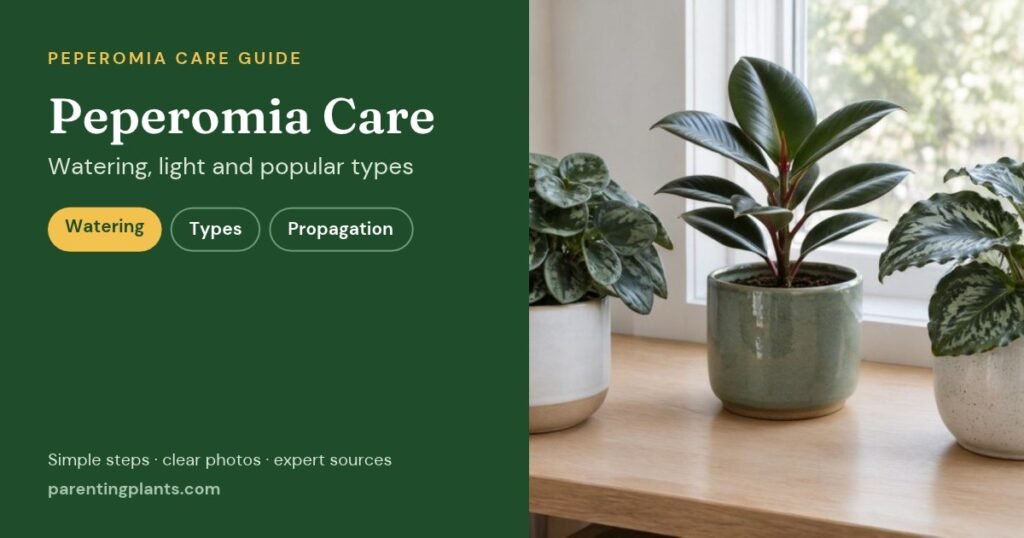
Peperomias are small, slow-growing houseplants with thick, often patterned leaves: the striped watermelon peperomia, the glossy baby rubber plant, the crinkly ripple peperomia and the tiny trailing string of turtles. With over a thousand species, they look very different, but almost all share the same care. The key fact: their thick leaves and stems store water, like a succulent. Most peperomias die from too much water, not too little.
Short answer: Give peperomia bright, indirect light. Let the top half of the soil dry out before watering, usually every 1 to 2 weeks, and less in winter. Use a small pot with a chunky, fast-draining mix. Keep it at 65 to 80°F (18 to 27°C). Popular peperomias are non-toxic to cats and dogs.
In this guide
Peperomia care at a glance
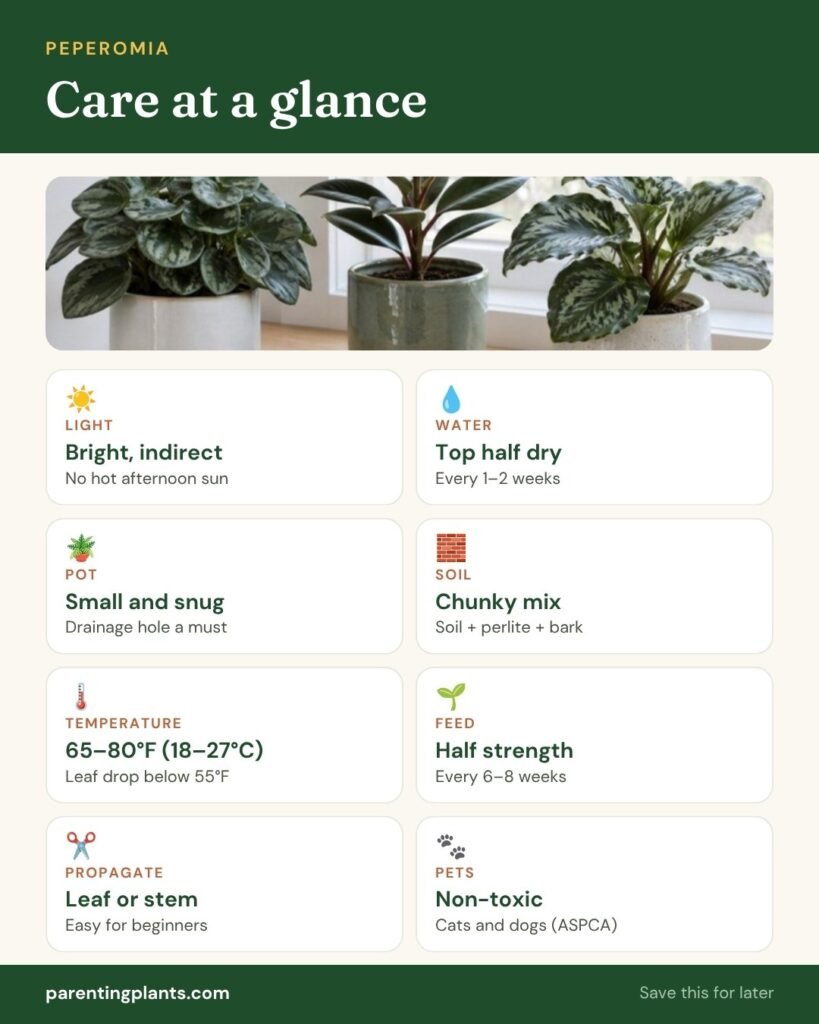
| Need | What it needs |
|---|---|
| Light | Bright to medium, indirect light; no hot direct sun |
| Water | When the top half of the soil is dry; every 1 to 2 weeks |
| Humidity | Average room humidity is fine |
| Temperature | 65 to 80°F (18 to 27°C); avoid below 55°F (13°C) |
| Soil | Chunky mix: potting soil plus perlite and bark |
| Pot | Small and snug, with a drainage hole |
| Fertilizer | Half-strength feed every 6 to 8 weeks in spring and summer |
| Pets | Non-toxic to cats and dogs (ASPCA) |
Free Plant Care Tracker: Never forget to water your Peperomia again. Get it free →
Popular peperomia types and how they differ
| Type | Looks like | Care notes |
|---|---|---|
| Watermelon peperomia (P. argyreia) | Round leaves with silver and green stripes on red stems | Stems snap easily; propagate from leaves |
| Baby rubber plant (P. obtusifolia) | Thick, glossy, spoon-shaped leaves, plain or variegated | The easiest; most drought-tolerant |
| Ripple peperomia (P. caperata) | Deeply wrinkled, heart-shaped leaves in green, red or silver | Slightly thinner leaves; likes a little more humidity |
| Raindrop peperomia (P. polybotrya) | Large, glossy, teardrop leaves | Very succulent; water sparingly |
| String of turtles (P. prostrata) | Tiny round leaves with turtle-shell pattern on trailing stems | Most sensitive to overwatering; small pot |
| ‘Hope’ and P. rotundifolia | Small round leaves on trailing stems | Good for shelves and hanging pots |
A good rule: the thicker and more succulent the leaves, the less often you water.
How much light does peperomia need?
Peperomias grow best in bright to medium, indirect light: near an east window, a few feet back from a south or west window, or right beside a large north window. Gentle morning sun is fine for most; hot afternoon sun scorches the leaves.
- Too little light: variegated types turn plain green, stems stretch and leaves get smaller. Watermelon and ripple types lose their contrast.
- Too much sun: pale, bleached or brown, crispy patches.
- They also grow well under a simple LED grow light, which makes them ideal for desks and shelves.
More detail in our houseplant lighting guide.
How often to water peperomia
Water when the top half of the soil is dry. For small pots, simply lift the pot: when it feels light, it is time. The leaves give a clue too: they feel a little softer and less firm when the plant is thirsty. Then water thoroughly and let all excess drain away.
| Situation | Typical interval |
|---|---|
| Spring and summer, bright light | Every 7 to 10 days |
| Spring and summer, medium light | Every 10 to 14 days |
| Autumn and winter | Every 2 to 4 weeks |
| Thick-leaved types (raindrop, baby rubber plant) | Toward the longer end |
Bottom watering works well for small peperomias: stand the pot in a bowl of water for 10 to 15 minutes, then let it drain. Never leave it sitting in water. Overwatering leads to drooping, mushy stems and root rot. Our root rot guide shows how to rescue a plant if that happens.
Soil, pot size and repotting
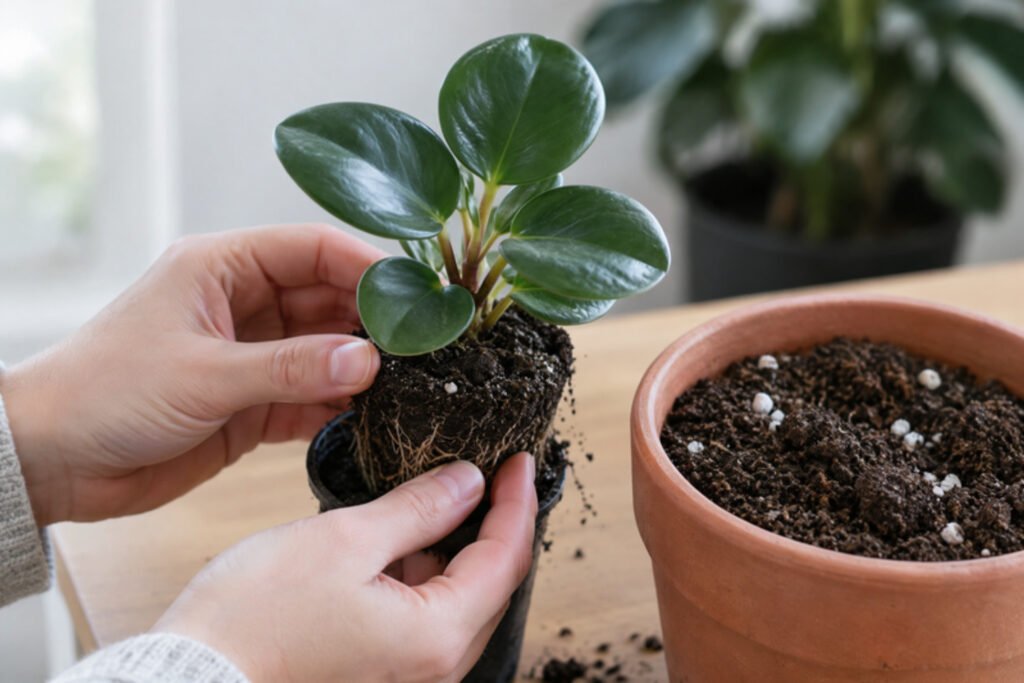
Peperomias have small, fine root systems. Many grow naturally on tree bark or mossy rocks. A big pot holds too much wet soil for those small roots and causes rot. Choose a pot only slightly bigger than the root ball, with a drainage hole.
Use a chunky, fast-draining mix: about 1 part potting mix, 1 part perlite and 1 part orchid bark, or a ready-made aroid or succulent mix. Terracotta pots help the soil dry evenly. Repot only every 2 to 3 years in spring, when roots fill the pot, going up just one size. See our potting soil guide.
Humidity and temperature
Most peperomias are happy in average household humidity. Ripple and watermelon types appreciate a little more (40 to 50%) in winter. Keep them between 65 and 80°F (18 to 27°C), and away from cold windows and drafts: a chill below about 55°F (13°C) often causes sudden leaf drop.
Fertilizing
Peperomias grow slowly and need little food. Use a balanced liquid fertilizer at half strength every 6 to 8 weeks in spring and summer, and not at all in winter. A once-a-year slow-release feed in spring also works.
Peperomia flowers
Healthy peperomias often send up thin, cream to green spikes that look like tails. These are the flowers. They are not showy, and many growers snip them off at the base so the plant puts its energy into leaves. Leaving them does no harm.
How to propagate peperomia
Peperomias are among the easiest plants to propagate, and the method depends on the type.
Stem cuttings (baby rubber plant, trailing types)
- Cut a stem 3 to 4 inches (8 to 10 cm) long with at least 2 to 3 leaves, just below a node.
- Remove the lowest leaf and let the cut dry for a few hours.
- Root it in water, or push it into barely damp mix.
- Keep it in bright, indirect light. Roots form in 3 to 6 weeks.
Leaf cuttings (watermelon and ripple peperomia)
- Cut a healthy leaf with about 1 inch (2.5 cm) of its stalk.
- Insert the stalk into barely moist mix so the leaf stands upright. You can also cut a watermelon leaf in half across the middle and set the cut edge into the mix.
- Cover loosely with a clear bag or container to raise humidity, airing it every few days.
- Tiny new plants appear at the base in 6 to 10 weeks. Be patient.
More techniques in our propagation guide.
Common peperomia problems and fixes
| What you see | Likely cause | What to do |
|---|---|---|
| Drooping, soft leaves, wet soil | Overwatering or root rot | Let it dry out; check roots; repot into fresh, chunky mix |
| Drooping, wrinkled leaves, dry soil | Underwatering | Water thoroughly; leaves firm up in a day or two |
| Sudden leaf drop | Cold, drafts, overwatering or a recent move | Keep warm and stable; water less |
| Corky, scabby bumps under leaves (edema) | Roots taking up more water than leaves can use | Water less, improve light and airflow |
| Variegated type turning plain green | Not enough light | Move to brighter, indirect light |
| Brown, crispy patches | Direct sun | Move back from the window |
| Watermelon leaves falling off with stalks | Overwatering, cold, or knocks | Water less; keep away from cold glass and busy edges |
| Tiny flies around the pot | Fungus gnats from damp soil | Let the top dry out; use sticky traps |
Fungus gnats are common in damp soil; our fungus gnat guide has a 4-week plan to clear them.
Pests
Mealybugs (white fluff in leaf joints) are the most common peperomia pest, followed by spider mites and fungus gnats. Inspect leaf joints and undersides regularly. Dab mealybugs with a cotton bud dipped in rubbing alcohol and follow up with insecticidal soap. More in our houseplant pests guide.
Is peperomia safe for cats and dogs?
Yes. The ASPCA lists several popular peperomias, including the baby rubber plant, watermelon peperomia and ripple peperomia, as non-toxic to cats and dogs. Their small size makes them great for pet-friendly shelves and desks. Always check the exact plant with our Plant Toxicity Checker, and browse more pet-friendly houseplants.
Quick care checklist
- Bright to medium, indirect light
- Water when the top half of the soil is dry
- Small pot and a chunky, fast-draining mix
- Keep above 55°F and away from cold drafts
- Feed lightly every 6 to 8 weeks in spring and summer
- Propagate from stem or leaf cuttings
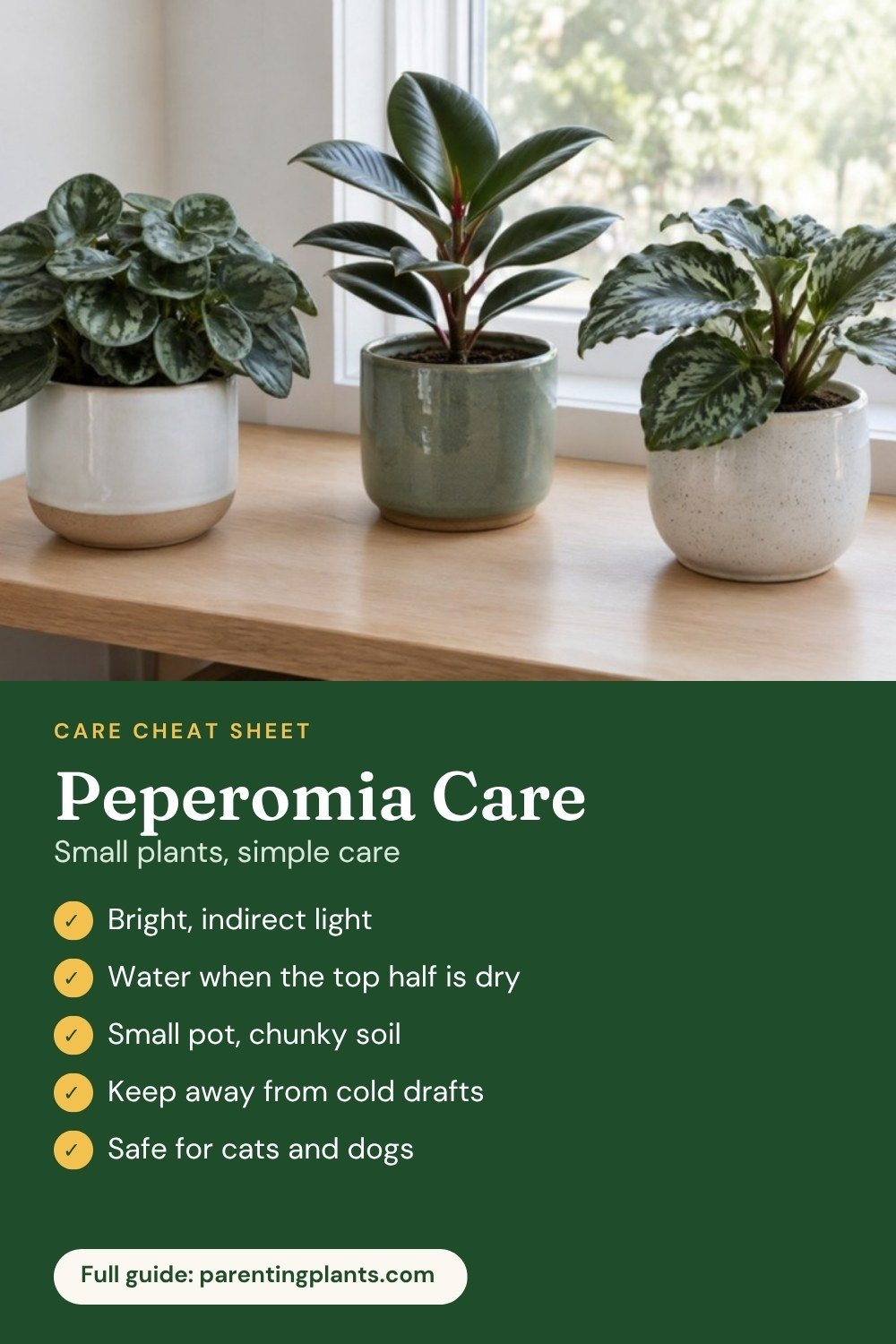
Save this for later: pin the cheat sheet below to your Pinterest plant board.
Want every plant’s care on one page?
The Houseplant Care Cards give you 30 printable one-page guides for popular houseplants: light, water, pet safety and quick fixes at a glance.
Peperomia care FAQ
How often should I water a peperomia?
When the top half of the soil is dry, usually every 7 to 14 days in spring and summer and every 2 to 4 weeks in winter. Thick-leaved types need water least often.
Why is my peperomia drooping?
Check the soil. Wet soil and soft leaves mean overwatering; dry soil and wrinkled leaves mean it needs water.
Why are my peperomia leaves falling off?
Usually cold drafts, overwatering or a sudden move. Keep it warm, let the soil dry more between waterings and give it bright, indirect light.
Is peperomia a succulent?
Not a true succulent, but its thick leaves and stems store water like one, so it needs much less water than most tropical houseplants.
Can peperomia grow in low light?
It tolerates medium light, but in low light it stretches, loses variegation and is more prone to rot. Bright, indirect light is best.
Is peperomia safe for cats?
Yes. The ASPCA lists popular peperomias such as the baby rubber plant and watermelon peperomia as non-toxic to cats and dogs.
How do you propagate watermelon peperomia?
From a leaf cutting. Insert a leaf with a short stalk, or half a leaf with the cut edge down, into barely moist mix and keep it humid. New plants appear in 6 to 10 weeks.
Sources and further reading
This guide was written by Manik at Parenting Plants and checked against the university extension and expert resources below. Read how we research and update our guides in our editorial guidelines.
- Clemson Cooperative Extension (HGIC): Peperomia houseplants
- NC State Extension Plant Toolbox: Peperomia obtusifolia (baby rubber plant)
- NC State Extension Plant Toolbox: Peperomia argyreia (watermelon peperomia)
- ASPCA: Toxic and non-toxic plants list
Looking for another plant? Browse all our houseplant care guides A to Z.
Free tracker
Never forget to water your Peperomia again
Track your Peperomia and every other plant you own. A ready-made plant care tracker for Google Sheets and Notion that shows exactly which plants need water today, with 90 houseplants built in.
You're in!
Check your inbox, plant friend! 📩
Your free Plant Care Tracker is on its way. We've emailed you both versions, Google Sheets and Notion, plus a bonus printable 2027 plant calendar. It usually arrives within a few minutes.
Can't find it? Check your Promotions or Spam folder, and add manik@parentingplants.com to your contacts so you never miss a plant tip.