Special Offer: Use code ILOVEPLANTS for 25% off on all digital products! Shop Now →

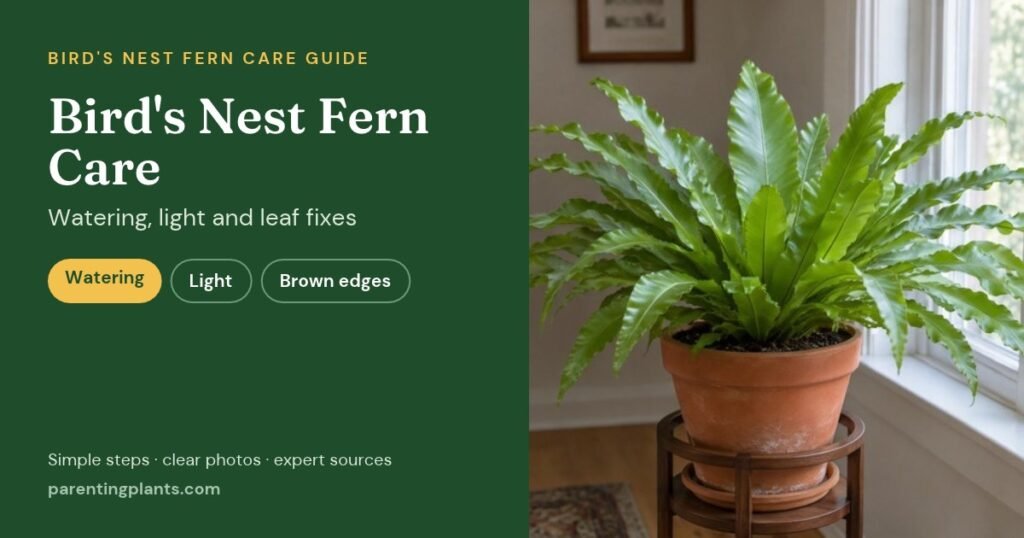
The bird’s nest fern (Asplenium nidus) looks nothing like a typical fern. Instead of lacy fronds, it grows a rosette of wide, glossy, wavy leaves from a fuzzy central crown that looks like a nest. In the rainforest it grows on tree branches, catching leaves and rain. Indoors it is one of the easiest ferns to keep: it handles average humidity better than most ferns and copes with medium light. There is one golden rule, though: never pour water into the centre.
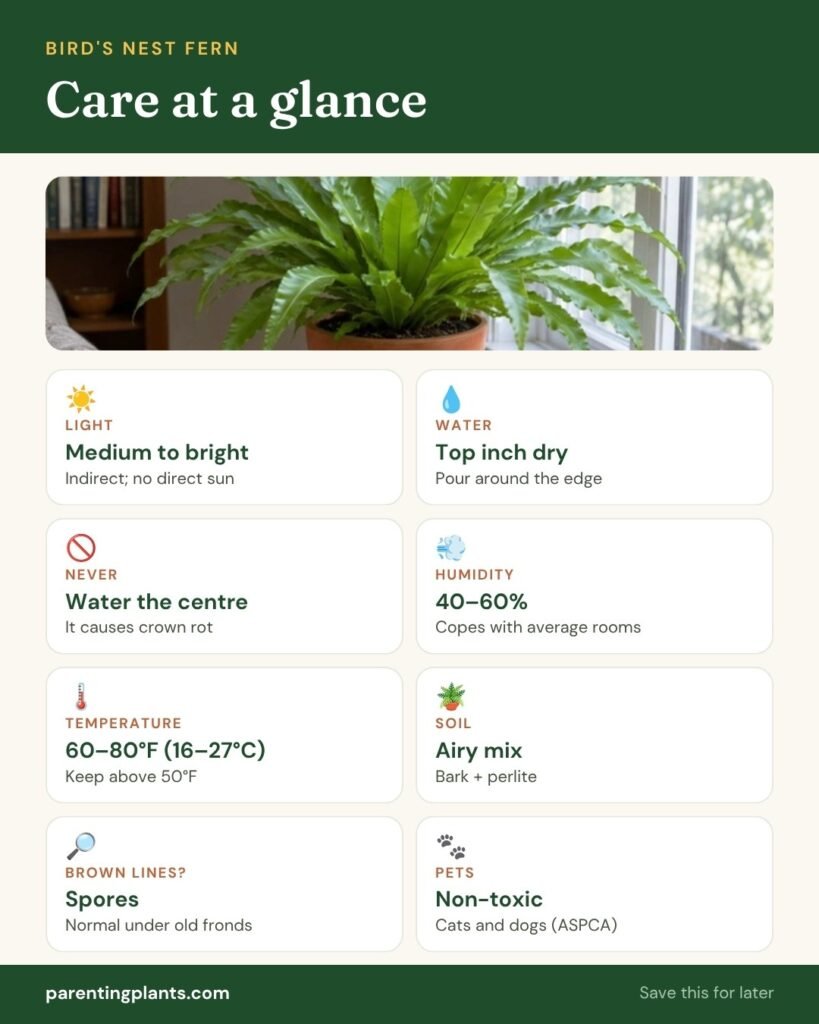
Short answer: Give bird’s nest fern medium to bright, indirect light. Water the soil around the edge of the pot when the top inch (2.5 cm) is dry, and never pour water into the central crown. Keep it at 60 to 80°F (16 to 27°C) with moderate humidity. It is non-toxic to cats and dogs.
In this guide
Bird’s nest fern care at a glance
| Need | What it needs |
|---|---|
| Light | Medium to bright, indirect light; no direct sun |
| Water | When the top inch is dry; water the soil edge, not the crown |
| Humidity | 40 to 60%; tolerates average rooms better than most ferns |
| Temperature | 60 to 80°F (16 to 27°C); keep above 50°F (10°C) |
| Soil | Airy mix with orchid bark and perlite |
| Fertilizer | Half-strength feed monthly in spring and summer |
| Size | Usually 1 to 3 ft (30 to 90 cm) wide indoors |
| Pets | Non-toxic to cats and dogs (ASPCA) |
Free Plant Care Tracker: Never forget to water your Bird’s Nest Fern again. Get it free →
Bird’s nest fern varieties
| Variety | Looks like | Notes |
|---|---|---|
| Classic (Asplenium nidus) | Broad, glossy, lightly wavy fronds | The most common; easy-going |
| ‘Crispy Wave’ | Narrower fronds with deep, crinkled waves | Compact; tolerates drier air well |
| ‘Victoria’ | Long fronds with tightly ruffled edges | Showy; give it room |
| ‘Osaka’ (A. antiquum) | Narrow, smooth, upright fronds | Compact; great on desks |
All share the same care.
How much light does a bird’s nest fern need?
Medium to bright, indirect light is ideal: near an east or north window, or a few feet back from a brighter one. Bird’s nest ferns tolerate lower light than you might expect, which is why they are popular in bathrooms and offices.
- Too much sun: fronds turn yellow-green, pale or develop brown, scorched patches.
- Too little light: new fronds are smaller and growth slows, but the plant usually stays healthy.
- Fronds that are flatter and less wavy can mean more light; more ruffled fronds often grow in lower light. Both are normal.
How to water a bird’s nest fern
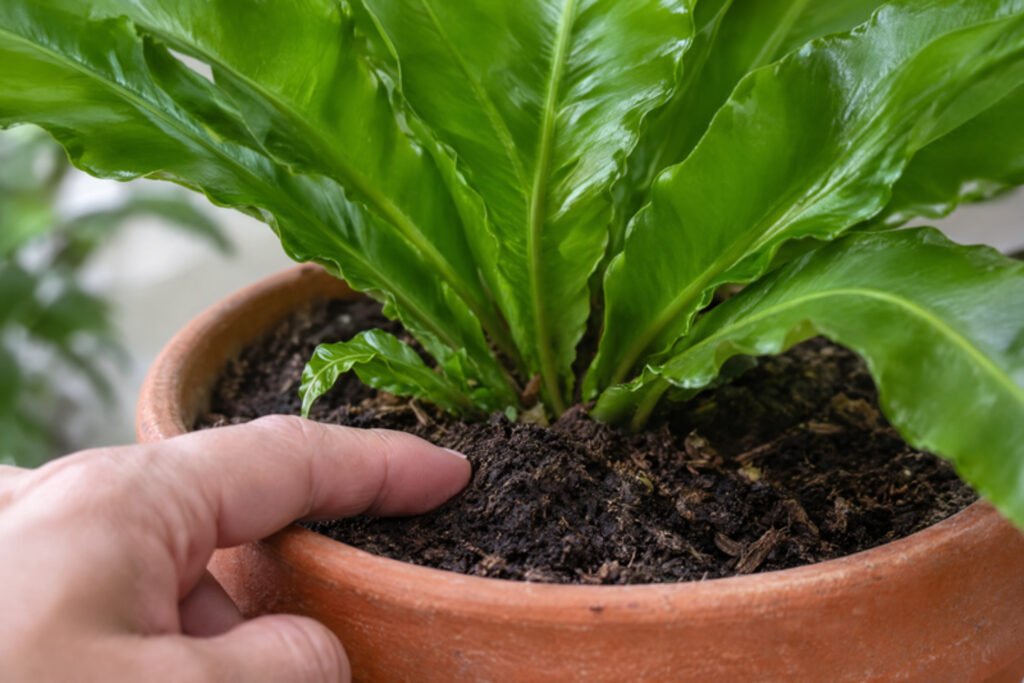
Water when the top inch (2.5 cm) of soil is dry. Pour the water slowly around the outer edge of the pot, not into the middle of the plant. Let it drain fully and empty the saucer.
Why not water the centre? Water that collects in the central crown sits against the soft new growth and can cause crown rot, which quickly kills the plant. In the wild, rain runs through the nest and drains straight away; in a pot indoors, it does not. If water does get in, tip the plant gently to drain it.
| Situation | Typical interval |
|---|---|
| Spring and summer | Every 5 to 7 days |
| Autumn and winter | Every 10 to 14 days |
| Warm, bright spot or small pot | Check every 3 to 4 days |
Unlike maidenhair ferns, bird’s nest ferns cope with a little drying between waterings. Consistently soggy soil is more dangerous than a slightly late watering. Our watering guide has more tips.
Humidity and temperature
Bird’s nest ferns prefer 40 to 60% humidity but tolerate average room humidity better than most ferns. In very dry, heated rooms, frond edges may brown. A humidifier or a bright bathroom helps; misting the fronds is not recommended, as water sitting in the crown can cause rot. See our humidity guide.
Keep it between 60 and 80°F (16 to 27°C). If you put it outside for summer, bring it back in before nights drop below 50°F (10°C).
Soil, pot and repotting
Because it grows on trees in nature, a bird’s nest fern needs an airy, chunky mix: about 2 parts potting mix, 1 part orchid bark and 1 part perlite. It has a fairly small root system, so do not overpot. Repot every 2 to 3 years in spring, going up one size, and keep the crown at the same level, never buried.
You can also mount small plants on a board with sphagnum moss, as they grow in the wild. Mounted plants need watering much more often.
Fertilizing
Feed with a balanced liquid fertilizer at half strength once a month in spring and summer, poured onto the soil, not into the crown. Too much fertilizer causes brown edges and spots. No feeding is needed in winter.
What are the brown lines under the leaves?
Neat, parallel brown stripes on the underside of mature fronds are sori: clusters of spore cases. They are how ferns reproduce, and they are completely normal. Do not scrub or spray them.
Scale insects, by contrast, look like scattered, raised brown bumps that you can flick off with a fingernail, often along the midrib and on both sides of the frond. If the marks are in tidy rows, they are spores; if they are random bumps, check for scale.
Handling and cleaning
Young fronds unfurl from the centre and are very tender. Do not touch or move the new fronds while they are developing; any damage becomes a permanent crease or brown mark. Wipe dust from mature fronds with a soft, damp cloth. Avoid leaf-shine products, which can damage the leaf surface. Remove old, damaged fronds by cutting them at the base.
Can you propagate a bird’s nest fern?
Not easily at home. Each plant grows from a single central crown, so it cannot be divided like a Boston fern, and fronds do not root as cuttings. Bird’s nest ferns are grown commercially from spores, which is slow and needs sterile conditions. If you want more, buying a young plant is the practical choice. For easier plants to multiply, see our propagation guide.
Common bird’s nest fern problems and fixes
| What you see | Likely cause | What to do |
|---|---|---|
| Brown, crispy frond edges | Dry air, underwatering or fertilizer build-up | Water more evenly, raise humidity, flush the soil |
| Brown, mushy centre | Crown rot from water in the centre | Water the soil edge only; remove rotten tissue; often fatal if severe |
| Yellowing fronds, soggy soil | Overwatering or poor drainage | Let the top inch dry; check drainage and roots |
| Pale, bleached or scorched patches | Direct sun | Move to indirect light |
| Brown lines in neat rows under fronds | Normal spores (sori) | Nothing to do |
| Raised brown bumps, sticky leaves | Scale insects | Scrape off; treat with insecticidal soap |
| Creased, distorted new fronds | Touched or knocked while unfurling | Avoid handling new growth; damage is cosmetic |
Brown frond edges are the most common complaint. Our free Plant Doctor can help you find the cause.
Is bird’s nest fern safe for cats and dogs?
Yes. The ASPCA lists the bird’s nest fern as non-toxic to cats, dogs and horses, making it a great pet-safe choice for bathrooms and shelves. Some cats love to chew the broad fronds, so place it out of reach if yours does. More options: pet-friendly houseplants.
Quick care checklist
- Medium to bright, indirect light
- Water the soil edge when the top inch is dry
- Never pour water into the central crown
- Keep at 60 to 80°F with moderate humidity
- Feed at half strength monthly in spring and summer
- Leave new fronds untouched while they unfurl
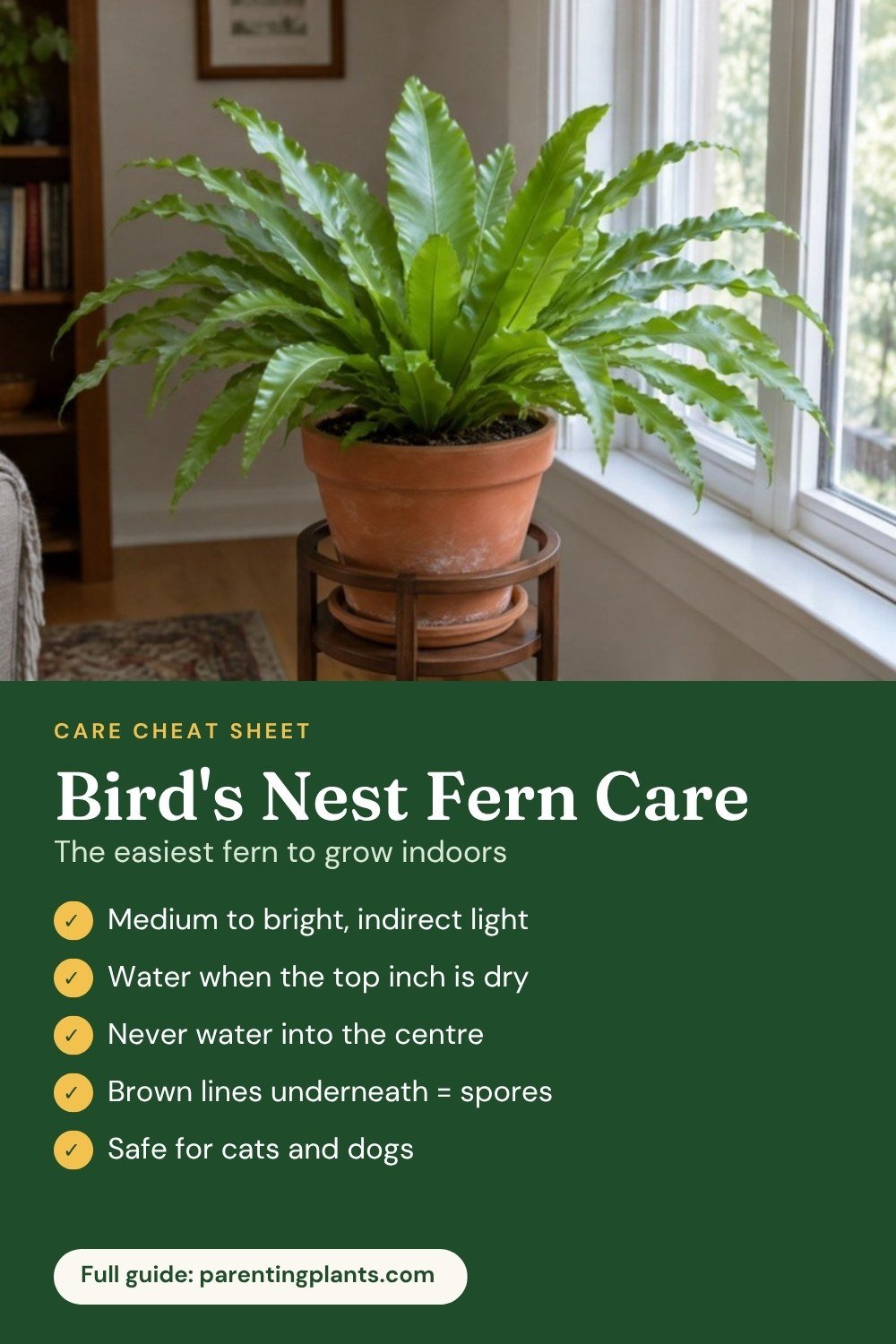
Save this for later: pin the cheat sheet below to your Pinterest plant board.
Leaves turning brown, crispy or yellow?
The Houseplant Rescue Guide matches 26 common plant problems to a clear photo, then gives you simple steps to fix each one and stop it coming back. No jargon, 50 pages, with printable checklists.
Bird’s nest fern care FAQ
Should you water a bird’s nest fern in the middle?
No. Water collecting in the central crown can cause crown rot. Pour water slowly around the edge of the pot instead.
How often should I water a bird’s nest fern?
When the top inch of soil is dry, usually every 5 to 7 days in spring and summer and every 10 to 14 days in winter.
Why are the edges of my bird’s nest fern turning brown?
Usually dry air, uneven watering or fertilizer build-up. Water evenly, raise humidity and flush the soil every few months.
What are the brown lines under my bird’s nest fern leaves?
Neat, parallel brown lines are spores (sori), a normal part of fern reproduction. Random raised bumps that come off with a fingernail are scale insects.
Can bird’s nest fern grow in low light?
It tolerates lower light than most ferns, but medium to bright, indirect light gives the best growth.
Is bird’s nest fern safe for cats?
Yes. The ASPCA lists bird’s nest fern as non-toxic to cats and dogs.
Can you divide a bird’s nest fern?
No. It grows from a single central crown, so it cannot be divided. New plants are grown from spores.
Sources and further reading
This guide was written by Manik at Parenting Plants and checked against the university extension and expert resources below. Read how we research and update our guides in our editorial guidelines.
- Clemson Cooperative Extension (HGIC): How to grow and care for bird’s nest fern
- University of Minnesota Extension: Tropical ferns as houseplants
- ASPCA: Toxic and non-toxic plants list
Looking for another plant? Browse all our houseplant care guides A to Z.
Free tracker
Never forget to water your Bird’s Nest Fern again
Track your Bird’s Nest Fern and every other plant you own. A ready-made plant care tracker for Google Sheets and Notion that shows exactly which plants need water today, with 90 houseplants built in.
You're in!
Check your inbox, plant friend! 📩
Your free Plant Care Tracker is on its way. We've emailed you both versions, Google Sheets and Notion, plus a bonus printable 2027 plant calendar. It usually arrives within a few minutes.
Can't find it? Check your Promotions or Spam folder, and add manik@parentingplants.com to your contacts so you never miss a plant tip.