Special Offer: Use code ILOVEPLANTS for 25% off on all digital products! Shop Now →

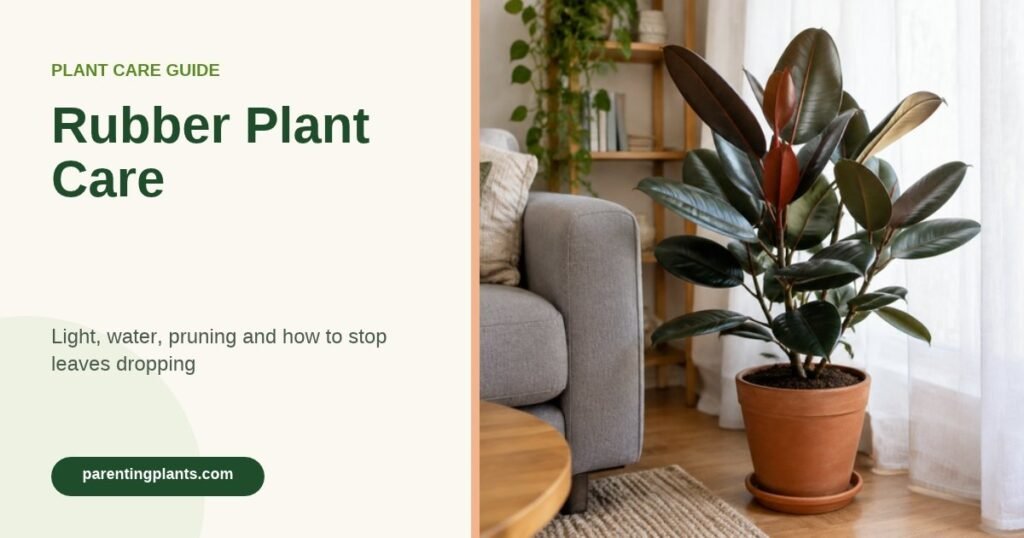
A rubber plant (Ficus elastica) gives you big, glossy, almost leather-like leaves and grows into a striking indoor tree. It is easy to keep once you get two things right: bright light and careful watering. Most problems, from dropping leaves to droopy stems, trace back to one of those.
Short answer: Give a rubber plant bright, indirect light with a little gentle morning sun, and water when the top 1 to 2 inches of soil are dry, usually every 1 to 2 weeks in spring and summer and every 2 to 4 weeks in winter. Keep it at 60 to 80°F (16 to 27°C), away from cold drafts, and feed it monthly in the growing season.
In this guide
Rubber plant care at a glance

| Need | What a rubber plant wants |
|---|---|
| Light | Bright, indirect light; 1 to 2 hours of gentle morning sun is fine |
| Water | When the top 1 to 2 inches are dry; less in winter |
| Soil | Well-draining indoor potting mix with extra perlite or bark |
| Temperature | 60 to 80°F (16 to 27°C); keep above 55°F (13°C) |
| Humidity | Average home humidity (40 to 50%) is fine |
| Fertilizer | Balanced liquid feed at half strength, monthly in spring and summer |
| Growth | Fast in good light; 6 to 10 feet indoors if not pruned |
| Pets | Keep away: the milky sap can irritate mouths and skin |
How much light does a rubber plant need?
Rubber plants grow best in bright, indirect light. A spot a few feet from an east-facing window is ideal, or set back from a south or west window behind a sheer curtain. A little soft morning sun keeps the leaves glossy and the color deep, especially on burgundy and variegated types.
- Too little light: long gaps between leaves, small new leaves, a plant leaning toward the window, and lower leaves dropping.
- Too much harsh sun: bleached, pale or brown crispy patches on the leaves facing the window.
- Variegated types (‘Tineke’, ‘Ruby’) need the brightest spot. In low light their cream and pink patches fade back to green.
Turn the pot a quarter turn every couple of weeks so the trunk grows straight. Our houseplant light guide shows how to judge your windows.
How often to water a rubber plant
Water when the top 1 to 2 inches of soil feel dry. In a bright room in spring and summer that is usually every 1 to 2 weeks. In winter, when growth slows, it can be every 2 to 4 weeks.
- Push a finger 2 inches into the soil. If it is dry, it is time.
- Water slowly until water runs out of the drainage hole.
- Let it drain for 15 to 30 minutes, then empty the saucer.
- Do not water again until the top layer dries out.
Overwatering is the number one rubber plant killer. Leaves that turn yellow and drop, with soil that stays wet, mean the roots are sitting in water. Let it dry out and check for root rot.
A rubber plant is a little more forgiving of thirst than of wet feet. If you are unsure, wait a few more days. More tips in our watering guide.
Best soil and pot
Use a well-draining indoor potting mix. Mixing in about one part perlite or orchid bark to three parts potting mix gives the roots air and stops the soil staying soggy. Always use a pot with a drainage hole.
Rubber plants grow well when slightly snug in their pot. Choose a pot only 1 to 2 inches wider than the root ball. Heavy ceramic or terracotta pots help stop tall plants from tipping. Our potting soil guide has simple recipes.
Temperature and humidity
Keep a rubber plant between 60 and 80°F (16 to 27°C). It dislikes cold more than heat: below about 55°F (13°C) leaves can drop, and a cold draft from a door or window in winter often causes sudden leaf loss.
- Keep it away from radiators, heating vents and air conditioners.
- Average room humidity is fine. Dusty leaves block light, so wipe them with a damp cloth every few weeks.
- Do not use leaf-shine products. They clog leaf pores.
See our temperature guide and humidity guide for more.
Fertilizing a rubber plant
Feed with a balanced liquid houseplant fertilizer at half strength once a month from spring to late summer. Stop in autumn and winter. Always fertilize damp soil, never bone-dry soil, and skip feeding for 4 to 6 weeks after repotting. Our fertilizing guide explains the details.
How to prune a rubber plant to make it bushy
Left alone, a rubber plant grows as a single tall stem. Pruning the top makes it branch out and grow fuller.
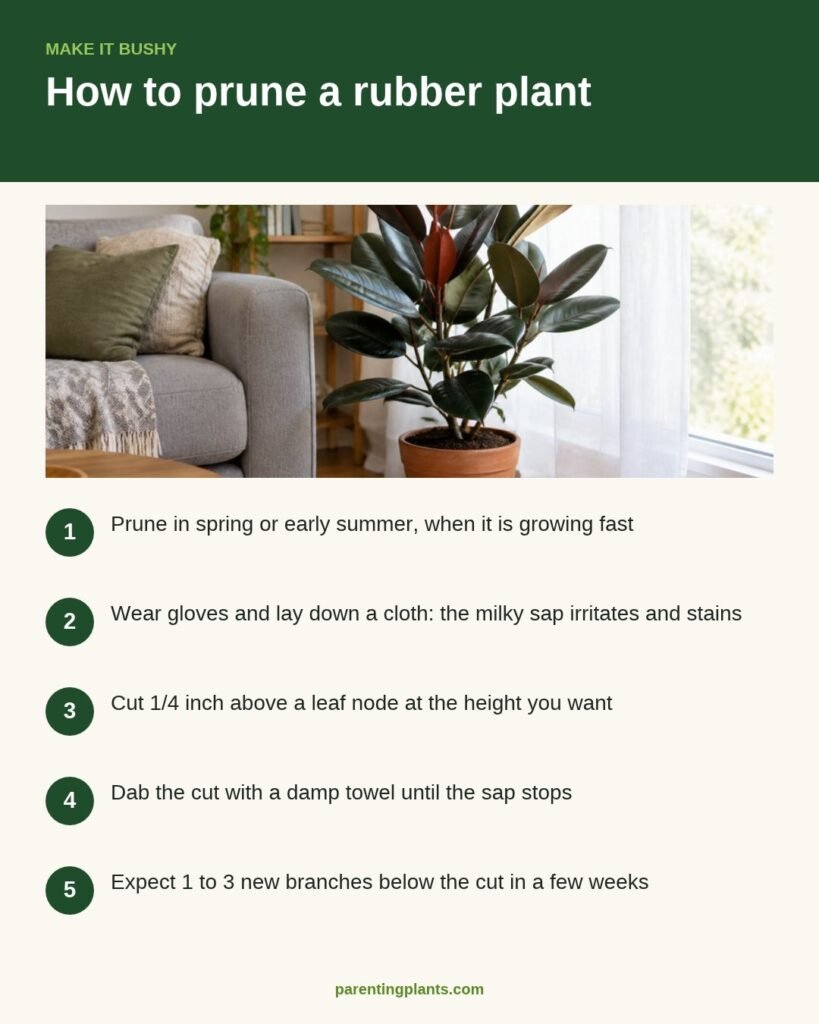
- Prune in spring or early summer, when the plant is growing fast.
- Wear gloves. Cut stems leak a milky white sap that can irritate skin and stain floors, so put a cloth down.
- Use clean, sharp pruners. Cut about 1/4 inch above a leaf node (where a leaf meets the stem) at the height you want.
- Dab the cut with a damp paper towel until the sap stops.
- Expect 1 to 3 new branches to grow from just below the cut within a few weeks.
Never remove more than a third of the plant at once. Our pruning guide shows exactly where to cut.
How to propagate a rubber plant
The tip you prune off can become a new plant.
- Take a 6 to 8 inch tip cutting with 2 to 3 leaves. Remove the lowest leaf.
- Let the sap stop, then rinse the cut end.
- Place the cutting in water or a small pot of moist potting mix with perlite.
- Keep it warm and in bright, indirect light. A clear bag over the top raises humidity.
- Roots usually form in 3 to 6 weeks. Pot water-rooted cuttings when the roots are 1 to 2 inches long.
You can roll large leaves gently and tie them loosely to save space and reduce water loss. More methods in our propagation guide.
When and how to repot
Repot every 1 to 2 years in spring, or when roots poke out of the drainage holes and water runs straight through. Move up only one pot size. If the plant is already as tall as you want, refresh the top 2 inches of soil instead of repotting. See our repotting guide.
Common rubber plant problems and fixes
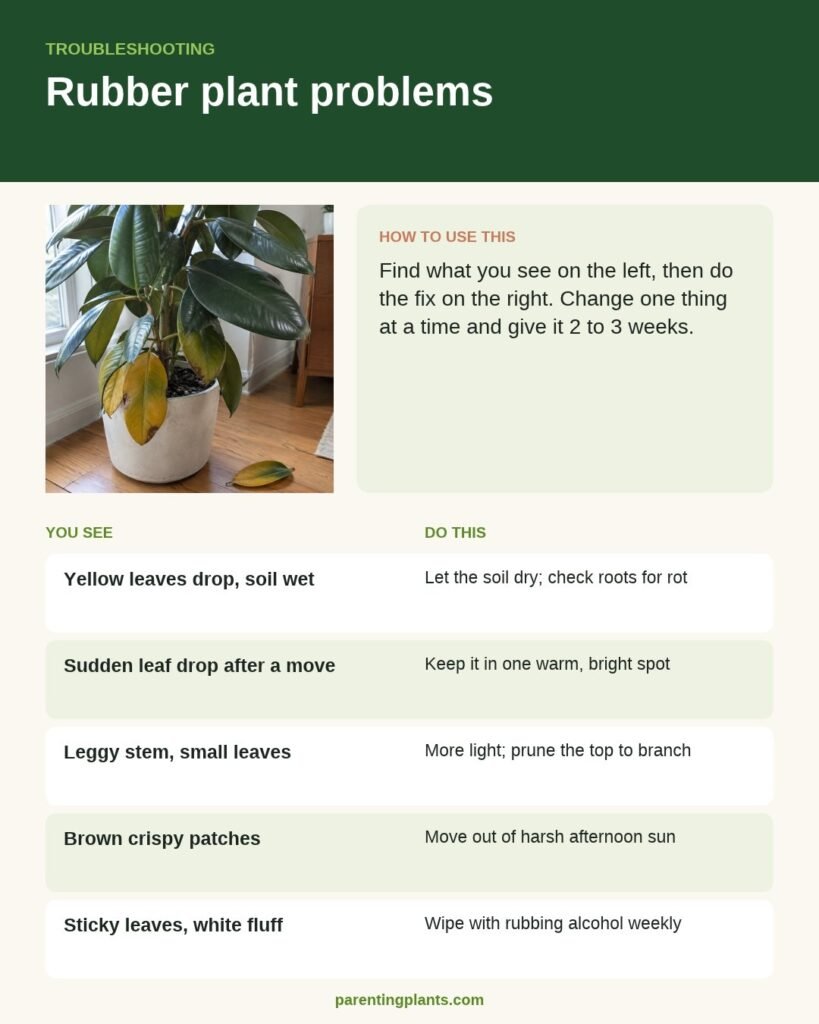
| What you see | Most likely cause | What to do |
|---|---|---|
| Lower leaves turn yellow and drop, soil wet | Overwatering | Let soil dry, check roots, water less often |
| Sudden leaf drop after a move or cold night | Shock or cold draft | Keep it in one warm, bright spot; it will regrow |
| Drooping leaves, dry soil | Underwatering | Water thoroughly; it should perk up in a day |
| Leggy stem, small leaves, big gaps | Too little light | Move closer to a bright window; prune to branch |
| Brown crispy patches on sunny side | Sunburn | Move out of harsh afternoon sun |
| Brown edges or tips | Uneven watering or salt build-up | Water deeply, flush the soil every few months |
| Sticky leaves, white fluff or tiny bumps | Mealybugs or scale | Wipe with rubbing alcohol, repeat weekly |
| Fine webbing, speckled leaves | Spider mites | Rinse leaves, use insecticidal soap |
For yellow leaves, start with our yellow leaves guide. For bugs, see our houseplant pests guide.
Is a rubber plant toxic to pets?
Treat a rubber plant as mildly toxic. Its milky latex sap can irritate skin and, if a cat or dog chews a leaf, may cause mouth irritation, drooling or vomiting. Place it out of reach of curious pets and wear gloves when pruning. If you need pet-safe alternatives, see our pet-friendly houseplants.
Quick action checklist
- Place it in bright, indirect light, a few feet from a window
- Water only when the top 1 to 2 inches are dry
- Use a pot with a drainage hole and a chunky, airy mix
- Keep it above 55°F and away from drafts and heaters
- Feed monthly in spring and summer, not in winter
- Wipe the leaves every few weeks
- Prune the top in spring if you want a bushier plant
Rubber plant still dropping leaves or looking droopy?
The Houseplant Rescue Guide matches 26 common plant problems to a clear photo, then gives you simple steps to fix each one and stop it coming back. No jargon, 50 pages, with printable checklists.
Rubber plant care FAQ
How often should I water a rubber plant?
Water when the top 1 to 2 inches of soil are dry. That is usually every 1 to 2 weeks in spring and summer and every 2 to 4 weeks in winter.
Why is my rubber plant dropping leaves?
The most common causes are overwatering, a sudden move, a cold draft or too little light. Check the soil first, then keep the plant in one warm, bright spot.
Can a rubber plant live in low light?
It can survive in medium light but grows leggy and drops lower leaves in low light. For a full, healthy plant, give it bright, indirect light.
How do I make my rubber plant bushier?
Cut the top of the main stem in spring, just above a leaf node. The plant usually grows 1 to 3 new branches below the cut.
Should I mist my rubber plant?
There is no need. Rubber plants are fine in average home humidity. Wiping dust off the leaves helps more than misting.
How fast does a rubber plant grow?
In bright light during spring and summer it can grow a foot or more a year. Growth slows a lot in winter and in low light.
Is a rubber plant safe for cats and dogs?
Treat it as mildly toxic. The milky sap can irritate the mouth and stomach, so keep it out of reach of pets.
Sources and further reading
Want to go deeper? These university extension and expert resources cover the same topic:
- NC State Extension Plant Toolbox: Ficus elastica (rubber plant)
- University of Illinois Extension: Watering houseplants
- University of Illinois Extension: Lighting for houseplants