Special Offer: Use code ILOVEPLANTS for 25% off on all digital products! Shop Now →

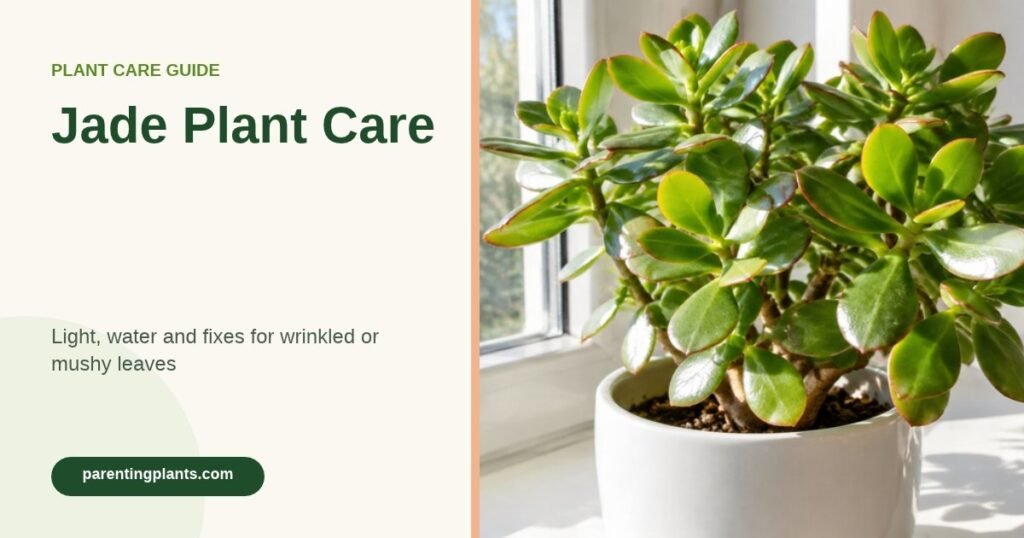
A jade plant (Crassula ovata) is a slow-growing succulent with thick, glossy leaves and a woody trunk that slowly turns it into a little tree. Looked after well, it can live for decades. The secret is simple: lots of light and very little water.
Short answer: Give a jade plant as much bright light as you can, ideally a few hours of direct sun in a south- or west-facing window. Water deeply only when the soil is completely dry, about every 2 to 3 weeks in spring and summer and once a month or less in winter. Use a gritty cactus mix in a pot with a drainage hole.
In this guide
Jade plant care at a glance
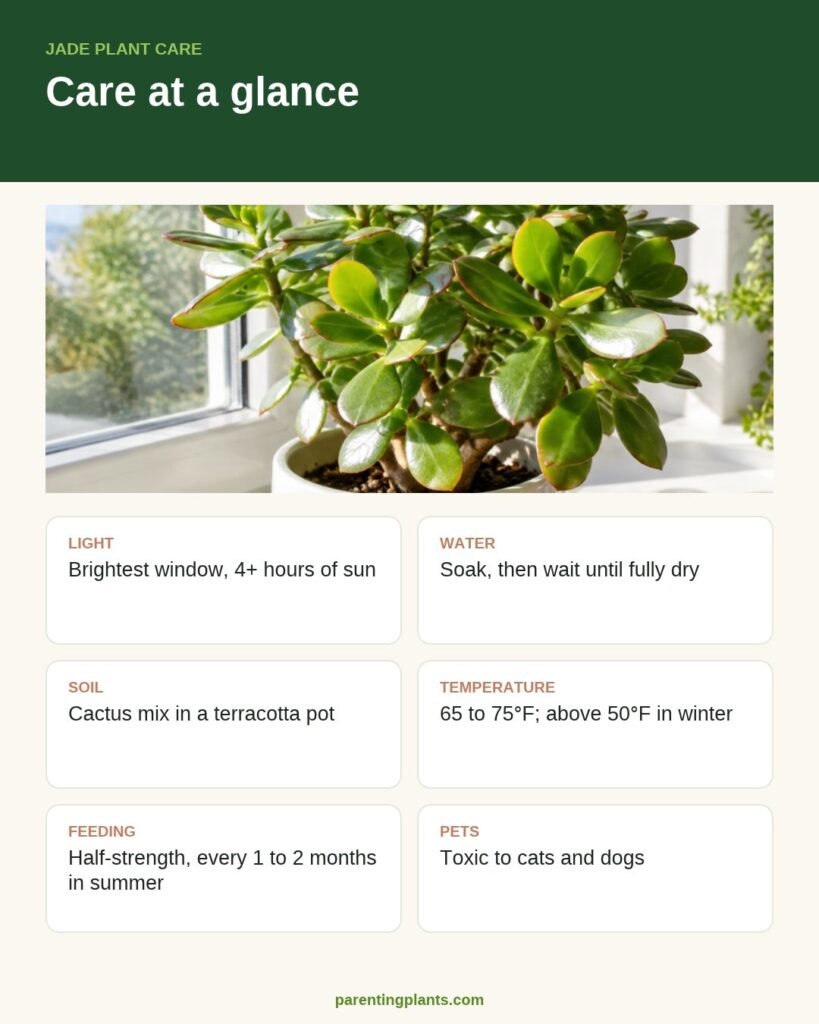
| Need | What a jade plant wants |
|---|---|
| Light | Bright light with at least 4 hours of direct sun if possible |
| Water | Soak, then wait until the soil is completely dry |
| Soil | Fast-draining cactus or succulent mix |
| Pot | Heavy terracotta or ceramic with a drainage hole |
| Temperature | 65 to 75°F (18 to 24°C) by day; cooler winter nights are fine, keep above 50°F (10°C) |
| Humidity | Normal, dry indoor air is perfect |
| Fertilizer | Succulent fertilizer at half strength every 1 to 2 months in spring and summer |
| Pets | Toxic to cats and dogs |
How much light does a jade plant need?
Jade plants love light. Give them the brightest window you have: south- or west-facing is best, with at least 4 hours of direct sun a day. An east window works too. In a dim room they survive, but they stretch and lose their compact, tree-like shape.
- Not enough light: stretched, leggy stems, leaves spaced far apart, plant leaning toward the window, dull green color.
- Good light: compact growth, thick leaves, and often a red tint along the leaf edges. That red edge is a healthy response to sun, not a problem.
- Moving it outdoors in summer? Introduce sun slowly over 1 to 2 weeks so the leaves don’t scorch.
If your home is dark, a grow light 6 to 12 inches above the plant for 12 to 14 hours a day works well. See our lighting guide.
How often to water a jade plant
Jade plants store water in their leaves, so they handle drought far better than wet soil. Use the soak and dry method:
- Check the soil all the way down with your finger or a wooden skewer. It should be completely dry.
- Water slowly until water runs out of the drainage hole.
- Let it drain fully and empty the saucer.
- Wait until the soil is completely dry again: usually 2 to 3 weeks in spring and summer, and every 4 to 6 weeks in winter.
Let the leaves tell you. Firm, plump leaves mean the plant has enough water. Slightly soft, thin or wrinkled leaves mean it is thirsty. Soft, yellow, see-through or mushy leaves mean too much water.
For more on reading soil, see our watering guide.
Best soil and pot for jade
Use a cactus or succulent mix, or mix regular potting mix with an equal amount of perlite or coarse sand. The soil should drain in seconds, not stay damp for days.
A terracotta pot is ideal: it is heavy enough to stop a top-heavy jade from tipping over and lets the soil dry faster. Jade plants like being a little root-bound, so repot only every 2 to 3 years, in spring. Wait a week before watering a newly repotted jade so any damaged roots can heal. See our potting soil guide and repotting guide.
Temperature and humidity
Normal room temperatures of 65 to 75°F (18 to 24°C) are ideal. Jade plants are happy with cooler nights, down to around 50 to 55°F (10 to 13°C) in winter, but are damaged by frost. Dry indoor air is no problem: unlike tropical plants, jade does not need extra humidity, and misting can encourage rot.
Fertilizing a jade plant
Jade plants need very little food. Feed with a succulent or balanced fertilizer at half strength every 1 to 2 months in spring and summer only. Water first, then feed, so you never fertilize dry roots. Skip feeding completely in autumn and winter. More in our fertilizing guide.
Pruning and shaping a jade plant
Pruning keeps a jade compact and helps it grow a thick, tree-like trunk.
- Prune in spring or summer.
- Use clean, sharp scissors. Cut just above a pair of leaves or a brown ring on the stem (a leaf node).
- New growth usually sprouts as two branches from the cut, making the plant fuller.
- Remove any long, floppy branches that make the plant top-heavy.
- Keep the healthy pieces you remove: they make easy cuttings.
Our pruning guide explains where to cut on any plant.
How to propagate a jade plant
Jade is one of the easiest plants to propagate, from a stem or even a single leaf.
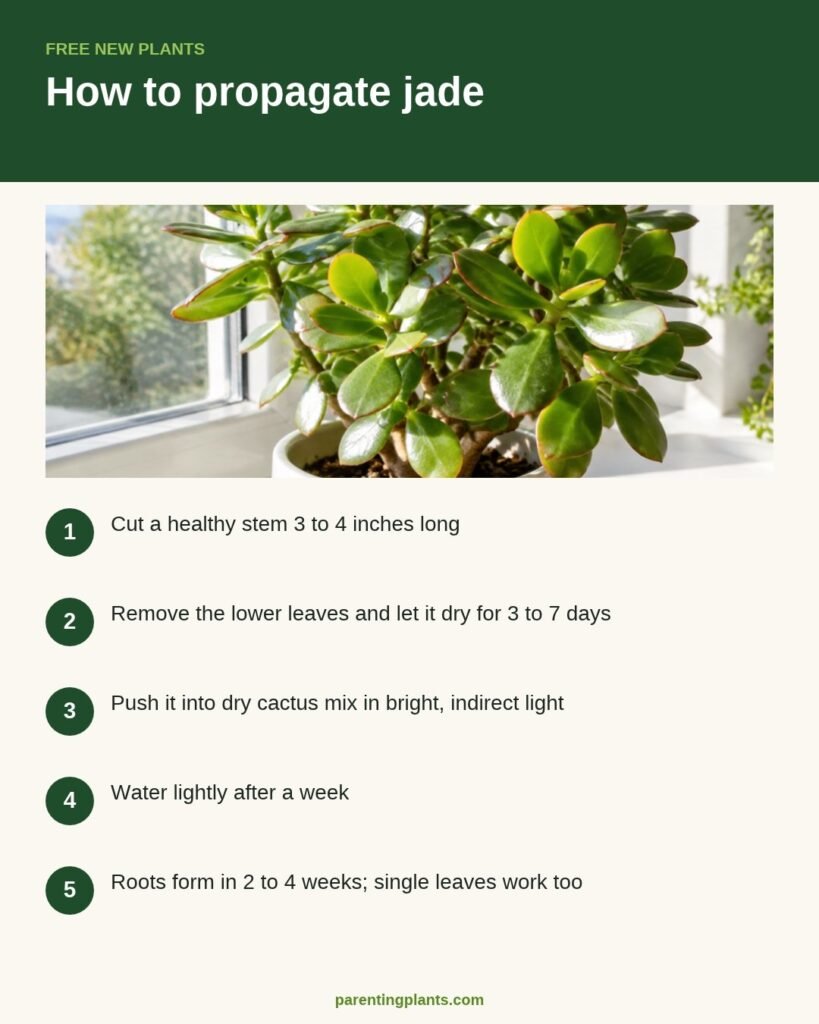
From a stem cutting (fastest)
- Cut a healthy stem 3 to 4 inches long.
- Remove the lower leaves and leave the cutting somewhere dry for 3 to 7 days until the cut end forms a dry callus.
- Push it into dry cactus mix and keep it in bright, indirect light.
- Water lightly after a week. Roots usually form in 2 to 4 weeks.
From a single leaf
- Twist off a plump leaf cleanly, including the base.
- Let it callus for a few days, then lay it on top of dry cactus mix.
- Mist the soil lightly every few days once tiny roots appear.
- A baby plant forms at the base in a few weeks. Leave the old leaf until it shrivels.
More methods in our propagation guide.
How to get a jade plant to flower
Mature jade plants can produce clusters of small white or pink star-shaped flowers in late autumn or winter. To encourage blooms:
- Give it plenty of sun all year.
- In autumn, keep it cooler at night (about 50 to 55°F) and water very little.
- Make sure it gets long, uninterrupted dark nights, away from lamps.
- Be patient: young plants rarely bloom until they are several years old.
Common jade plant problems and fixes
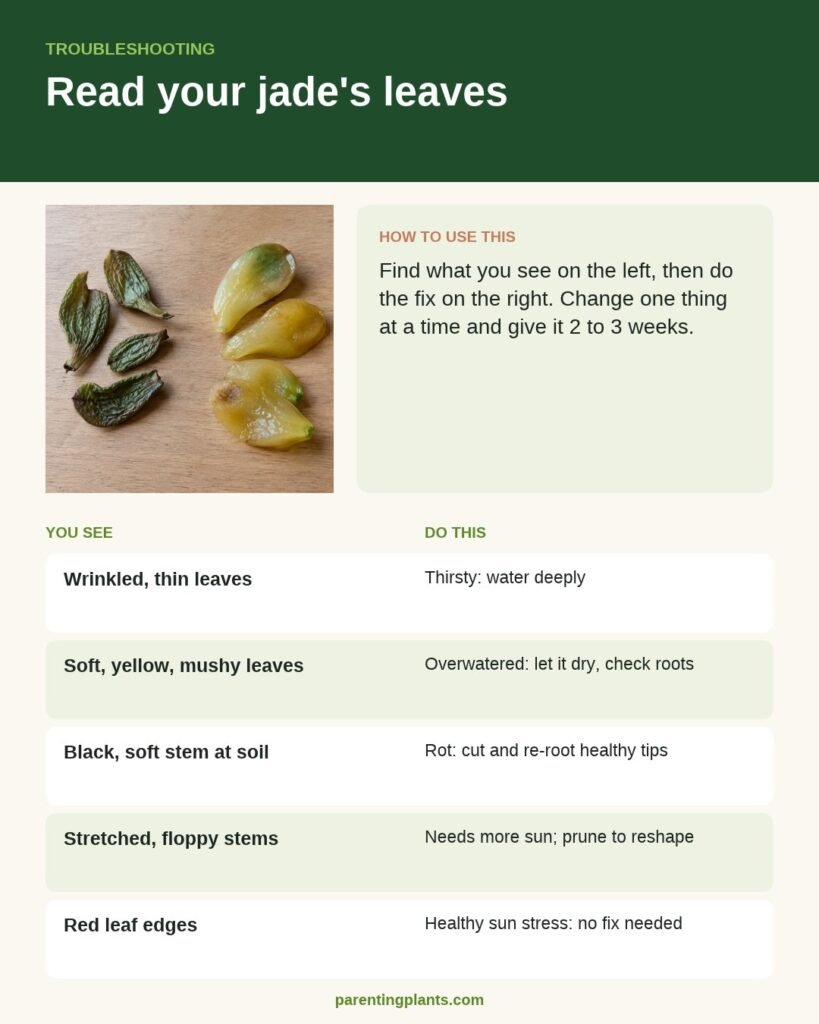
| What you see | Most likely cause | What to do |
|---|---|---|
| Wrinkled, thin or deflated leaves, dry soil | Underwatering | Water deeply; leaves plump up in a few days |
| Soft, yellow, see-through or mushy leaves | Overwatering | Stop watering, let soil dry, check roots for rot |
| Black, mushy stem near the soil | Root or stem rot | Cut healthy pieces above the rot and re-root them |
| Leaves dropping suddenly | Over- or underwatering, or a cold draft | Check soil moisture and move away from cold glass |
| Long, stretched, floppy stems | Not enough light | Move to a sunnier window, prune to reshape |
| Red leaf edges | Plenty of sun | Normal and healthy; no fix needed |
| Brown, dry patches | Sunburn after a sudden move | Increase sun gradually; trim damaged leaves |
| White cottony fluff in leaf joints | Mealybugs | Dab with 70% rubbing alcohol on a cotton swab |
Rot is the biggest threat, so see our root rot guide if the stem goes soft. For bugs, our houseplant pests guide has full treatments.
Is a jade plant toxic to pets?
Yes. The ASPCA lists jade plants as toxic to cats and dogs. Eating the leaves can cause vomiting, depression and loss of coordination. Keep jade out of reach of pets, and call your vet or a pet poison line if you think your pet has eaten some. For safer choices, see our pet-friendly houseplants.
Quick action checklist
- Put it in your sunniest window (4+ hours of direct sun)
- Water deeply, then wait until the soil is completely dry
- Use cactus mix in a terracotta pot with a drainage hole
- Water even less in winter
- Feed lightly every 1 to 2 months in spring and summer only
- Prune leggy stems in spring and root the cuttings
- Keep it out of reach of cats and dogs
Jade leaves turning soft, wrinkled or falling off?
The Houseplant Rescue Guide matches 26 common plant problems to a clear photo, then gives you simple steps to fix each one and stop it coming back. No jargon, 50 pages, with printable checklists.
Jade plant care FAQ
How often should I water a jade plant?
Only when the soil is completely dry. That is usually every 2 to 3 weeks in spring and summer and every 4 to 6 weeks in winter.
Why are my jade plant leaves wrinkled?
Wrinkled, thin leaves usually mean the plant is thirsty. Water deeply and the leaves should plump up within a few days. If the soil is wet and the leaves are wrinkled, check the roots for rot.
Why are my jade plant leaves soft and mushy?
Soft, yellow or see-through leaves mean overwatering. Stop watering, let the soil dry out completely and check the roots and stem for rot.
Can a jade plant live in low light?
It can survive for a while, but it will stretch and become leggy. Jade plants need bright light and some direct sun to stay compact.
Why are my jade plant leaves turning red?
Red edges are a normal response to bright sun and are a sign of a healthy plant. They are not a problem.
How do I make my jade plant thicker?
Give it more sun and prune the tips in spring. Each cut usually sprouts two new branches, making the plant fuller and the trunk thicker over time.
Is a jade plant toxic to cats?
Yes. The ASPCA lists jade plants as toxic to cats and dogs. Keep it out of reach.
Sources and further reading
Want to go deeper? These university extension and expert resources cover the same topic:
- NC State Extension Plant Toolbox: Crassula ovata (jade plant)
- University of Illinois Extension: Jade plant
- Iowa State University Extension: Growing succulents indoors
- ASPCA: Jade plant toxicity