Special Offer: Use code ILOVEPLANTS for 25% off on all digital products! Shop Now →

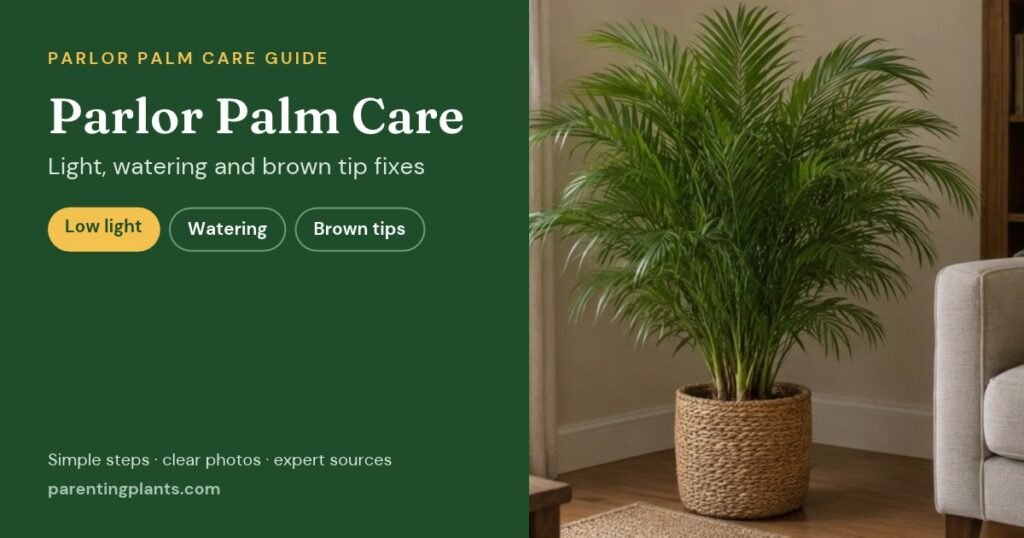
The parlor palm (Chamaedorea elegans) has been a favourite indoor palm since Victorian times because it does something most palms cannot: it grows happily away from a sunny window. It is slow, compact and safe for pets, which makes it one of the best palms for apartments, offices and bedrooms. This guide covers everything that keeps it full and green, plus the common mistakes that turn the fronds brown.
Short answer: Give parlor palm low to medium, indirect light and keep it out of direct sun. Water when the top inch (2.5 cm) of soil is dry, usually every 1 to 2 weeks, and never let the pot stand in water. It likes humidity above 40%, temperatures of 65 to 80°F (18 to 27°C) and is non-toxic to cats and dogs.
In this guide
Parlor palm care at a glance
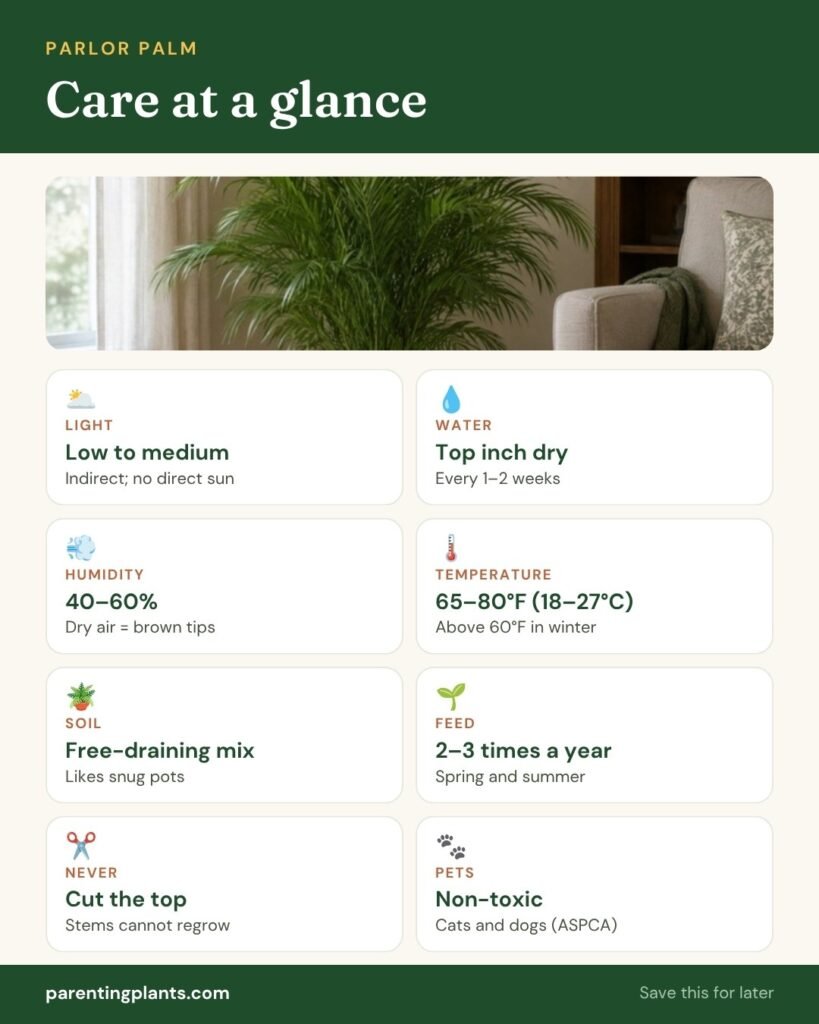
| Need | What it needs |
|---|---|
| Light | Low to medium, indirect light; no direct sun |
| Water | When the top inch (2.5 cm) is dry; every 1 to 2 weeks |
| Humidity | 40 to 60%; brown tips in very dry air |
| Temperature | 65 to 80°F (18 to 27°C); keep above 60°F (16°C) in winter |
| Soil | Free-draining potting mix with bark or perlite |
| Fertilizer | Palm or balanced feed 2 to 3 times in spring and summer |
| Growth | Slow; usually 2 to 4 ft (60 to 120 cm) indoors |
| Pets | Non-toxic to cats and dogs (ASPCA) |
Free Plant Care Tracker: Never forget to water your Parlor Palm again. Get it free →
What to know before you buy
A parlor palm in a shop is usually several young palms planted together to make the pot look full. Each stem is a separate plant with a single growing point at the top. That has two important consequences:
- Never cut the top off a stem. A palm cannot branch or regrow from the cut. That stem will simply stop growing.
- You cannot grow new plants from cuttings. Parlor palms are grown from seed. The only home option is carefully splitting the stems in the pot (see below).
Indoors, parlor palms grow slowly, adding a few new fronds a year and reaching about 2 to 4 ft (60 to 120 cm), occasionally more. Buy the size you want rather than hoping it will shoot up.
How much light does a parlor palm need?
Parlor palms grow in the shade of taller trees in the rainforests of Mexico and Central America, so they are adapted to low to medium, indirect light. A spot a few feet from an east or north window is ideal, or well back from a bright south or west window.
- Direct sun scorches the fronds, leaving yellow or brown, bleached patches.
- Very low light is tolerated, but growth slows and the plant can thin out over time.
- Rotate the pot every few weeks so all sides get light and the palm grows evenly.
It is one of the few palms on our best low-light houseplants list.
How often to water a parlor palm
Water when the top inch (2.5 cm) of soil feels dry. Water slowly until it drains from the bottom, then tip out the saucer. Parlor palms like evenly moist soil, but soggy soil quickly causes root rot, which shows as yellowing, drooping fronds.
| Situation | Typical interval |
|---|---|
| Spring and summer, medium light | Every 7 to 10 days |
| Spring and summer, low light | Every 10 to 14 days |
| Autumn and winter | Every 2 to 3 weeks |
| Near a heater or in very dry air | Check twice a week |
Palms are sensitive to salts and fluoride in some tap water, which show up as brown tips. If you see them, water with filtered or rain water and flush the pot thoroughly every few months to wash out built-up salts. More help in our watering guide.
Humidity and temperature
Parlor palms prefer moderate to high humidity, ideally 40 to 60%. In centrally heated homes in winter, the air is often much drier, which leads to brown tips and spider mites. Run a humidifier nearby, group plants together or set the pot on a tray of pebbles and water (with the pot base above the water). See our humidity guide.
Keep it between 65 and 80°F (18 to 27°C), and above 60°F (16°C) in winter. Cold drafts and temperatures below about 45°F (7°C) can damage the fronds. Keep it away from heaters, which dry it out fast.
Soil, pot and repotting
Use a free-draining potting mix with added bark or perlite (about 3 parts mix to 1 part bark or perlite). Always use a pot with a drainage hole. Palms like slightly crowded roots and have fragile roots, so repot only every 2 to 3 years, in spring, when roots fill the pot. Move up just one pot size and keep the palm at the same depth it was growing. Our repotting guide has step-by-step photos.
Fertilizing
Feed lightly. A slow-release palm fertilizer with micronutrients, or a balanced liquid houseplant feed at half strength, 2 to 3 times between spring and late summer is enough. Over-feeding is a common cause of brown tips. Do not feed in autumn or winter.
Brown tips: what to trim and what to leave
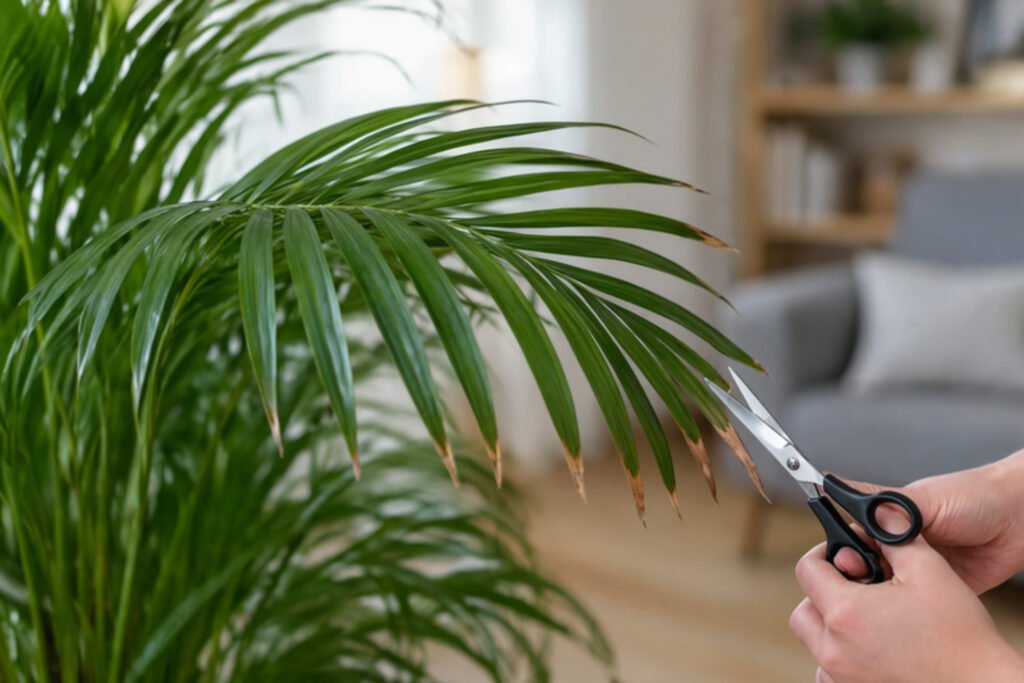
A few brown tips are common on indoor palms. They will not turn green again, but you can tidy them:
- Brown tip only: trim just the brown part with clean, sharp scissors, following the natural point of the leaflet. Leave a hair of brown so you do not cut into green tissue.
- Whole frond brown or yellow: cut it off near the base of its stalk. Old lower fronds naturally die off one at a time.
- Never cut the growing tip at the top of a stem.
Then fix the cause: dry air, uneven watering, salt build-up or too much fertilizer.
Parlor palm flowers
Mature parlor palms sometimes produce sprays of small yellow, bead-like flowers on branching stalks. They are harmless and a sign the plant is mature and content. Some people cut them off to keep the plant tidy and focused on leaves; either way is fine.
Can you propagate a parlor palm?
Not from cuttings. The practical home method is dividing a pot that contains several stems, but palms dislike root disturbance, so expect some sulking afterwards.
- In spring, water the palm the day before and slide it out of the pot.
- Gently tease the root ball apart into clumps with 2 or more stems each. Avoid tearing roots.
- Pot each clump in fresh, free-draining mix at the same depth.
- Water, then keep in medium, indirect light with higher humidity for a few weeks.
- Expect a few brown fronds while it settles. New growth means it has recovered.
If your palm looks healthy, there is no need to divide it. See our propagation guide for plants that are easier to multiply.
Common parlor palm problems and fixes
| What you see | Likely cause | What to do |
|---|---|---|
| Brown, crispy leaf tips | Dry air, salt or fluoride build-up, uneven watering | Raise humidity, flush the soil, use filtered water |
| Yellow lower fronds, one at a time | Normal ageing | Cut off old fronds at the base |
| Many yellow, drooping fronds, wet soil | Overwatering or root rot | Let soil dry, check roots, repot if they are mushy |
| Pale, bleached or scorched patches | Direct sun | Move away from the window |
| Fine webbing, speckled pale fronds | Spider mites | Shower the plant, treat weekly, raise humidity |
| Thin, sparse plant | Low light over a long time, or stems dying off | Brighter indirect light; add a younger palm to the pot |
| Brown spots with yellow halos | Leaf spot after wet foliage | Water the soil, not the fronds; remove badly spotted fronds |
Not sure which one you have? Try the free Plant Doctor.
Pests
Spider mites are the main pest of indoor palms, especially in warm, dry rooms. Look for fine webbing and tiny pale speckles on the fronds. Scale and mealybugs also appear on frond stalks. Give the palm a lukewarm shower every month or two to knock pests off, and treat outbreaks with insecticidal soap every 5 to 7 days. See our houseplant pests guide.
Is parlor palm safe for cats and dogs?
Yes. The ASPCA lists the parlor palm as non-toxic to cats, dogs and horses, which makes it a popular choice for pet owners. Do not confuse it with the sago palm (Cycas revoluta), which is not a true palm and is highly toxic to pets. More safe picks: pet-friendly houseplants.
Quick care checklist
- Low to medium, indirect light; no direct sun
- Water when the top inch is dry
- Keep humidity above 40% in winter
- Keep above 60°F and away from heaters
- Feed lightly 2 to 3 times in spring and summer
- Never cut the top of a stem
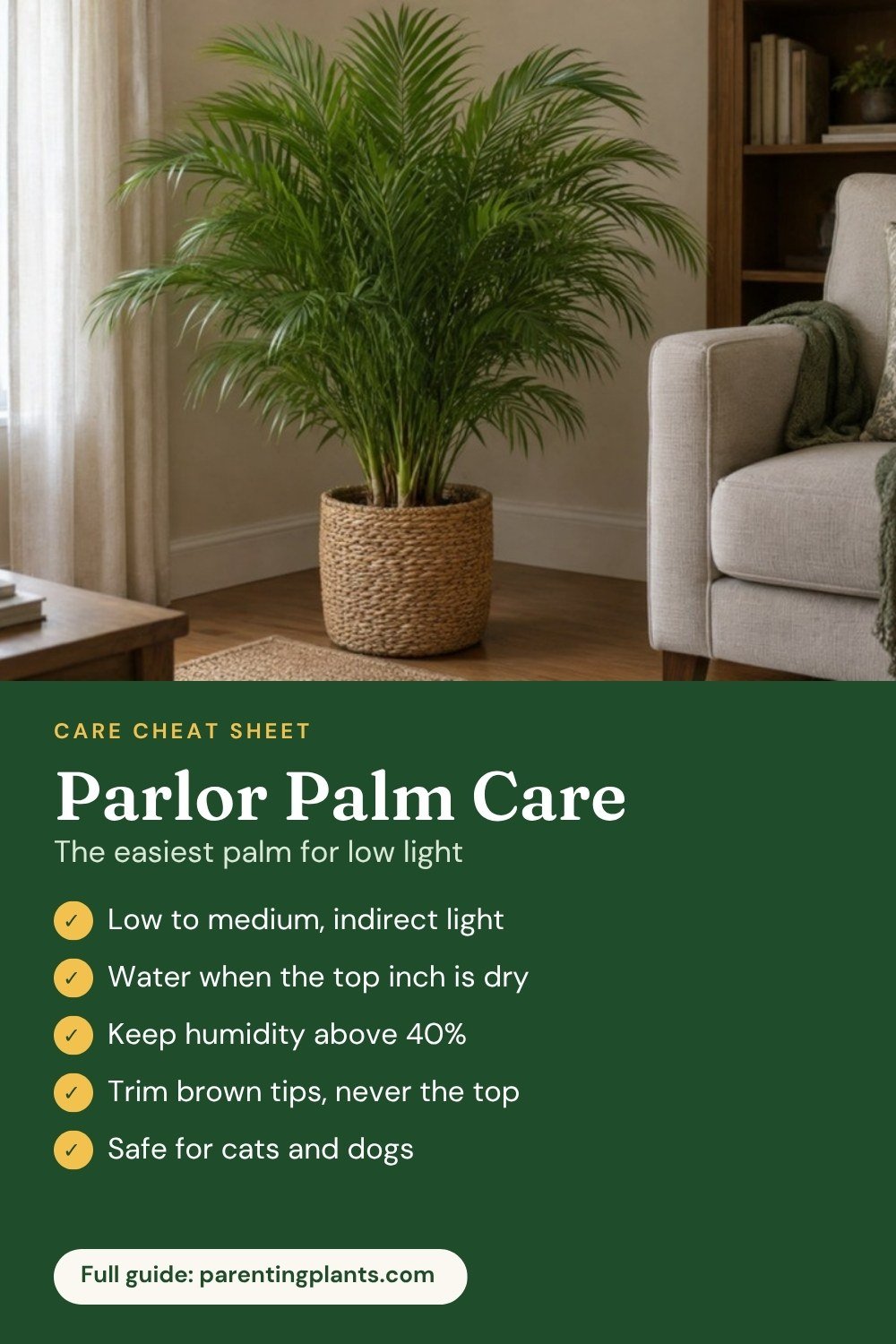
Save this for later: pin the cheat sheet below to your Pinterest plant board.
Leaves turning brown, crispy or yellow?
The Houseplant Rescue Guide matches 26 common plant problems to a clear photo, then gives you simple steps to fix each one and stop it coming back. No jargon, 50 pages, with printable checklists.
Parlor palm care FAQ
Can a parlor palm live in low light?
Yes. It is one of the best palms for low to medium, indirect light. In very dim spots it survives but grows slowly and may thin out.
How often should I water a parlor palm?
When the top inch of soil is dry, usually every 7 to 14 days in spring and summer and every 2 to 3 weeks in winter.
Why are the tips of my parlor palm turning brown?
Usually dry air, salt or fluoride build-up from tap water or fertilizer, or uneven watering. Raise humidity, flush the soil and use filtered water.
Should I cut brown leaves off my parlor palm?
Cut off fronds that are fully brown or yellow at the base. For brown tips, trim only the brown part. Never cut the growing tip.
Is a parlor palm safe for cats?
Yes. The ASPCA lists parlor palm as non-toxic to cats and dogs.
How big does a parlor palm get indoors?
Usually 2 to 4 feet tall over several years. It is a slow grower.
Can you grow a parlor palm from a cutting?
No. Palms cannot be grown from cuttings. You can only divide a pot of several stems or grow new plants from seed.
Sources and further reading
This guide was written by Manik at Parenting Plants and checked against the university extension and expert resources below. Read how we research and update our guides in our editorial guidelines.
- Clemson Cooperative Extension (HGIC): Indoor palms
- Penn State Extension: Palms as houseplants
- ASPCA: Toxic and non-toxic plants list
Looking for another plant? Browse all our houseplant care guides A to Z.
Free tracker
Never forget to water your Parlor Palm again
Track your Parlor Palm and every other plant you own. A ready-made plant care tracker for Google Sheets and Notion that shows exactly which plants need water today, with 90 houseplants built in.
You're in!
Check your inbox, plant friend! 📩
Your free Plant Care Tracker is on its way. We've emailed you both versions, Google Sheets and Notion, plus a bonus printable 2027 plant calendar. It usually arrives within a few minutes.
Can't find it? Check your Promotions or Spam folder, and add manik@parentingplants.com to your contacts so you never miss a plant tip.