Special Offer: Use code ILOVEPLANTS for 25% off on all digital products! Shop Now →

A dim room does not have to mean an empty one. Plenty of houseplants come from shady forest floors and grow happily without a sunny window. The trick is choosing the right plant, and then watering it less, because plants in low light use much less water. Here are the 12 that cope best, with how to care for each one.
Short answer: The best low-light houseplants are the ZZ plant, snake plant, pothos, heartleaf philodendron, cast iron plant, Chinese evergreen and peace lily. For homes with cats or dogs, choose the cast iron plant, parlor palm, prayer plant or spider plant. All of them need some natural light, such as a north window or a spot a few feet back from a brighter one, and less water than they would in a bright room.
In this guide
What counts as low light?
Low light is not no light. Every plant needs some light to make food. University of Minnesota Extension defines low light as roughly 50 to 250 foot-candles: the light near a north-facing window, a few feet back from an east window, or a fairly dark corner of a bright room.
- Low light: by a north window; several feet back from an east or west window; a room shaded by trees, a porch or a nearby building.
- Medium light: by an east window, or near a west window out of direct sun.
- Bright light: by a south or southwest window.
The shadow test. Hold your hand about a foot above where the plant will sit at midday. A sharp, clear shadow means bright light. A soft, fuzzy shadow means medium light. A faint shadow you can barely see means low light. If there is no shadow at all, no plant will thrive there without a grow light.
For more ways to measure light, see our houseplant lighting guide.
Low-light houseplants at a glance
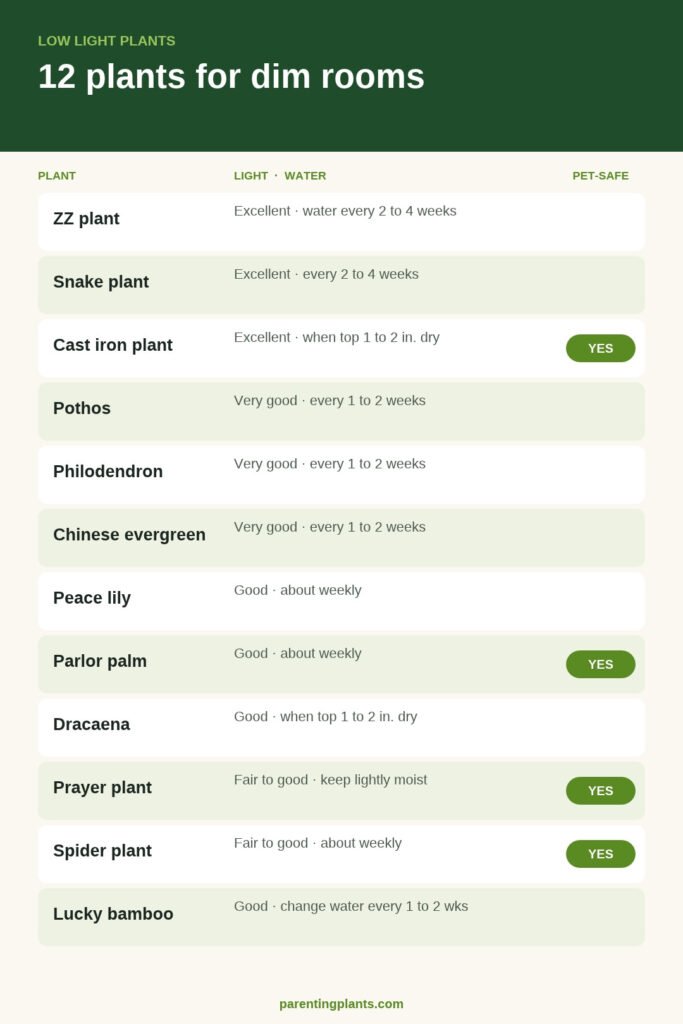
| Plant | How it copes with low light | Water | Pets |
|---|---|---|---|
| ZZ plant | Excellent | Every 2 to 4 weeks | Toxic |
| Snake plant | Excellent | Every 2 to 4 weeks | Toxic |
| Cast iron plant | Excellent | When top 1 to 2 inches dry | Safe |
| Pothos | Very good (plain green types) | Every 1 to 2 weeks | Toxic |
| Heartleaf philodendron | Very good | Every 1 to 2 weeks | Toxic |
| Chinese evergreen | Very good (dark green types) | Every 1 to 2 weeks | Toxic |
| Peace lily | Good (fewer flowers) | About weekly | Toxic |
| Parlor palm | Good | About weekly | Safe |
| Dracaena | Good | When top 1 to 2 inches dry | Toxic |
| Prayer plant | Fair to good | Keep lightly moist | Safe |
| Spider plant | Fair to good | About weekly | Safe |
| Lucky bamboo | Good | Change water every 1 to 2 weeks | Toxic |
Watering times are a rough guide for low light. Always check the soil first.
The 12 best low-light houseplants
1. ZZ plant
Zamioculcas zamiifolia. The toughest plant on this list. Its thick stems and potato-like rhizomes store water, so it shrugs off dim corners, office lighting and forgotten waterings.
- Water: Water every 2 to 4 weeks, only when the soil is completely dry. Yellow stems almost always mean too much water.
- Pets: Toxic if chewed.
- Full care: see our ZZ plant care guide.
2. Snake plant
Dracaena trifasciata. Stiff, upright leaves that look good in a narrow space. It is happy anywhere from a north window to bright sun and is very hard to kill unless overwatered.
- Water: Let the soil dry out completely: every 2 to 4 weeks in low light, even less in winter.
- Pets: Toxic to cats and dogs.
- Full care: see our snake plant care guide.
3. Pothos
Epipremnum aureum. Fast-growing trailing vine for shelves and hanging baskets. Plain green types such as ‘Jade’ handle low light better than heavily variegated ones like ‘Marble Queen’.
- Water: Water when the top inch or two of soil is dry, roughly every 1 to 2 weeks.
- Pets: Toxic to cats and dogs.
4. Heartleaf philodendron
Philodendron hederaceum. Soft, heart-shaped leaves on long trailing stems. One of the few plants that copes with genuinely low light, growing slower but staying healthy.
- Water: Water when the top inch of soil is dry, about every 1 to 2 weeks.
- Pets: Toxic to cats and dogs.
- Full care: see our philodendron care guide.
5. Cast iron plant
Aspidistra elatior. Named for how hard it is to kill. Tall, dark green leaves for dim hallways and corners where almost nothing else grows. Slow, but very long-lived.
- Water: Water when the top inch or two of soil is dry; keep it on the dry side in winter.
- Pets: Pet-safe.
6. Chinese evergreen
Aglaonema. Patterned leaves in green, silver, pink or red. Dark green varieties handle low light best; pink and red ones need more light. Move it to a darker spot gradually, as it can drop leaves after a sudden change.
- Water: Water when the top inch or two of soil is dry, about every 1 to 2 weeks.
- Pets: Toxic to cats and dogs.
7. Peace lily
Spathiphyllum. Glossy leaves that grow well in medium to low light. It flowers less in a dim room but stays lush, and droops dramatically to tell you when it is thirsty.
- Water: Water when the top inch is dry or the leaves start to droop, usually about weekly.
- Pets: Toxic to cats and dogs.
- Full care: see our peace lily care guide.
8. Parlor palm
Chamaedorea elegans. A soft, feathery palm that, unlike most palms, is happy away from the window. Great for adding height to a living room or bedroom.
- Water: Keep the soil lightly moist: water when the top inch is dry, about weekly.
- Pets: Pet-safe.
9. Dracaena
Dracaena fragrans and relatives. Corn plant, ‘Janet Craig’ and similar dracaenas form small trees with long, strappy leaves. Green-leaved types tolerate low light well.
- Water: Water when the top inch or two is dry. Use filtered or rain water if the leaf tips go brown.
- Pets: Toxic to cats and dogs.
10. Prayer plant
Maranta leuconeura. Striking patterned leaves that fold up at night. It prefers medium light but does well in lower light as long as it never sits in direct sun.
- Water: Keep the soil lightly moist; water when the top half inch is dry. Likes humidity.
- Pets: Pet-safe.
11. Spider plant
Chlorophytum comosum. Arching striped leaves and baby plantlets. It grows best in medium light but copes with lower light, growing slower and greener.
- Water: Water when the top inch is dry, about weekly.
- Pets: Pet-safe.
- Full care: see our spider plant care guide.
12. Lucky bamboo
Dracaena sanderiana. Grows in water or soil and actually prefers shade: direct sun scorches it. A good choice for a desk or shelf far from the window.
- Water: If grown in water, keep the roots covered and change the water every 1 to 2 weeks.
- Pets: Toxic to cats and dogs.
- Full care: see our lucky bamboo care guide.
Which low-light plant is right for you?
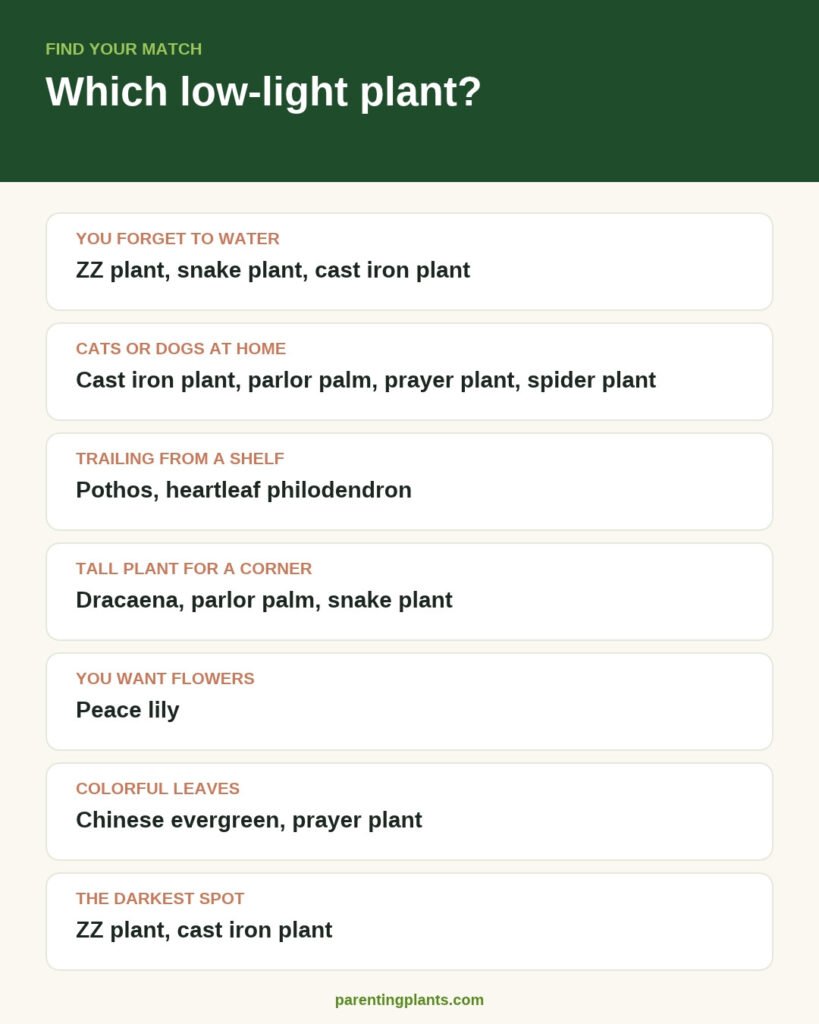
| If you… | Choose |
|---|---|
| Forget to water | ZZ plant, snake plant, cast iron plant |
| Have cats or dogs | Cast iron plant, parlor palm, prayer plant, spider plant |
| Want a trailing plant for a shelf | Pothos, heartleaf philodendron |
| Want something tall for a corner | Dracaena, parlor palm, snake plant |
| Want flowers | Peace lily |
| Want colorful leaves | Chinese evergreen, prayer plant |
| Have the darkest spot in the house | ZZ plant, cast iron plant |
New to plants? Our list of the best houseplants for beginners covers the easiest plants for every kind of room, and our pet-friendly houseplants guide has more safe choices.
How to care for plants in low light
Low-light plants are easy, but they need a slightly different routine from plants on a sunny windowsill. The biggest mistake is watering them as often as you would in a bright room.
- Water less. Less light means slower growth and much less water used. Soil stays wet for longer, so always check before watering. Overwatering is the number one killer of plants in dim rooms. See our watering guide.
- Feed less. Use half-strength fertilizer a few times in spring and summer at most, and none in winter.
- Use pots with drainage holes and empty the saucer after watering.
- Dust the leaves every month or two with a damp cloth. Dust blocks light, and in a dim room every bit counts.
- Turn the pot a quarter turn every week or two so the plant does not lean toward the window.
- Move plants gradually. Moving a plant from a bright spot to a dark one overnight can make it drop leaves. Shift it a little further from the window each week.
- Expect slow growth. A plant in low light may only put out a few new leaves a year. That is normal, not a problem.
Signs your plant needs more light
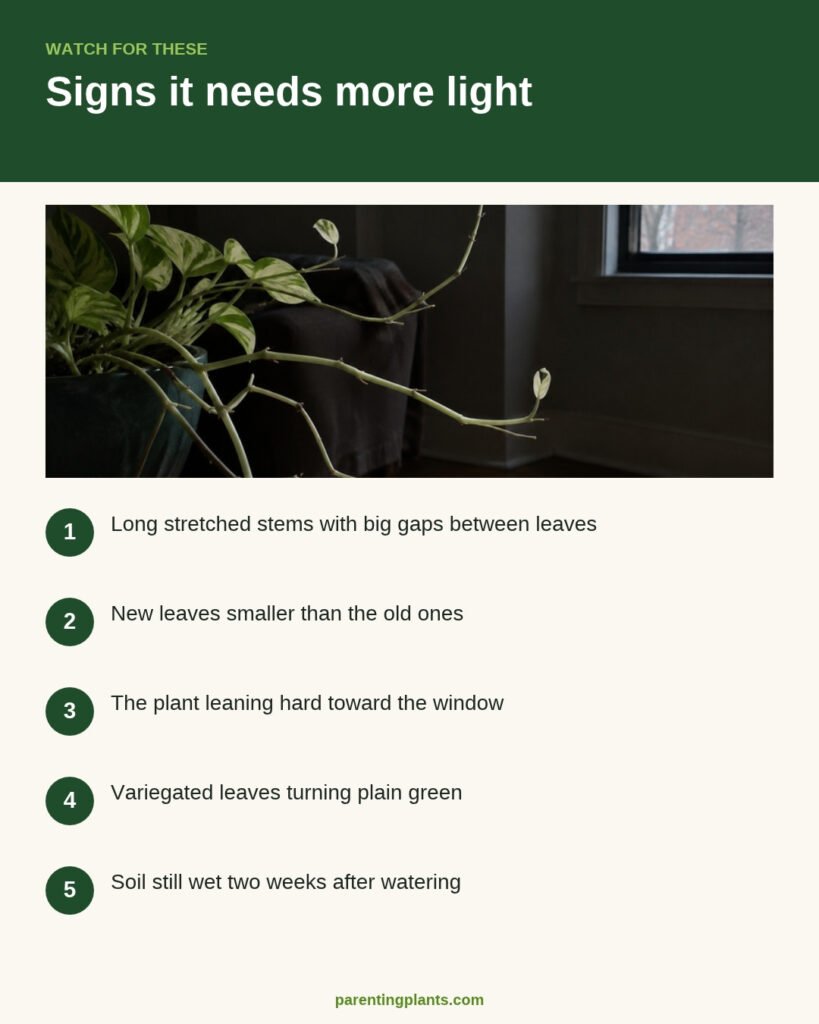
Even low-light plants have limits. Move your plant closer to a window, or add a grow light, if you see:
- Long, stretched stems with big gaps between the leaves
- New leaves that are smaller than the old ones
- The whole plant leaning hard toward the window
- Variegated or colorful leaves turning plain green
- Pale, yellow-green leaves or lower leaves dropping
- Soil that stays wet for more than two weeks after watering
Yellow leaves can also come from overwatering, which is common in dim rooms. Our yellow leaves guide helps you tell the causes apart.
What about rooms with no windows?
No houseplant can live long in a room with no natural light unless you give it a grow light. Bathrooms with frosted windows and offices with overhead lights usually count as low light; a windowless storage room does not.
A simple full-spectrum LED grow bulb or bar placed 12 to 24 inches above foliage plants, on a timer for 12 to 14 hours a day, will keep any plant on this list healthy. ZZ plants and snake plants also do well under ordinary bright office lighting that stays on most of the day.
Quick action checklist
- Check your light with the shadow test before buying
- Pick a plant rated for low light (ZZ, snake plant, cast iron plant and pothos are the safest bets)
- Choose pet-safe plants if you have cats or dogs
- Water only when the soil is dry, and less often than in a bright room
- Dust the leaves and turn the pot regularly
- Watch for stretching or pale leaves and move closer to light if needed
- Use a grow light for rooms with no windows
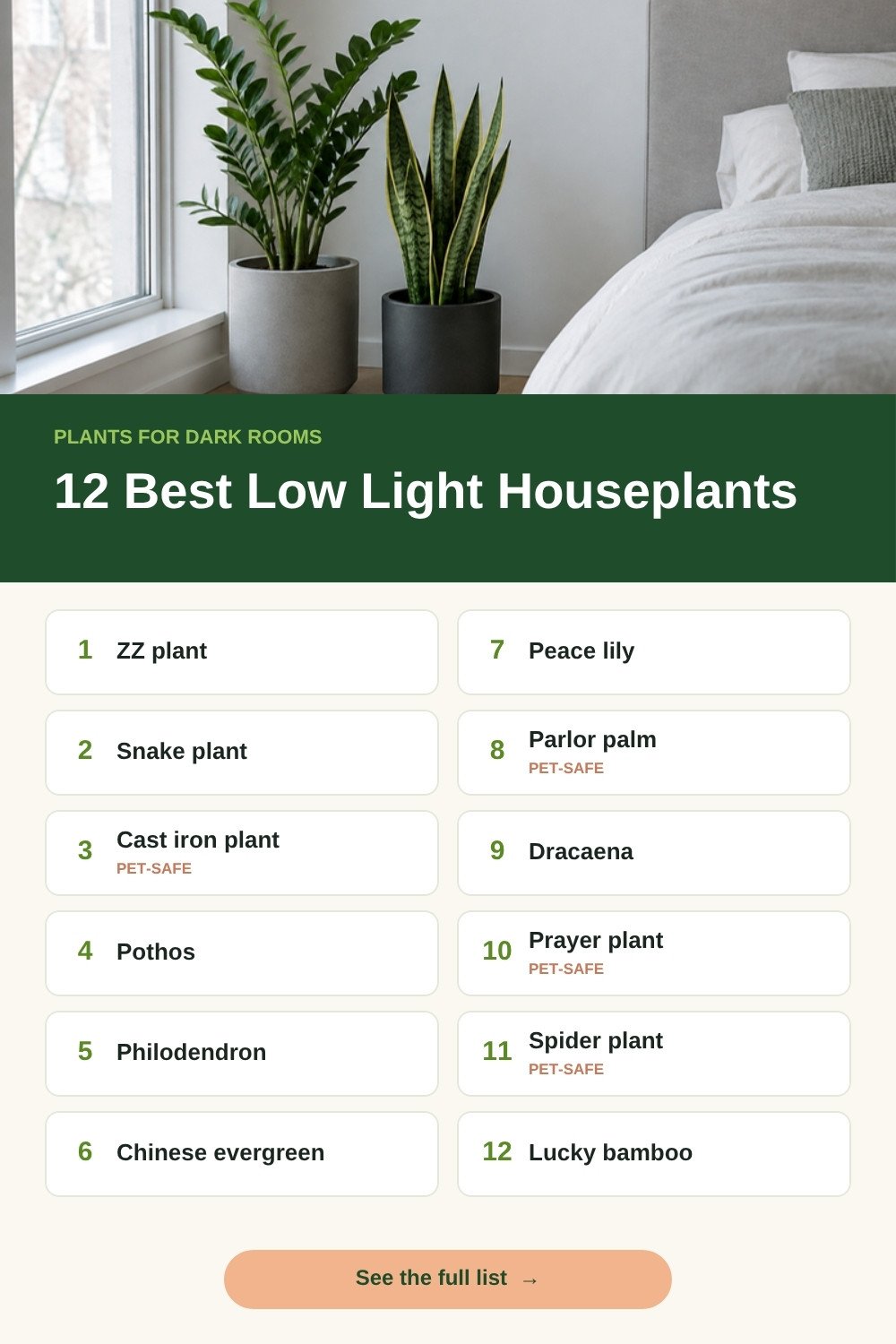
Save this for later: pin the cheat sheet below to your Pinterest plant board so it is there when you need it.
Low-light plant looking pale, leggy or yellow?
The Houseplant Rescue Guide matches 26 common plant problems to a clear photo, then gives you simple steps to fix each one and stop it coming back. No jargon, 50 pages, with printable checklists.
Low-light houseplants FAQ
What is the best houseplant for low light?
The ZZ plant is the toughest, followed by the snake plant and cast iron plant. All three tolerate dim corners and infrequent watering.
Can any plant live with no sunlight at all?
No. Every plant needs some light. In a room with no windows, use a grow light for 12 to 14 hours a day.
Which low-light plants are safe for cats and dogs?
The cast iron plant, parlor palm, prayer plant and spider plant are listed as non-toxic to cats and dogs by the ASPCA.
Is a north-facing window low light?
Yes. A north window gives soft, indirect light all day, which suits every plant on this list.
How often should I water plants in low light?
Less often than in bright light. Check the soil and water only when the top inch or two is dry. For ZZ and snake plants, wait until the soil is completely dry.
Can low-light plants grow in a bathroom?
Yes, if the bathroom has a window. Pothos, peace lily, heartleaf philodendron, cast iron plant and prayer plant enjoy the extra humidity.
Why is my low-light plant getting leggy?
It is stretching toward the light because it is not getting enough. Move it closer to a window or add a grow light, then prune the long stems.
Sources and further reading
Want to go deeper? These university extension and expert resources cover the same topic:
- University of Minnesota Extension: Lighting for indoor plants
- Penn State Extension: Low-light houseplants
- University of Illinois Extension: Brighten dim interiors with low-light houseplants
- ASPCA: Toxic and non-toxic plants list

[…] an easy beginner plant, low-light picks and pet-safe […]