Special Offer: Use code ILOVEPLANTS for 25% off on all digital products! Shop Now →

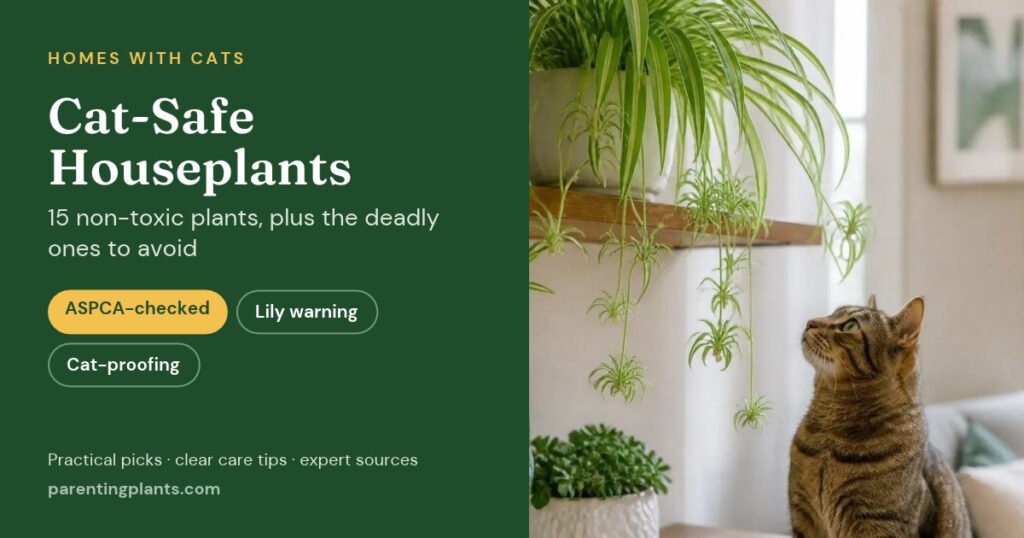
Cats and houseplants can live together happily, but cats are harder to plant-proof than dogs. They climb, jump onto shelves you thought were out of reach, bat at dangling leaves and sometimes chew greenery on purpose. They are also more sensitive than dogs to some plant toxins, and one common flower, the lily, can kill a cat in a matter of days.
This guide lists 15 houseplants the ASPCA lists as non-toxic to cats, the plants you should never bring into a cat home, and practical ways to stop your cat chewing leaves or using your pots as a litter box.
Short answer: Cat-safe houseplants include spider plant, Boston fern, bird’s nest fern, staghorn fern, parlor palm, areca palm, calathea, prayer plant, peperomia, African violet, Christmas cactus, hoya, moth orchid, haworthia and polka dot plant. Never keep true lilies (Lilium) or daylilies (Hemerocallis) in a home with cats: every part, including pollen and vase water, can cause fatal kidney failure. Other common plants toxic to cats include pothos, philodendron, monstera, peace lily, ZZ plant, snake plant, aloe, jade and dracaena.
In this guide
Cat-safe houseplants at a glance
All of these are listed as non-toxic to cats by the ASPCA. “Cat appeal” is how tempting the plant tends to be to chewers and climbers.
| Plant | Light | Care level | Cat appeal | Best spot |
|---|---|---|---|---|
| Spider plant | Medium to bright | Easy | Very high | Hanging, away from furniture |
| Boston fern | Bright, indirect | Moderate | High | Hanging basket |
| Bird’s nest fern | Low to medium | Easy | Medium | Shelf or bathroom |
| Staghorn fern | Bright, indirect | Moderate | Low | Mounted on a wall |
| Parlor palm | Low to medium | Easy | High | Floor or stand |
| Areca palm | Bright, indirect | Moderate | High | Floor |
| Calathea / prayer plant | Medium, indirect | Moderate | Medium | Shelf or table |
| Peperomia | Low to medium | Easy | Low | Shelf or desk |
| African violet | Bright, indirect | Moderate | Medium | Windowsill |
| Christmas cactus | Bright, indirect | Easy | Low | Shelf |
| Hoya | Medium to bright | Easy | Low | Hanging or shelf |
| Moth orchid | Bright, indirect | Moderate | Medium | Windowsill |
| Haworthia | Bright | Very easy | Low | Sunny windowsill |
| Polka dot plant | Bright, indirect | Moderate | Medium | Shelf |
| Cast iron plant | Low to medium | Very easy | Low | Floor or hallway |
Free Plant Care Tracker: Never forget a watering again. Get it free →
First: never keep lilies in a home with cats
Lilies are the most dangerous plant for cats. True lilies (Lilium, including Easter, Asiatic, Oriental, stargazer and tiger lilies) and daylilies (Hemerocallis) cause sudden kidney failure in cats. Licking a little pollen off their fur or drinking the vase water is enough. Dogs are not affected in the same way.
- Signs usually start within a few hours: vomiting, drooling, not eating and hiding, followed by kidney failure within one to three days.
- Act immediately if you think your cat touched a lily, even if it seems well. Purdue University’s veterinary college advises that cats treated quickly have a good chance of recovery, while treatment delayed more than about 18 hours often comes too late to prevent permanent kidney damage.
- Check bouquets. Lilies are common in cut flowers sent as gifts. Ask florists for lily-free arrangements.
What about peace lilies and calla lilies? They are not true lilies and do not cause kidney failure, but they are still toxic to cats, causing painful mouth irritation, drooling and vomiting.
15 cat-safe houseplants
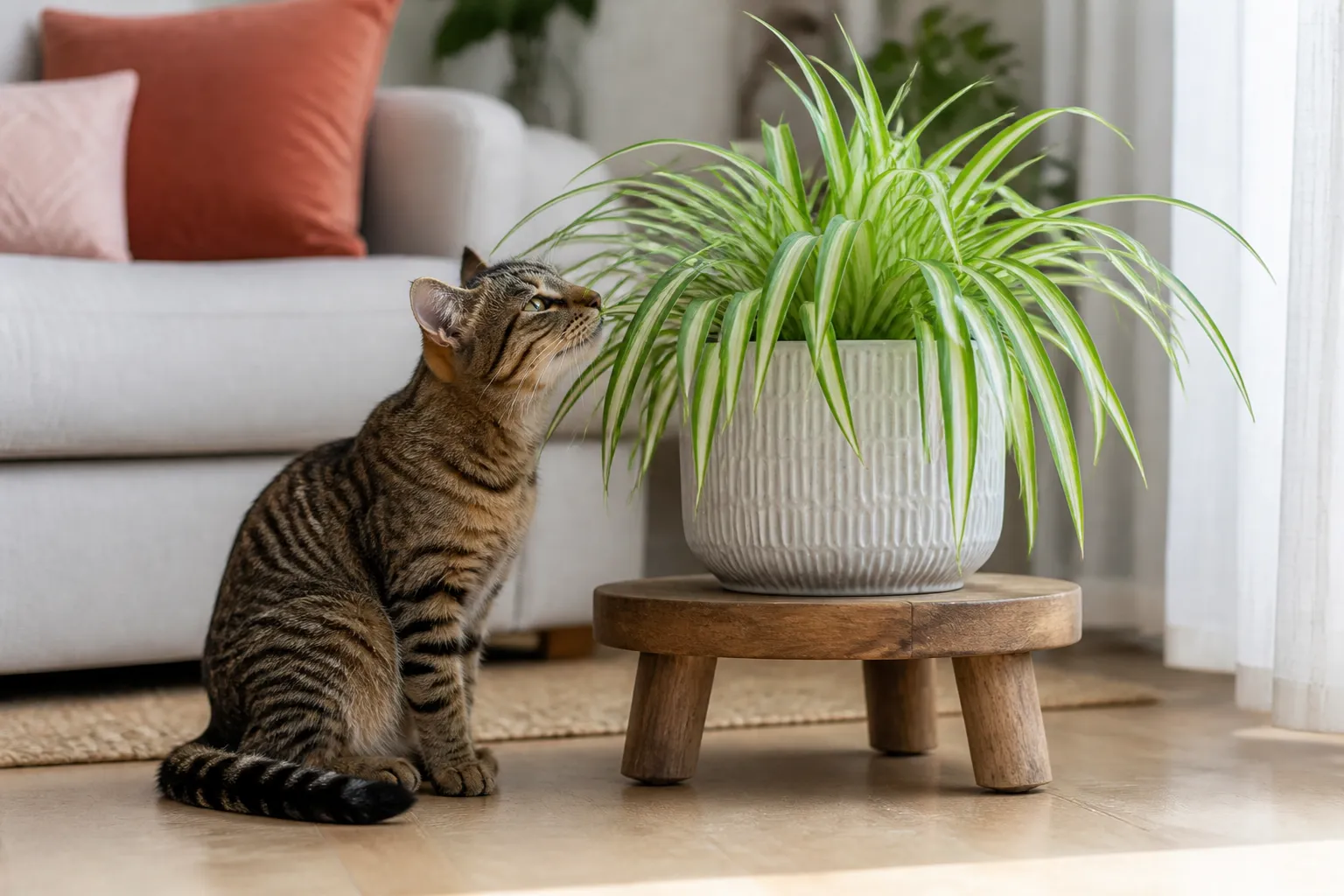
1. Spider plant (Chlorophytum comosum)
Light: Medium to bright, indirect · Water: When the top inch is dry · Size: 1 to 2 ft, trailing babies · Pets: Non-toxic to cats (ASPCA)
The classic cat-safe plant, and the one cats love most. Many cats are strongly drawn to spider plants and chew the leaves, which can cause mild vomiting. Hang it from the ceiling, well away from any furniture your cat could jump from, and offer cat grass as a distraction.
➜ Full care: Spider plant care guide
2. Boston fern (Nephrolepis exaltata)
Light: Bright, indirect · Water: Keep evenly moist · Size: 1 to 3 ft wide · Pets: Non-toxic to cats (ASPCA)
Lush and safe, but the arching fronds invite batting and chewing. A hanging basket works best. Needs humidity and regular watering.
➜ Full care: Boston fern care guide
3. Bird’s nest fern (Asplenium nidus)
Light: Low to medium, indirect · Water: When the top inch is dry · Size: 1 to 2 ft · Pets: Non-toxic to cats (ASPCA)
Broad, wavy fronds and an easy-going nature make this the best fern for most homes. Some cats like to chew the soft new fronds, so a shelf is better than the floor.
➜ Full care: Bird’s nest fern care guide
4. Staghorn fern (Platycerium bifurcatum)
Light: Bright, indirect · Water: Soak weekly in warm weather, less in winter · Size: 1 to 3 ft wide · Pets: Non-toxic to cats (ASPCA)
Usually mounted on a board and hung on the wall, which makes it one of the most cat-proof plants you can own. Water by soaking the whole mount. See our indoor fern care guide for details.
5. Parlor palm (Chamaedorea elegans)
Light: Low to medium, indirect · Water: When the top inch is dry · Size: 2 to 4 ft · Pets: Non-toxic to cats (ASPCA)
Easy, low-light and safe. Cats often chew the soft, grassy fronds, so expect a few nibbled tips.
➜ Full care: Parlor palm care guide
6. Areca palm (Dypsis lutescens)
Light: Bright, indirect · Water: When the top inch is dry · Size: 4 to 7 ft · Pets: Non-toxic to cats (ASPCA)
A large, feathery palm for a bright room. Big enough that a little chewing does not show.
7. Calathea and prayer plant (Goeppertia and Maranta)
Light: Medium, indirect · Water: Keep lightly moist · Size: 1 to 2 ft · Pets: Non-toxic to cats (ASPCA)
Bold patterns and movement (the leaves rise and fall each day), all safe for cats. Prayer plants are easier; see our prayer plant guide.
➜ Full care: Calathea care guide
8. Peperomia (Peperomia)
Light: Low to medium, indirect · Water: When the top half of the soil is dry · Size: 6 to 12 in · Pets: Non-toxic to cats (ASPCA)
Small, thick-leaved and usually ignored by cats. Ideal for desks and shelves in lower light.
➜ Full care: Peperomia care guide
9. African violet (Saintpaulia)
Light: Bright, indirect · Water: From below, when the top is dry · Size: 4 to 8 in · Pets: Non-toxic to cats (ASPCA)
A flowering plant that is safe for cats, unlike many gift plants. Keep it on a bright windowsill.
➜ Full care: African violet care guide
10. Christmas cactus (Schlumbergera)
Light: Bright, indirect · Water: When the top inch is dry · Size: 1 to 2 ft wide · Pets: Non-toxic to cats (ASPCA)
Spineless, safe and covered in flowers in winter, making it a better holiday choice than lilies, amaryllis or poinsettia.
➜ Full care: Christmas cactus care guide
11. Hoya (Hoya carnosa and others)
Light: Medium to bright, indirect · Water: When the soil is mostly dry · Size: Trailing or climbing · Pets: Non-toxic to cats (ASPCA)
Thick, waxy leaves that most cats ignore, and scented flowers when it matures.
➜ Full care: Hoya care guide
12. Moth orchid (Phalaenopsis)
Light: Bright, indirect · Water: About weekly, when the bark is nearly dry · Size: 1 to 2 ft in flower · Pets: Non-toxic to cats (ASPCA)
Safe for cats, and the flower spikes are usually too high to bother them. Some cats like to dig in the loose bark, so top it with a few larger stones.
➜ Full care: orchid care guide
13. Haworthia (Haworthiopsis and Haworthia)
Light: Bright; some gentle sun · Water: Every 2 to 3 weeks · Size: 3 to 6 in · Pets: Non-toxic to cats (ASPCA)
A small, striped succulent that looks like aloe but is safe for cats. A good swap if you love aloe vera, which is toxic. Needs a bright windowsill.
14. Polka dot plant (Hypoestes phyllostachya)
Light: Bright, indirect · Water: Keep lightly moist · Size: 6 to 12 in · Pets: Non-toxic to cats (ASPCA)
Pink, white or red spotted leaves that are safe for cats. Pinch the tips to keep it bushy; it gets leggy in low light.
15. Cast iron plant (Aspidistra elatior)
Light: Low to medium, indirect · Water: When the top 2 inches are dry · Size: 2 to 3 ft · Pets: Non-toxic to cats (ASPCA)
Tough, leathery leaves that hold up to curious cats, and it grows in dim rooms where little else will.
➜ Full care: Cast iron plant care guide
Bonus: plants grown for cats. Cat grass (young wheat, oat or barley grass) gives cats something safe to chew and can steer them away from your other plants. Catnip and valerian are also safe. Keep a fresh pot going by sowing a new one every two to three weeks.
Common houseplants that are toxic to cats
Cats are smaller than most dogs and process some toxins less well, so plant poisoning can be more serious. These popular plants are listed as toxic to cats by the ASPCA:
| Plant | Main signs in cats | How serious |
|---|---|---|
| Lilies (Lilium) and daylilies (Hemerocallis) | Vomiting, not eating, kidney failure | Severe; often fatal without fast treatment |
| Sago palm | Vomiting, liver failure | Severe; can be fatal |
| Kalanchoe | Vomiting, diarrhoea; heart rhythm problems in large amounts | Moderate to severe |
| Pothos, philodendron, monstera | Mouth pain, drooling, pawing at mouth, vomiting | Usually mild to moderate |
| Peace lily, calla lily, ZZ plant, dieffenbachia | Mouth and throat irritation, drooling | Usually mild to moderate |
| Dracaena (incl. lucky bamboo) | Vomiting, drooling, dilated pupils | Mild to moderate |
| Snake plant | Nausea, vomiting, diarrhoea | Mild |
| Aloe vera | Vomiting, lethargy, diarrhoea | Moderate |
| Jade plant | Vomiting, wobbliness, slow heart rate | Moderate |
| English ivy, asparagus fern | Vomiting, abdominal pain | Mild to moderate |
| Tulip and hyacinth bulbs, cyclamen | Vomiting, drooling; more serious in large amounts | Moderate |
Check any plant in our plant toxicity checker, or see our pet-friendly houseplants guide if you have both cats and dogs.
How to keep cats out of your plants
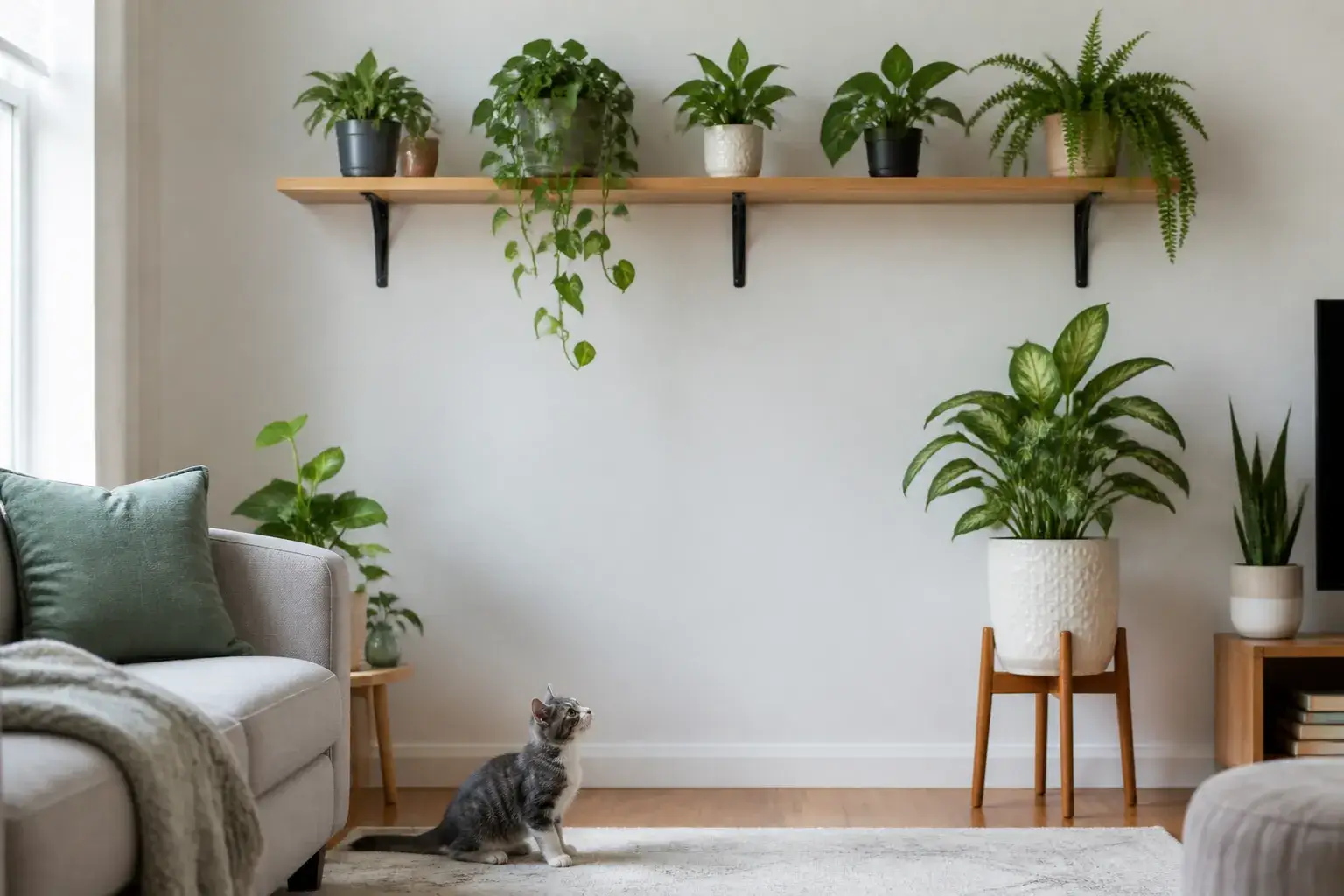
- Think in three dimensions. A shelf is not out of reach if there is a sofa, bookcase or cat tree nearby to jump from. Hang plants from the ceiling in open space, or keep them in a room the cat cannot enter.
- Use cabinets, cloches and terrariums for small, delicate plants.
- Stop litter-box use. Cover the soil with large pebbles, pine cones or a circle of mesh. Cats dislike digging through them.
- Make leaves less fun: place plants where they do not swing or dangle near a resting spot, and trim trailing stems.
- Offer cat grass. Many cats chew plants because they want to chew grass. Give them their own pot.
- Use gentle deterrents. Double-sided tape on the shelf edge or a sheet of foil around the pot often works. Citrus peel on the soil can deter some cats.
Do not use essential oils as a deterrent. Many essential oils, including tea tree, citrus and eucalyptus oils, are toxic to cats, whether sprayed, diffused or on their fur.
What to do if your cat eats a plant
- Move your cat away and remove any plant material from its mouth or fur.
- Identify the plant and take a photo. If it might be a lily, treat it as an emergency.
- Watch for signs: drooling, pawing at the mouth, vomiting, not eating, hiding, wobbliness or changes in urination.
- Call for advice: your vet, the ASPCA Animal Poison Control: (888) 426-4435, or the Pet Poison Helpline: (855) 764-7661. A consultation fee may apply.
- Do not give milk, salt or anything to make your cat vomit unless a vet tells you to.
Quick checklist
- Never bring lilies or daylilies into a home with cats
- Choose plants the ASPCA lists as non-toxic to cats
- Hang tempting plants away from jumping-off points
- Cover soil with pebbles to stop digging
- Grow cat grass as a safe alternative
- Save the ASPCA poison line: (888) 426-4435
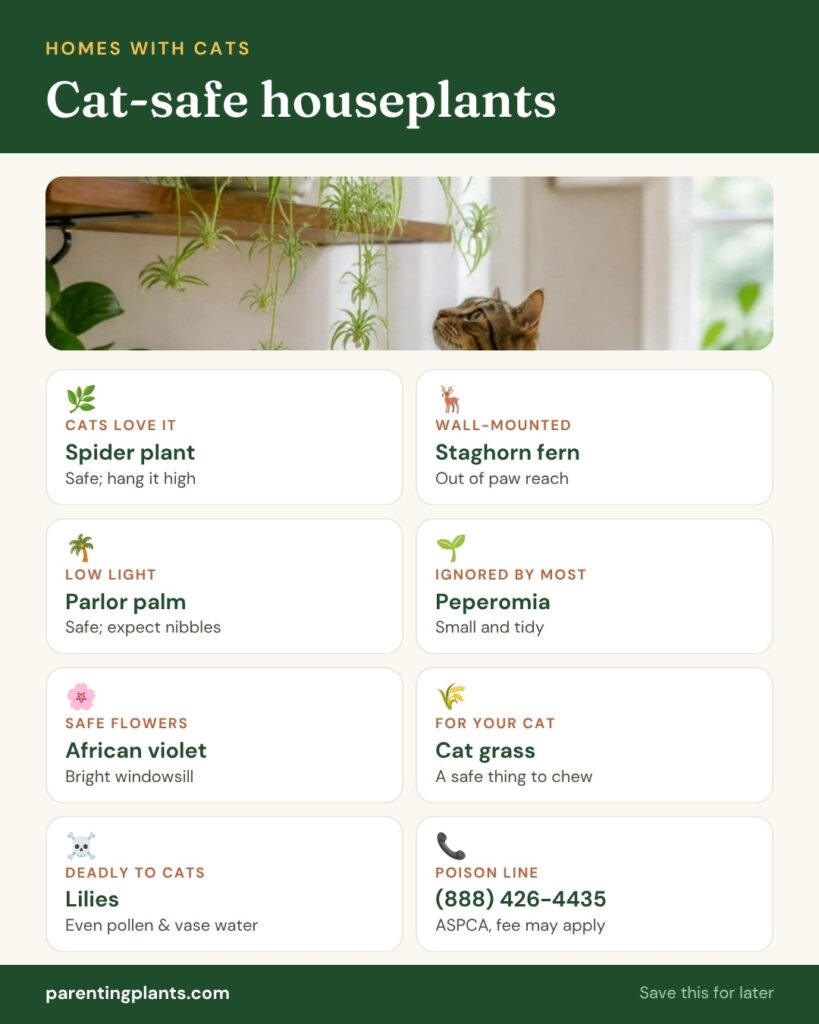
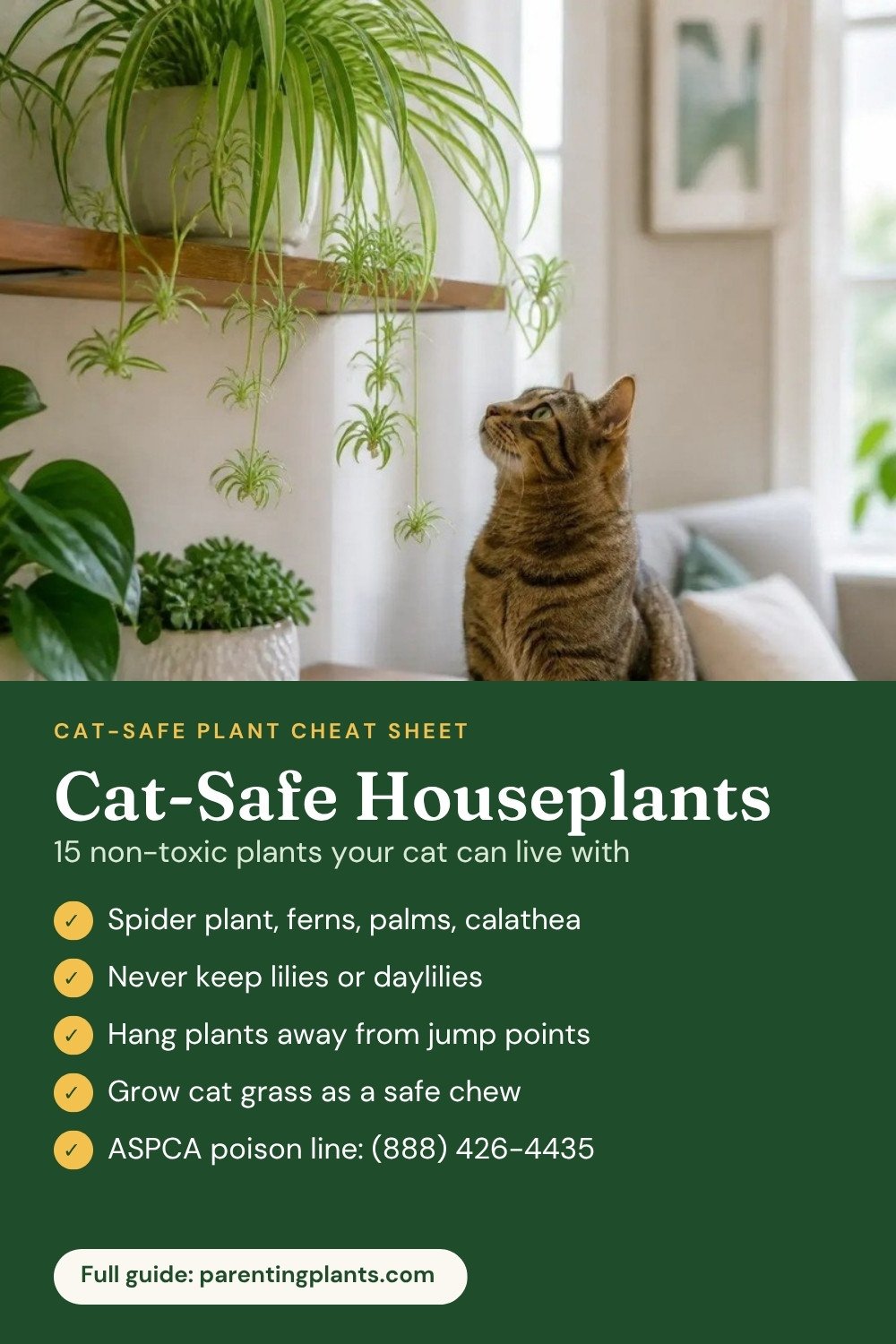
Save this for later: pin the cheat sheet below to your Pinterest plant board.
Want every plant’s care on one page?
The Houseplant Care Cards give you 30 printable one-page guides for popular houseplants: light, water, pet safety and quick fixes at a glance.
Cat-safe houseplants FAQ
What houseplants are safe for cats?
Spider plant, Boston fern, bird’s nest fern, staghorn fern, parlor palm, areca palm, calathea, prayer plant, peperomia, African violet, Christmas cactus, hoya, moth orchid, haworthia, polka dot plant and cast iron plant are listed as non-toxic to cats by the ASPCA.
What plant is most poisonous to cats?
True lilies (Lilium) and daylilies (Hemerocallis). Even a small amount of pollen, leaf or vase water can cause fatal kidney failure. Get to a vet immediately if your cat is exposed.
Is a peace lily poisonous to cats?
Yes, but it is not a true lily. Peace lily causes mouth irritation, drooling and vomiting rather than kidney failure.
Why do cats eat spider plants?
Cats seem to enjoy the texture and mild scent of spider plants. The plant is non-toxic, but eating a lot can cause vomiting, so hang it out of reach and offer cat grass instead.
Is pothos toxic to cats?
Yes. Pothos contains calcium oxalate crystals that cause mouth pain, drooling and vomiting.
How do I stop my cat digging in my plant pots?
Cover the soil with large pebbles, pine cones or mesh, and make sure the litter box is clean and easy to reach.
Are succulents safe for cats?
Some are and some are not. Haworthia and echeveria are listed as non-toxic, but aloe vera, jade plant and kalanchoe are toxic to cats.
Sources and further reading
This guide was written by Manik at Parenting Plants and checked against the expert and university resources below. Read how we research and update our guides in our editorial guidelines.
- ASPCA: Toxic and non-toxic plants list
- Purdue University College of Veterinary Medicine: Beautiful spring lilies pose serious danger to cats
- U.S. Food and Drug Administration: Lovely lilies and curious cats: a dangerous combination
- ASPCA: These houseplants can cause trouble for your pets
- Pet Poison Helpline: Poison control for dogs and cats
Looking for a specific plant? Browse all our houseplant care guides A to Z.
Free tracker
Get the free Plant Care Tracker
A ready-made plant care tracker for Google Sheets and Notion that shows exactly which plants need water today, with 90 houseplants built in.
You're in!
Check your inbox, plant friend! 📩
Your free Plant Care Tracker is on its way. We've emailed you both versions, Google Sheets and Notion, plus a bonus printable 2027 plant calendar. It usually arrives within a few minutes.
Can't find it? Check your Promotions or Spam folder, and add manik@parentingplants.com to your contacts so you never miss a plant tip.