Special Offer: Use code ILOVEPLANTS for 25% off on all digital products! Shop Now →

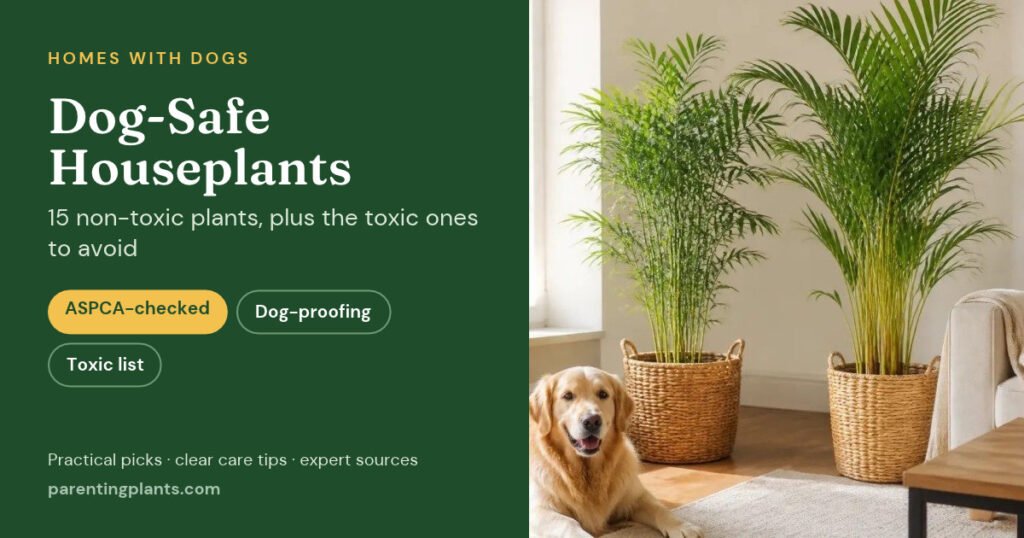
Dogs explore with their mouths. Puppies chew anything at nose height, bored adult dogs shred leaves, and some dogs dig happily in a pot of soil. If you share your home with a dog, the safest approach is simple: grow plants that will not hurt them if they take a bite, and keep toxic plants out of the house or well out of reach.
This guide lists 15 houseplants the ASPCA lists as non-toxic to dogs, sorted by where they work best in your home. It also covers the common houseplants that are toxic to dogs, the hidden dangers in the pot itself, and exactly what to do if your dog eats a plant.
Short answer: Dog-safe houseplants include spider plant, Boston fern, parlor palm, areca palm, Kentia palm, cast iron plant, calathea, prayer plant, ponytail palm, money tree, peperomia, bird’s nest fern, Christmas cactus, African violet, hoya and moth orchids. Common houseplants that are toxic to dogs include sago palm (which can be deadly), aloe vera, pothos, philodendron, monstera, peace lily, ZZ plant, snake plant, dieffenbachia, dracaena and jade. If your dog eats a toxic plant, call your vet or the ASPCA Animal Poison Control: (888) 426-4435.
In this guide
Dog-safe houseplants at a glance
Every plant in this table is listed as non-toxic to dogs by the ASPCA. “Chew-proof” is our rating of how well the plant tolerates a curious dog.
| Plant | Light | Care level | Chew-proof? | Best spot |
|---|---|---|---|---|
| Spider plant | Medium to bright | Easy | Low | Hanging or high shelf |
| Boston fern | Bright, indirect | Moderate | Low | Hanging basket |
| Parlor palm | Low to medium | Easy | Medium | Floor or table |
| Areca palm | Bright, indirect | Moderate | Medium | Floor |
| Kentia palm | Low to medium | Easy | High | Floor |
| Cast iron plant | Low to medium | Very easy | High | Floor or hallway |
| Calathea / prayer plant | Medium, indirect | Moderate | Low | Table or shelf |
| Ponytail palm | Bright | Easy | High | Floor or table |
| Money tree | Medium to bright | Easy | Medium | Floor |
| Peperomia | Low to medium | Easy | Medium | Shelf or desk |
| Bird’s nest fern | Low to medium | Easy | Medium | Shelf or bathroom |
| Christmas cactus | Bright, indirect | Easy | Medium | Shelf |
| African violet | Bright, indirect | Moderate | Low | Windowsill |
| Hoya | Medium to bright | Easy | Medium | Hanging or shelf |
| Moth orchid | Bright, indirect | Moderate | Low | Windowsill or shelf |
Free Plant Care Tracker: Never forget a watering again. Get it free →
What “dog-safe” really means
In this guide, “dog-safe” means the plant appears on the ASPCA’s list of plants that are non-toxic to dogs. That means it contains no compounds known to poison dogs. It does not mean your dog should eat it:
- Any plant can cause mild stomach upset if a dog eats a lot of it, because dogs are not built to digest leaves. Expect a little vomiting or diarrhoea at worst.
- Plants can be choking hazards, especially tough leaves, stems or large pieces swallowed whole.
- Pesticides and fertilizers on a safe plant can still poison a dog (more on this below).
Plant names are confusing, too. “Palm” and “fern” in a common name do not tell you anything: the parlor palm is safe, the sago palm can kill a dog, and the asparagus “fern” is toxic. Always check the botanical name, or use our plant toxicity checker.
15 dog-safe houseplants, by where they work best
Floor plants (best for large or gentle dogs)
1. Cast iron plant (Aspidistra elatior)
Light: Low to medium, indirect · Water: When the top 2 inches are dry · Size: 2 to 3 ft · Pets: Non-toxic to dogs (ASPCA)
The toughest dog-safe plant you can buy. Its leathery leaves stand up to wagging tails and the odd nibble, it grows in dim hallways, and it shrugs off missed waterings. If you want one indestructible floor plant, start here.
➜ Full care: Cast iron plant care guide
2. Kentia palm (Howea forsteriana)
Light: Low to medium, indirect · Water: When the top 1 to 2 inches are dry · Size: 5 to 10 ft · Pets: Non-toxic to dogs (ASPCA)
A tall, elegant palm that copes with low light. Its tough, high fronds are mostly out of reach of all but the tallest dogs. Pricey, but it lasts for decades. See our guide to tall low-light indoor plants.
3. Parlor palm (Chamaedorea elegans)
Light: Low to medium, indirect · Water: When the top inch is dry · Size: 2 to 4 ft · Pets: Non-toxic to dogs (ASPCA)
An affordable, easy palm for lower light. Its soft fronds are tempting to chew, so place it on a stand if your dog is a nibbler.
➜ Full care: Parlor palm care guide
4. Areca palm (Dypsis lutescens)
Light: Bright, indirect · Water: When the top inch is dry · Size: 4 to 7 ft · Pets: Non-toxic to dogs (ASPCA)
A big, bushy, feathery palm for a bright room. It needs more light and humidity than the Kentia or parlor palm, and brown tips are common in dry, heated homes.
5. Ponytail palm (Beaucarnea recurvata)
Light: Bright, some direct sun is fine · Water: Every 2 to 4 weeks · Size: 2 to 6 ft · Pets: Non-toxic to dogs (ASPCA)
Not a true palm but a drought-tolerant succulent with a swollen trunk and a fountain of thin leaves. Its hard trunk and stiff pot make it very sturdy around dogs. Needs a bright spot and very little water.
6. Money tree (Pachira aquatica)
Light: Medium to bright, indirect · Water: When the top 2 inches are dry · Size: 3 to 6 ft · Pets: Non-toxic to dogs (ASPCA)
A popular braided-trunk tree that is safe for pets. Leaves sit high on the trunk, out of reach of most dogs. It needs a fairly bright spot to keep its leaves.
➜ Full care: Money tree care guide
Hanging plants and high shelves (best for puppies and chewers)
7. Spider plant (Chlorophytum comosum)
Light: Medium to bright, indirect · Water: When the top inch is dry · Size: 1 to 2 ft, trailing babies · Pets: Non-toxic to dogs (ASPCA)
Cheerful, easy and safe, but its dangling babies are irresistible to some dogs. Hang it or put it on a high shelf. Eating a lot can cause mild vomiting.
➜ Full care: Spider plant care guide
8. Boston fern (Nephrolepis exaltata)
Light: Bright, indirect · Water: Keep evenly moist · Size: 1 to 3 ft wide · Pets: Non-toxic to dogs (ASPCA)
A lush hanging-basket classic that is safe for dogs. It needs humidity and regular watering. See our guide to caring for every type of indoor fern.
➜ Full care: Boston fern care guide
9. Hoya (Hoya carnosa and others)
Light: Medium to bright, indirect · Water: When the soil is mostly dry · Size: Trailing or climbing · Pets: Non-toxic to dogs (ASPCA)
Waxy-leaved trailing plants with scented, star-shaped flowers. Hoyas are slow, easy and happy in a hanging pot well above a dog’s reach.
➜ Full care: Hoya care guide
Shelves, desks and windowsills
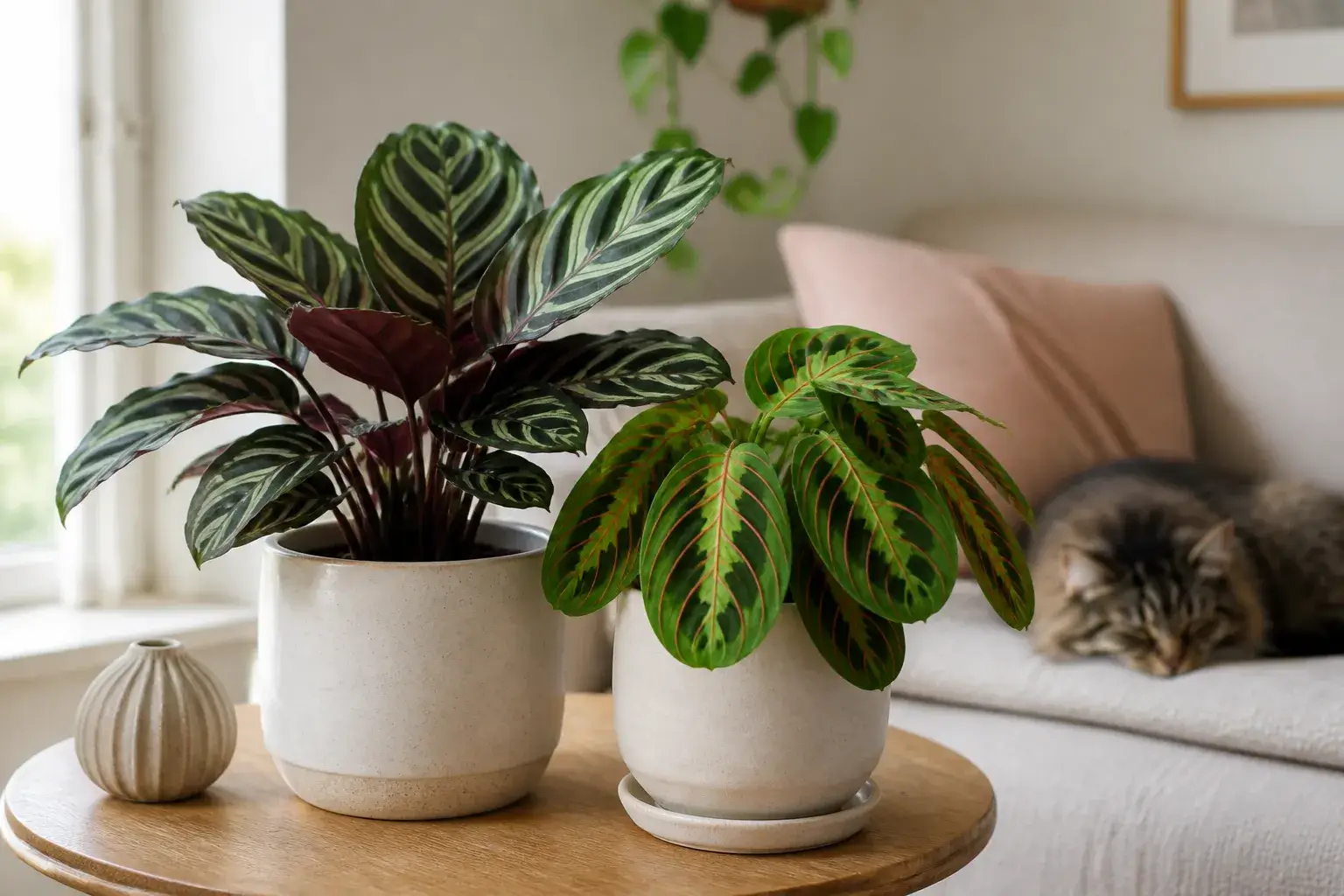
10. Calathea and prayer plant (Goeppertia and Maranta)
Light: Medium, indirect · Water: Keep lightly moist · Size: 1 to 2 ft · Pets: Non-toxic to dogs (ASPCA)
Stunning patterned leaves, all safe for dogs. Both like humidity and steady moisture. Prayer plants are the easier of the two; see our prayer plant care guide.
➜ Full care: Calathea care guide
11. Peperomia (Peperomia)
Light: Low to medium, indirect · Water: When the top half of the soil is dry · Size: 6 to 12 in · Pets: Non-toxic to dogs (ASPCA)
Compact, easy and available in dozens of leaf shapes. A great small plant for a desk or shelf.
➜ Full care: Peperomia care guide
12. Bird’s nest fern (Asplenium nidus)
Light: Low to medium, indirect · Water: When the top inch is dry · Size: 1 to 2 ft · Pets: Non-toxic to dogs (ASPCA)
The easiest fern for most homes, with broad, wavy fronds. Happy in a bathroom.
➜ Full care: Bird’s nest fern care guide
13. Christmas cactus (Schlumbergera)
Light: Bright, indirect · Water: When the top inch is dry · Size: 1 to 2 ft wide · Pets: Non-toxic to dogs (ASPCA)
A safe, flowering alternative to toxic holiday plants such as amaryllis and holly. It has no sharp spines. Eating it may cause mild vomiting.
➜ Full care: Christmas cactus care guide
14. African violet (Saintpaulia)
Light: Bright, indirect · Water: From below, when the top is dry · Size: 4 to 8 in · Pets: Non-toxic to dogs (ASPCA)
One of the few houseplants that flowers almost all year, and safe for dogs. Keep it on a windowsill above dog height.
➜ Full care: African violet care guide
15. Moth orchid (Phalaenopsis)
Light: Bright, indirect · Water: About weekly, when the bark is nearly dry · Size: 1 to 2 ft in flower · Pets: Non-toxic to dogs (ASPCA)
The supermarket orchid is non-toxic to dogs. Its bark mix can be tempting to dig in, though, so keep it high.
➜ Full care: orchid care guide
Common houseplants that are toxic to dogs
These popular houseplants are listed as toxic to dogs by the ASPCA. Most cause mouth pain, drooling and vomiting rather than serious poisoning, but a few can be dangerous. Keep them out of reach, or out of a dog home altogether.
| Plant | Main signs in dogs | How serious |
|---|---|---|
| Sago palm (Cycas revoluta) | Vomiting, bloody stool, liver failure | Severe; can be fatal. Seeds are the most toxic part |
| Aloe vera | Vomiting, diarrhoea, lethargy | Moderate |
| Pothos, philodendron, monstera | Mouth pain, drooling, pawing at mouth, vomiting | Usually mild to moderate |
| Peace lily, ZZ plant, dieffenbachia | Mouth and throat irritation, drooling, vomiting | Usually mild to moderate; dieffenbachia can cause swelling |
| Snake plant | Nausea, vomiting, diarrhoea | Mild |
| Dracaena (corn plant, lucky bamboo) | Vomiting, drooling, dilated pupils | Mild to moderate |
| Jade plant | Vomiting, lethargy, wobbliness | Mild to moderate |
| Fiddle leaf fig, rubber plant | Mouth and skin irritation, vomiting | Mild |
| English ivy | Vomiting, abdominal pain, drooling | Moderate |
| Asparagus fern | Vomiting, diarrhoea; skin irritation | Mild to moderate |
| Kalanchoe, cyclamen, azalea (gift plants) | Vomiting; heart rhythm problems in large amounts | Moderate to severe |
Sago palms are the big one. They are sold as houseplants and bonsai, and every part is poisonous to dogs. If your dog chews a sago palm, treat it as an emergency and call your vet immediately, even if your dog seems fine.
The ASPCA’s full database is linked in our sources. You can also check any plant in our plant toxicity checker or our pet-friendly houseplants guide for homes with both cats and dogs.
Hidden dangers in the pot
Even a perfectly safe plant can hurt a dog because of what is in or on the pot. These are often more dangerous than the plant itself:
- Fertilizers, especially organic ones with bone meal, blood meal or fish meal. Dogs love the smell, and eating a lot can cause vomiting, pancreatitis or a blockage. Store them sealed and out of reach, and water in any granules fully.
- Slug and snail pellets containing metaldehyde are extremely poisonous to dogs. Never use them on houseplants or patio pots.
- Systemic insecticide granules and pesticide sprays. Use insecticidal soap or wipe pests off by hand instead; see our houseplant pests guide.
- Cocoa shell mulch contains theobromine, the same compound that makes chocolate toxic to dogs.
- Broken pots and saucers after a dog knocks a plant over.
How to dog-proof your houseplants
- Go up. Hanging planters, wall shelves and tall plant stands put leaves out of reach.
- Use heavy, wide pots for floor plants so a wagging tail or a curious nose cannot tip them over.
- Stop the digging. Cover the soil with large, smooth stones, a layer of coarse bark, or a cut-to-fit circle of mesh.
- Give your dog something better to chew. Most plant chewing comes from boredom or teething. Chews, puzzle toys and walks help.
- Teach “leave it”. Reward your dog for walking past plants.
- Try a pet-safe bitter spray on leaves that get chewed; test it on one leaf first.
- Keep puppies away from all plants until they are past the teething stage, and remove fallen leaves quickly.
What to do if your dog eats a plant
- Remove any plant material from your dog’s mouth and move the plant away.
- Identify the plant. Take a photo and note the name on the label, if you have it, and roughly how much was eaten.
- Watch for signs: drooling, pawing at the mouth, vomiting, diarrhoea, lethargy, wobbliness, swelling of the face or difficulty breathing.
- Call for advice if the plant is toxic or you are not sure: your vet, the ASPCA Animal Poison Control: (888) 426-4435, or the Pet Poison Helpline: (855) 764-7661. A consultation fee may apply.
- Do not make your dog vomit unless a vet tells you to.
Get emergency help straight away for sago palm, any swelling or breathing trouble, collapse, or seizures.
Quick checklist
- Choose plants the ASPCA lists as non-toxic to dogs
- Check botanical names; “palm” and “fern” can be misleading
- Never keep sago palm in a home with a dog
- Use heavy pots and cover soil to stop digging
- Store fertilizer and pest products out of reach
- Save the ASPCA poison line: (888) 426-4435
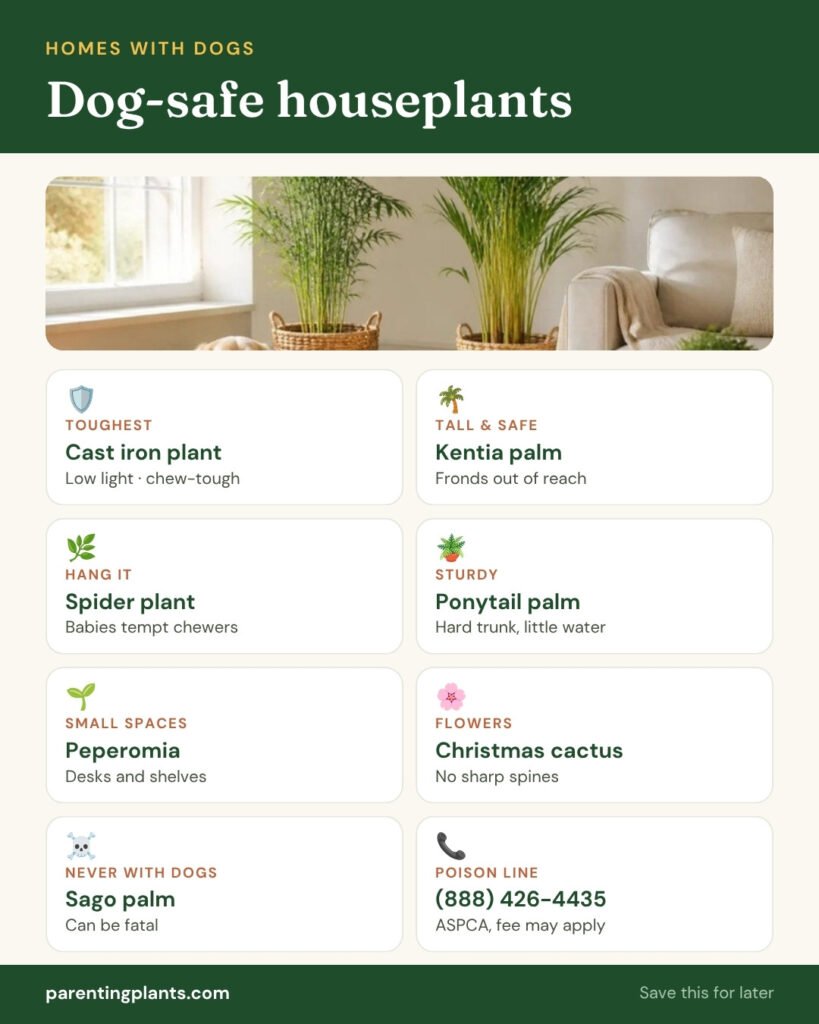
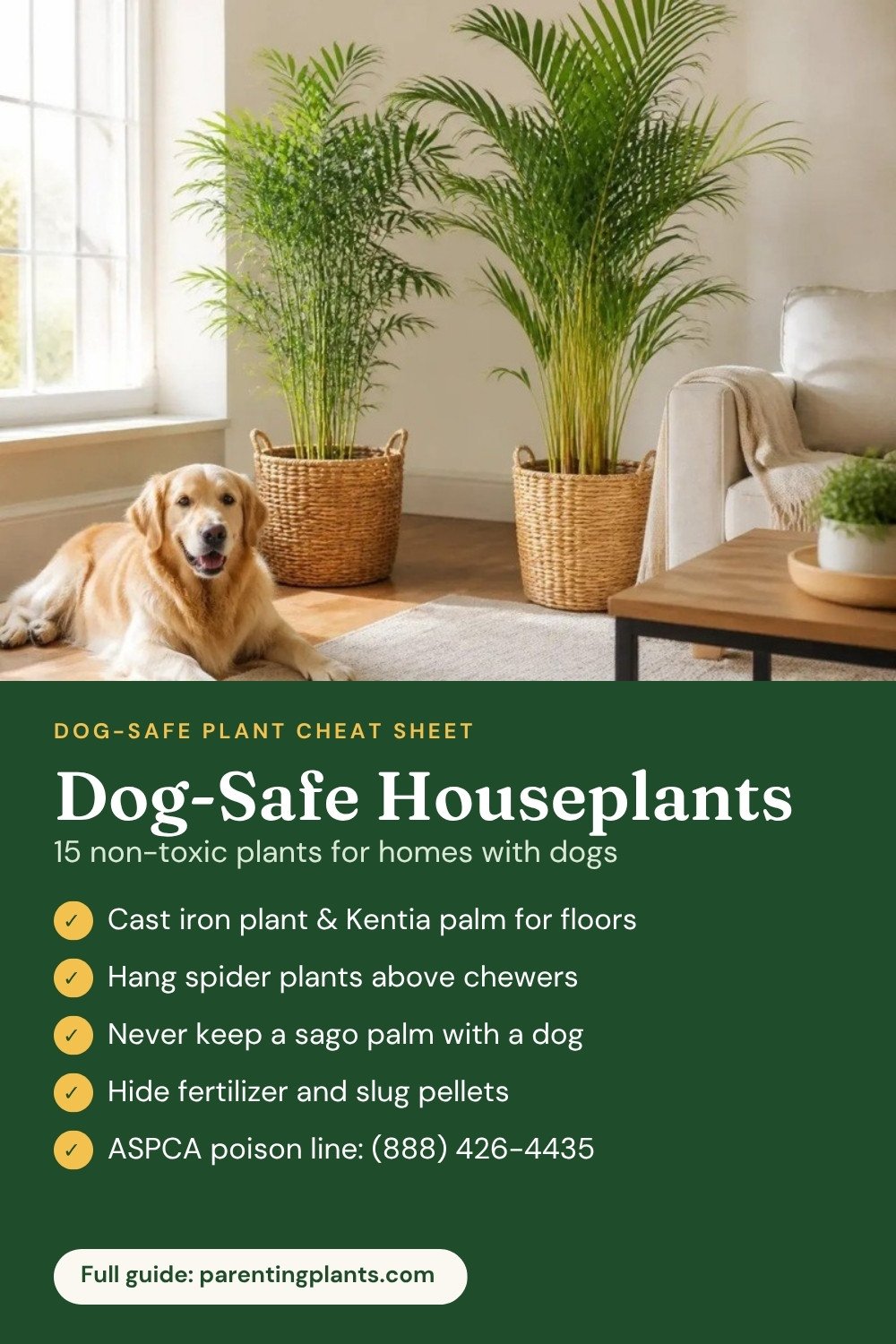
Save this for later: pin the cheat sheet below to your Pinterest plant board.
Want every plant’s care on one page?
The Houseplant Care Cards give you 30 printable one-page guides for popular houseplants: light, water, pet safety and quick fixes at a glance.
Dog-safe houseplants FAQ
What houseplants are safe for dogs?
Spider plant, Boston fern, parlor palm, areca palm, Kentia palm, cast iron plant, calathea, prayer plant, ponytail palm, money tree, peperomia, bird’s nest fern, Christmas cactus, African violet, hoya and moth orchids are listed as non-toxic to dogs by the ASPCA.
What is the most dangerous houseplant for dogs?
The sago palm. All parts, especially the seeds, can cause liver failure in dogs, and it is often fatal. Call your vet immediately if your dog chews one.
Is pothos toxic to dogs?
Yes. Pothos contains calcium oxalate crystals that cause mouth pain, drooling, pawing at the mouth and vomiting. It is rarely life-threatening but should be kept out of reach.
Is snake plant safe for dogs?
No. Snake plant is listed as toxic to dogs and can cause nausea, vomiting and diarrhoea, though symptoms are usually mild.
Why does my dog eat my plants?
Usually boredom, teething, curiosity or the smell of fertilizer in the soil. More exercise, chew toys and moving plants out of reach usually solve it.
Are spider plants safe for dogs?
Yes. Spider plants are listed as non-toxic to dogs by the ASPCA. Eating a lot can still cause mild stomach upset.
What should I do if my dog ate a toxic plant?
Remove any leaves from its mouth, identify the plant, and call your vet or the ASPCA Animal Poison Control Center on (888) 426-4435. Do not make your dog vomit unless a vet advises it.
Sources and further reading
This guide was written by Manik at Parenting Plants and checked against the expert and university resources below. Read how we research and update our guides in our editorial guidelines.
- ASPCA: Toxic and non-toxic plants list
- ASPCA: These houseplants can cause trouble for your pets
- Pet Poison Helpline: Poison control for dogs and cats
- Penn State Extension: Palms as houseplants
- NC State Extension: Aspidistra elatior (cast iron plant)
Looking for a specific plant? Browse all our houseplant care guides A to Z.
Free tracker
Get the free Plant Care Tracker
A ready-made plant care tracker for Google Sheets and Notion that shows exactly which plants need water today, with 90 houseplants built in.
You're in!
Check your inbox, plant friend! 📩
Your free Plant Care Tracker is on its way. We've emailed you both versions, Google Sheets and Notion, plus a bonus printable 2027 plant calendar. It usually arrives within a few minutes.
Can't find it? Check your Promotions or Spam folder, and add manik@parentingplants.com to your contacts so you never miss a plant tip.