Special Offer: Use code ILOVEPLANTS for 25% off on all digital products! Shop Now →

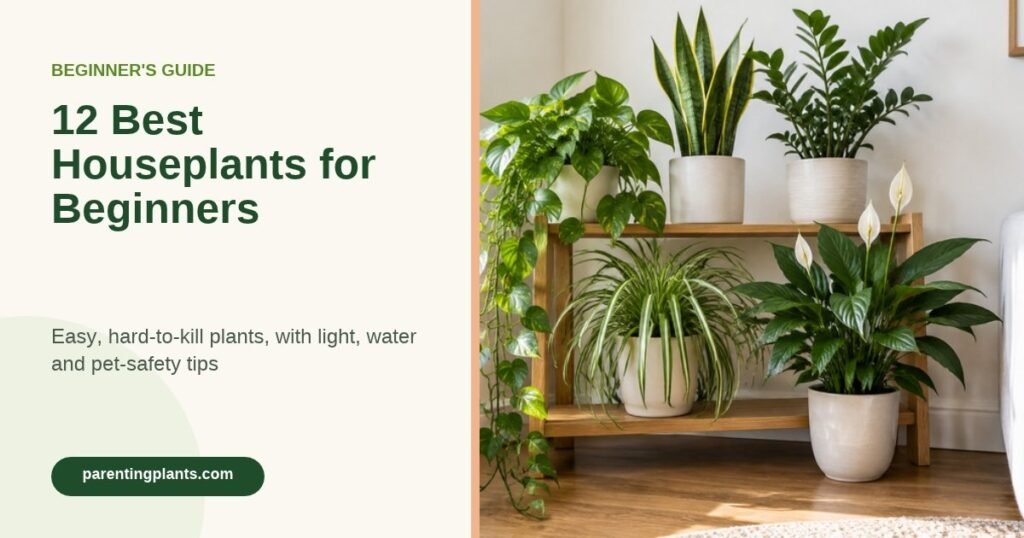
The best houseplants for beginners are the ones that forgive the usual first mistakes: a missed watering, a dim corner, a week away. This list sticks to plants that are genuinely hard to kill, tells you which ones are safe for pets, and shows you how to keep a new plant alive through its first month.
Short answer: The easiest houseplants for beginners are pothos, snake plant, ZZ plant, spider plant and peace lily. They handle missed waterings and average indoor light. For a sunny windowsill, choose a jade plant or aloe vera. If you have cats or dogs, the easiest pet-safe options are spider plant, cast iron plant and parlor palm.
In this guide
The 12 easiest houseplants at a glance
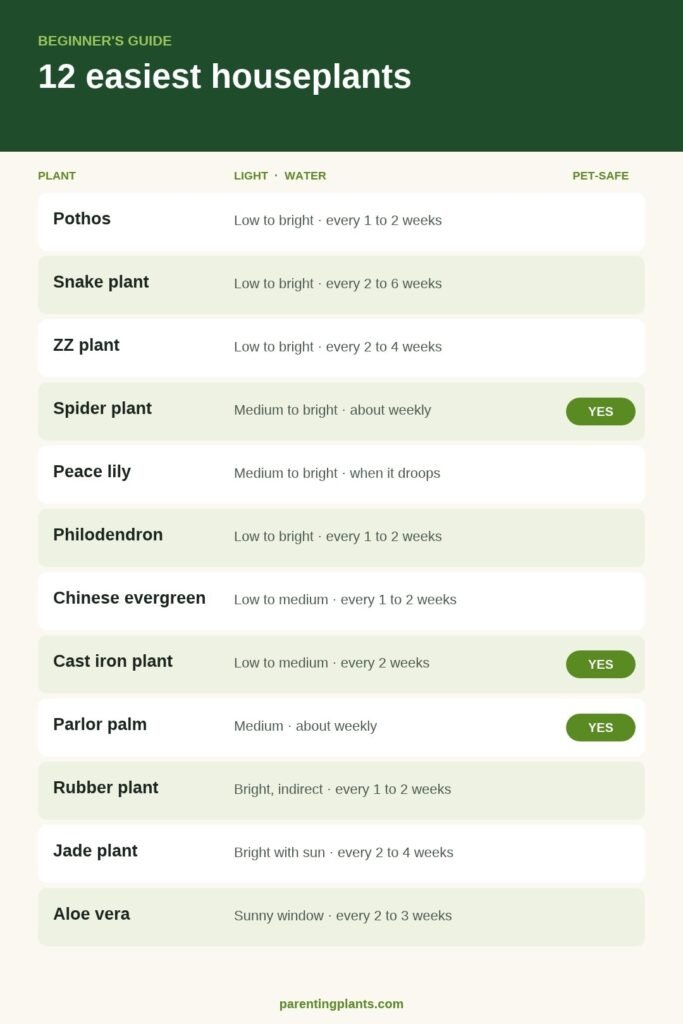
| Plant | Light | Water | Pet-safe? |
|---|---|---|---|
| Pothos | Low to bright | Every 1 to 2 weeks | No |
| Snake plant | Low to bright | Every 2 to 6 weeks | No |
| ZZ plant | Low to bright | Every 2 to 4 weeks | No |
| Spider plant | Medium to bright | About weekly | Yes |
| Peace lily | Medium to bright | When it starts to droop | No |
| Heartleaf philodendron | Low to bright | Every 1 to 2 weeks | No |
| Chinese evergreen | Low to medium | Every 1 to 2 weeks | No |
| Cast iron plant | Low to medium | Every 2 weeks | Yes |
| Parlor palm | Medium | About weekly | Yes |
| Rubber plant | Bright, indirect | Every 1 to 2 weeks | No (mild) |
| Jade plant | Bright with sun | Every 2 to 4 weeks | No |
| Aloe vera | Full sun window | Every 2 to 3 weeks | No |
What makes a houseplant beginner-friendly?
Every plant on this list passes four tests:
- Forgives missed waterings. It stores water in leaves, stems or roots, so a late drink won’t kill it.
- Copes with normal indoor light. Most do fine a few feet from a window. Only jade and aloe need a sunny sill.
- Handles dry home air. No humidifier needed.
- Tells you what it needs. Drooping, wrinkling or pale growth give clear, early warning signs.
We left out popular but fussier plants like calatheas, fiddle leaf figs and ferns. They are lovely, but better as your second or third plant.
12 best houseplants for beginners
1. Pothos (Epipremnum aureum)
The classic first houseplant. Pothos trails or climbs, grows fast and shows you clearly when it needs water by drooping slightly, then perks up within hours of a drink.
- Light: Low to bright, indirect light. Variegated types keep their color best in brighter spots.
- Water: When the top 1 to 2 inches are dry, about every 1 to 2 weeks.
- Pets: Toxic to cats and dogs.
- Beginner tip: Snip long vines and root them in water to make new plants for free.
2. Snake plant (Dracaena trifasciata)
Almost impossible to kill unless you drown it. Its stiff, upright leaves store water, so it is perfect for forgetful owners and frequent travelers.
- Light: Low to bright, indirect light.
- Water: Only when the soil is completely dry, every 2 to 6 weeks.
- Pets: Toxic to cats and dogs.
- Beginner tip: Use cactus mix and a pot with a drainage hole.
Full care: snake plant care guide
3. ZZ plant (Zamioculcas zamiifolia)
Glossy, architectural leaves that look good even in an office corner. Underground rhizomes store water, so it handles weeks of neglect.
- Light: Low to bright, indirect light; grows faster in brighter spots.
- Water: When the soil is completely dry, every 2 to 4 weeks.
- Pets: Toxic to cats and dogs.
- Beginner tip: Yellow leaves almost always mean too much water.
Full care: ZZ plant care guide
4. Spider plant (Chlorophytum comosum)
Cheerful, fast-growing and one of the few easy plants that is safe for pets. It produces baby plantlets you can pot up and share.
- Light: Bright, indirect light; tolerates medium light.
- Water: When the top inch is dry, about once a week.
- Pets: Non-toxic to cats and dogs (ASPCA).
- Beginner tip: Brown tips are usually tap-water salts, not a sign of dying.
Full care: spider plant care guide
5. Peace lily (Spathiphyllum)
The plant that tells you when it is thirsty: it droops dramatically, then stands back up within hours of watering. It also flowers indoors.
- Light: Medium to bright, indirect light; flowers less in low light.
- Water: When the top inch is dry or the leaves just start to droop.
- Pets: Toxic to cats and dogs.
- Beginner tip: Never let it sit in water; droop plus wet soil means overwatering.
Full care: peace lily care guide
6. Heartleaf philodendron (Philodendron hederaceum)
Soft, heart-shaped leaves on trailing vines. Very similar to pothos in care, and just as forgiving.
- Light: Low to bright, indirect light.
- Water: When the top 1 to 2 inches are dry.
- Pets: Toxic to cats and dogs.
- Beginner tip: Pinch the tips to keep it bushy instead of leggy.
7. Chinese evergreen (Aglaonema)
Patterned leaves in green, silver, pink or red, and a real tolerance for lower light and dry air. Slow-growing and tidy.
- Light: Low to medium, indirect light; colorful types prefer brighter light.
- Water: When the top 1 to 2 inches are dry.
- Pets: Toxic to cats and dogs.
- Beginner tip: Keep it warm (above 60°F) and away from cold windows in winter.
8. Cast iron plant (Aspidistra elatior)
Named for how tough it is. It handles deep shade, cool rooms and irregular watering better than almost anything else.
- Light: Low to medium, indirect light; avoid direct sun.
- Water: When the top 2 inches are dry.
- Pets: Non-toxic to cats and dogs (ASPCA).
- Beginner tip: It grows slowly, so buy the size you want.
9. Parlor palm (Chamaedorea elegans)
A soft, feathery palm that brings a tropical look to medium-light rooms, and is safe for pets.
- Light: Medium, indirect light; tolerates lower light.
- Water: When the top inch is dry; keep evenly moist but never soggy.
- Pets: Non-toxic to cats and dogs (ASPCA).
- Beginner tip: Brown tips usually mean dry air or uneven watering.
10. Rubber plant (Ficus elastica)
Big, glossy leaves on a plant that grows into an indoor tree. Easy once it has a bright spot it can stay in.
- Light: Bright, indirect light.
- Water: When the top 1 to 2 inches are dry.
- Pets: Mildly toxic: the milky sap irritates.
- Beginner tip: Don’t move it around; sudden changes cause leaf drop.
Full care: rubber plant care guide
11. Jade plant (Crassula ovata)
A long-lived succulent with thick leaves and a woody trunk. Perfect for a sunny windowsill and owners who forget to water.
- Light: Bright light with some direct sun.
- Water: Only when the soil is completely dry, every 2 to 4 weeks.
- Pets: Toxic to cats and dogs (ASPCA).
- Beginner tip: Soft, mushy leaves mean too much water.
Full care: jade plant care guide
12. Aloe vera (Aloe vera)
A useful, sculptural succulent that thrives on neglect and makes pups you can share.
- Light: Your sunniest window, 6+ hours of light.
- Water: Only when the soil is completely dry, every 2 to 3 weeks.
- Pets: Toxic to cats and dogs (ASPCA).
- Beginner tip: Floppy leaves mean it needs more light.
Full care: aloe vera care guide
Which beginner plant suits your home?
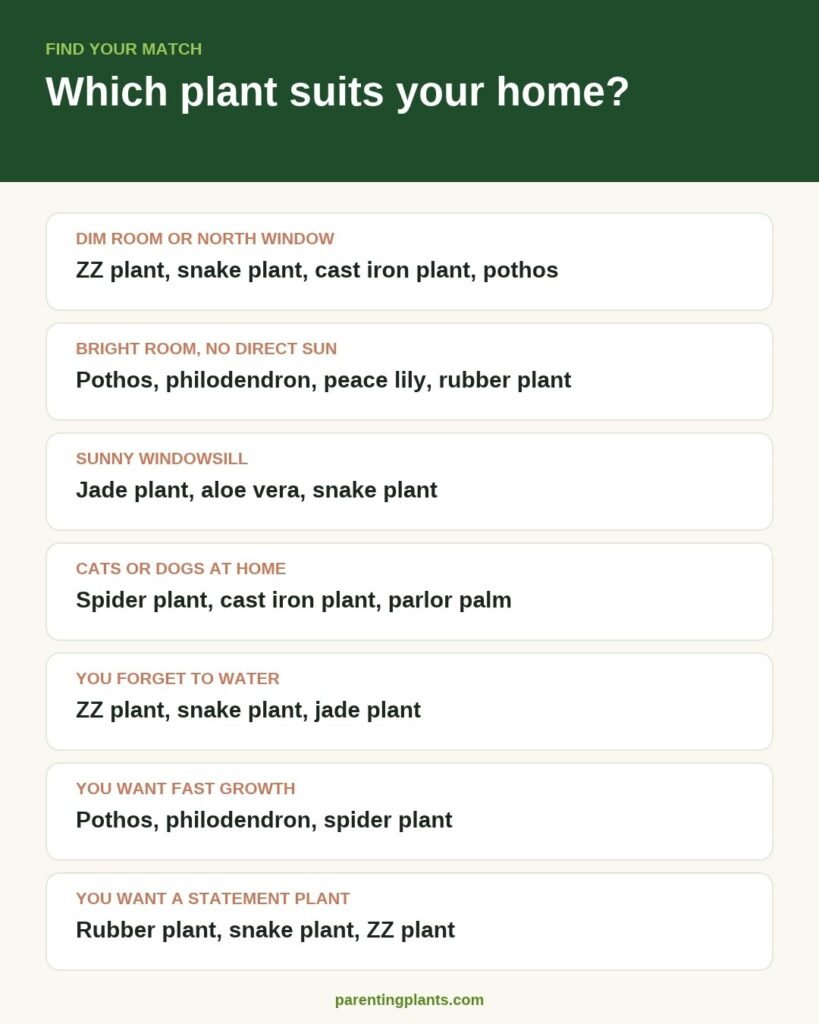
| Your situation | Best choices |
|---|---|
| Dim room or north window | ZZ plant, snake plant, cast iron plant, pothos |
| Bright room, no direct sun | Pothos, philodendron, peace lily, rubber plant, spider plant |
| Sunny south or west windowsill | Jade plant, aloe vera, snake plant |
| Cats or dogs at home | Spider plant, cast iron plant, parlor palm |
| You travel or forget to water | ZZ plant, snake plant, jade plant |
| You want fast results | Pothos, philodendron, spider plant |
| You want a statement plant | Rubber plant, snake plant, ZZ plant |
Not sure how bright your room is? Our lighting guide shows how to read your windows.
Your first month: how to keep a new plant alive
- Check for pests before it comes home. Look under leaves and in stem joints. Keep a new plant away from your others for 2 weeks.
- Pick its spot and leave it there. Plants drop a leaf or two after a move. That is normal; moving it again makes it worse.
- Don’t repot straight away. Wait a few weeks unless it is badly root-bound or sitting in soggy soil.
- Check the pot has a drainage hole. If the decorative pot has none, keep the plant in its plastic pot inside it and empty out extra water.
- Water by feel, not by schedule. Push a finger into the soil before every watering.
- Hold off on fertilizer for the first 1 to 2 months. Shop plants usually have plenty of food in the soil.
The golden rule: more beginner plants die from too much water than too little. When in doubt, wait a few days.
5 beginner mistakes to avoid
- Watering on a fixed schedule. Soil dries at different speeds in summer and winter. See our watering guide.
- Pots without drainage holes. Water collects at the bottom and rots the roots. See our root rot guide.
- Putting low-light plants in a dark corner. ‘Low light’ still means a window in the room.
- Moving plants around. Find a good spot and stick with it.
- Panicking over one yellow leaf. Older leaves yellow naturally. Worry when several turn at once; our yellow leaves guide explains why.
Ready to shop? Our houseplant supplies guide lists the few tools you actually need.
Quick action checklist
- Match the plant to your light before you buy
- Choose pet-safe plants if you have cats or dogs
- Use a pot with a drainage hole
- Check the soil before every watering
- Keep new plants in one spot and away from others for 2 weeks
- Skip fertilizer for the first 1 to 2 months
Bought your first plant and something already looks wrong?
The Houseplant Rescue Guide matches 26 common plant problems to a clear photo, then gives you simple steps to fix each one and stop it coming back. No jargon, 50 pages, with printable checklists.
Beginner houseplants FAQ
What is the easiest houseplant to keep alive?
The snake plant and ZZ plant are the hardest to kill. Both store water, tolerate low light and only need watering every few weeks.
What is the best low-light houseplant for beginners?
ZZ plant, snake plant, cast iron plant and pothos all cope with low light, as long as the room still has a window.
Which beginner houseplants are safe for cats and dogs?
Spider plant, cast iron plant and parlor palm are easy to grow and listed as non-toxic to cats and dogs by the ASPCA.
How often should I water a beginner houseplant?
Water when the soil is dry to the right depth for that plant, not on a schedule. Most tropical plants need water when the top 1 to 2 inches are dry; succulents when the soil is dry all the way down.
Should I repot a plant right after buying it?
Usually no. Let it settle for a few weeks first. Repot sooner only if it is badly root-bound or the soil stays soggy.
Why is my new houseplant dropping leaves?
A leaf or two dropping after a move is normal stress. Keep it in one spot, avoid overwatering and it should settle within a few weeks.
Sources and further reading
Want to go deeper? These university extension and expert resources cover the same topic:
- Iowa State University Extension: Easy low-maintenance houseplants
- University of Illinois Extension: Getting started with houseplants
- ASPCA: Toxic and non-toxic plants list