Special Offer: Use code ILOVEPLANTS for 25% off on all digital products! Shop Now →

Walk into any garden center and you will see hundreds of houseplants, many with confusing names. The good news: almost all of them fall into a handful of groups, and plants in the same group need roughly the same care. Learn the groups, match them to the light in your home, and choosing (and keeping alive) a new plant becomes much easier.
Short answer: Houseplants fall into six main types: trailing and climbing plants (like pothos), upright statement plants (like snake plant and monstera), patterned-leaf plants (like Chinese evergreen), succulents and cacti (like jade and aloe), flowering plants (like peace lily and orchids) and palms and ferns. For beginners, the easiest varieties are pothos, snake plant, ZZ plant, spider plant and heartleaf philodendron. Always choose by the light you have first, then by looks.
In this guide
The 6 main types of houseplants

| Type | What they are like | Best for |
|---|---|---|
| Trailing and climbing | Long vines; fast-growing; easy to propagate | Shelves, hanging baskets, moss poles |
| Upright and statement | Height and big leaves; some are very tough | Floors and corners |
| Patterned leaves | Colorful, striped or spotted foliage; often compact | Desks, tables, shelves |
| Succulents and cacti | Store water; need sun and very little watering | Sunny windowsills; forgetful waterers |
| Flowering | Grown for blooms; usually need more light | Bright rooms; adding color |
| Palms, ferns and others | Soft, leafy texture; ferns like humidity | Bathrooms, living rooms, adding softness |
All 33 varieties at a glance
Use this table to shortlist plants, then read the notes below. Difficulty assumes you give the plant the light it needs.
| Variety | Light | Difficulty | Pets |
|---|---|---|---|
| Pothos | Low to bright, indirect | Easy | Toxic |
| Heartleaf philodendron | Low to bright, indirect | Easy | Toxic |
| Hoya (wax plant) | Bright, indirect; some gentle sun | Easy | Safe |
| Tradescantia (inch plant) | Bright, indirect | Easy | Toxic |
| String of pearls | Bright light, some direct sun | Needs more care | Toxic |
| Snake plant | Low to bright | Easy | Toxic |
| ZZ plant | Low to bright, indirect | Easy | Toxic |
| Monstera | Bright, indirect | Easy | Toxic |
| Rubber plant | Bright, indirect | Easy | Toxic |
| Dracaena | Medium to bright, indirect | Easy | Toxic |
| Fiddle leaf fig | Very bright, some direct sun | Needs more care | Toxic |
| Bird of paradise | Very bright, direct sun | Medium | Toxic |
| Chinese evergreen | Low to medium, indirect | Easy | Toxic |
| Peperomia | Medium to bright, indirect | Easy | Safe |
| Prayer plant | Medium, indirect | Medium | Safe |
| Calathea | Medium, indirect | Needs more care | Safe |
| Polka dot plant | Bright, indirect | Medium | Safe |
| Jade plant | Bright, with direct sun | Easy | Toxic |
| Aloe vera | Bright, with direct sun | Easy | Toxic |
| Haworthia (zebra plant) | Bright, indirect to some sun | Easy | Safe |
| Echeveria | Bright, direct sun | Medium | Safe |
| Christmas cactus | Bright, indirect | Easy | Safe |
| Peace lily | Low to medium, indirect | Easy | Toxic |
| Moth orchid | Bright, indirect | Medium | Safe |
| Anthurium | Bright, indirect | Medium | Toxic |
| African violet | Bright, indirect | Medium | Safe |
| Bromeliad | Bright, indirect | Easy | Safe |
| Spider plant | Medium to bright, indirect | Easy | Safe |
| Parlor palm | Low to medium, indirect | Easy | Safe |
| Boston fern | Medium to bright, indirect | Needs more care | Safe |
| Bird’s nest fern | Medium, indirect | Easy | Safe |
| Lucky bamboo | Low to medium, indirect | Easy | Toxic |
| Air plant | Bright, indirect | Medium | Likely safe |
Pet safety is based on the ASPCA toxic and non-toxic plant list. If you have cats or dogs, see our full list of pet-friendly houseplants.
Trailing and climbing plants
Vines that spill over shelves, hang from baskets or climb a moss pole. Most grow fast, so you see results quickly, and you can root the cuttings to make more plants.
Pothos
Epipremnum aureum. The classic starter plant. Heart-shaped leaves in green, gold or marbled white, and it grows almost anywhere except full darkness. It droops when thirsty and perks up within hours of watering.
- Light: Low to bright, indirect
- Water: When the top 1 to 2 inches are dry
- Difficulty: Easy
- Pets: Toxic to pets
- Full care: see our pothos care guide
Heartleaf philodendron
Philodendron hederaceum. Softer, thinner leaves than pothos and just as easy. Copes well with lower light and roots easily in water.
- Light: Low to bright, indirect
- Water: When the top inch is dry
- Difficulty: Easy
- Pets: Toxic to pets
- Full care: see our philodendron care guide
Hoya (wax plant)
Hoya carnosa and relatives. Thick, waxy leaves on long vines, and mature plants produce clusters of sweet-scented, star-shaped flowers. Leave the old flower stalks on, because new blooms grow from them.
- Light: Bright, indirect; some gentle sun
- Water: When the soil is mostly dry
- Difficulty: Easy
- Pets: Pet-safe
- Full care: see our hoya care guide
Tradescantia (inch plant)
Tradescantia zebrina, T. fluminensis. Fast-growing trailer with purple, silver or pink striped leaves. Needs brighter light to keep its color and benefits from regular pinching to stay full.
- Light: Bright, indirect
- Water: Keep lightly moist
- Difficulty: Easy
- Pets: Toxic to pets
String of pearls
Curio rowleyanus (Senecio). A succulent with bead-like leaves on thin trailing stems. Beautiful but fussier than it looks: it wants bright light and rots quickly if overwatered.
- Light: Bright light, some direct sun
- Water: When the soil is completely dry
- Difficulty: Needs more care
- Pets: Toxic to pets
Upright and statement plants
Plants with height and presence for a floor or corner. Some, like the snake plant and ZZ plant, are nearly indestructible; others, like the fiddle leaf fig, reward a bright, steady spot.
Snake plant
Dracaena trifasciata (Sansevieria). Stiff, upright leaves that tolerate low light, dry air and weeks without water. Overwatering is the only real way to kill it.
- Light: Low to bright
- Water: When the soil is completely dry
- Difficulty: Easy
- Pets: Toxic to pets
- Full care: see our snake plant care guide
ZZ plant
Zamioculcas zamiifolia. Glossy leaves on thick stems that store water in underground rhizomes. One of the best plants for dim rooms and forgetful waterers.
- Light: Low to bright, indirect
- Water: Every 2 to 4 weeks, when completely dry
- Difficulty: Easy
- Pets: Toxic to pets
- Full care: see our ZZ plant care guide
Monstera
Monstera deliciosa. The famous split-leaf plant. Grows big and fast in good light, and the holes (fenestrations) appear as the plant matures. Give it a moss pole to climb.
- Light: Bright, indirect
- Water: When the top 2 inches are dry
- Difficulty: Easy
- Pets: Toxic to pets
- Full care: see our monstera care guide
Rubber plant
Ficus elastica. Thick, glossy leaves in dark green, burgundy or variegated pink. Forgiving, and pruning makes it branch into a fuller tree.
- Light: Bright, indirect
- Water: When the top 1 to 2 inches are dry
- Difficulty: Easy
- Pets: Toxic to pets
- Full care: see our rubber plant care guide
Dracaena
Dracaena fragrans, D. marginata and others. Corn plant, dragon tree and ‘Janet Craig’ form slim trees with strappy leaves. Tolerant of lower light; use filtered water if the tips brown.
- Light: Medium to bright, indirect
- Water: When the top 1 to 2 inches are dry
- Difficulty: Easy
- Pets: Toxic to pets
Fiddle leaf fig
Ficus lyrata. Huge, violin-shaped leaves and a reputation for drama. It needs very bright light, steady watering and to be left in one spot; moving it often causes leaf drop.
- Light: Very bright, some direct sun
- Water: When the top 2 inches are dry
- Difficulty: Needs more care
- Pets: Toxic to pets
- Full care: see our fiddle leaf fig care guide
Bird of paradise
Strelitzia nicolai, S. reginae. Large, banana-like leaves that bring a tropical look. Needs your brightest spot, ideally with some direct sun, to grow well indoors.
- Light: Very bright, direct sun
- Water: When the top 2 inches are dry
- Difficulty: Medium
- Pets: Toxic to pets
- Full care: see our bird of paradise care guide
Plants with patterned or colorful leaves
Grown for their leaf markings rather than flowers. Many are naturally compact, which makes them great for desks and shelves.
Chinese evergreen
Aglaonema. Silver, pink or red patterned leaves and a very forgiving nature. Dark green types handle low light; colorful ones need more.
- Light: Low to medium, indirect
- Water: When the top inch is dry
- Difficulty: Easy
- Pets: Toxic to pets
Peperomia
Peperomia obtusifolia, P. argyreia and others. A big family of small, thick-leaved plants, from the round ‘baby rubber plant’ to striped watermelon peperomia. Compact and tolerant of missed waterings.
- Light: Medium to bright, indirect
- Water: When the top half of the soil is dry
- Difficulty: Easy
- Pets: Pet-safe
Prayer plant
Maranta leuconeura. Painted leaves that fold up at night like hands in prayer. Likes evenly moist soil, humidity and no direct sun.
- Light: Medium, indirect
- Water: Keep lightly moist
- Difficulty: Medium
- Pets: Pet-safe
Calathea
Goeppertia (Calathea) species. Some of the most striking leaves of any houseplant, but sensitive: crispy edges appear with dry air, tap water or uneven watering.
- Light: Medium, indirect
- Water: Keep evenly moist; use filtered water
- Difficulty: Needs more care
- Pets: Pet-safe
- Full care: see our calathea care guide
Polka dot plant
Hypoestes phyllostachya. Small leaves splashed with pink, red or white. Fast-growing and cheerful; pinch the tips to keep it bushy.
- Light: Bright, indirect
- Water: Keep lightly moist
- Difficulty: Medium
- Pets: Pet-safe
Succulents and cacti
Plants that store water in thick leaves or stems. They need a bright, sunny window and very little water, which makes them ideal for people who travel or forget to water, and a poor choice for dim rooms.
Jade plant
Crassula ovata. Thick, glossy leaves on a woody trunk that slowly becomes a miniature tree. Can live for decades.
- Light: Bright, with direct sun
- Water: When the soil is completely dry
- Difficulty: Easy
- Pets: Toxic to pets
- Full care: see our jade plant care guide
Aloe vera
Aloe vera. Spiky, upright rosettes that produce baby plants (pups) you can pot up. Needs your sunniest window to stay firm and upright.
- Light: Bright, with direct sun
- Water: When the soil is completely dry
- Difficulty: Easy
- Pets: Toxic to pets
- Full care: see our aloe vera care guide
Haworthia (zebra plant)
Haworthiopsis attenuata and relatives. A small, striped succulent that, unlike most, tolerates a bit less light. Perfect for a windowsill or desk.
- Light: Bright, indirect to some sun
- Water: When the soil is completely dry
- Difficulty: Easy
- Pets: Pet-safe
Echeveria
Echeveria species. Rosettes shaped like roses, in blue, pink, purple or green. Beautiful but needs strong sun indoors or it stretches and loses color.
- Light: Bright, direct sun
- Water: When the soil is completely dry
- Difficulty: Medium
- Pets: Pet-safe
Christmas cactus
Schlumbergera. A forest cactus with flat, segmented stems that flowers in winter. Unlike desert cacti, it likes a little more water and no harsh sun.
- Light: Bright, indirect
- Water: When the top inch is dry
- Difficulty: Easy
- Pets: Pet-safe
Flowering houseplants
Plants you grow for blooms as well as leaves. Most need more light than foliage plants to flower well, and some need a seasonal change to bloom again.
Peace lily
Spathiphyllum. White, sail-like flowers and glossy leaves. Tolerates lower light (with fewer flowers) and droops clearly when it needs water.
- Light: Low to medium, indirect
- Water: When the top inch is dry or it starts to droop
- Difficulty: Easy
- Pets: Toxic to pets
- Full care: see our peace lily care guide
Moth orchid
Phalaenopsis. The supermarket orchid, and the easiest one to keep. Flowers last for months, and it grows in bark, not soil.
- Light: Bright, indirect
- Water: About weekly, when the bark is nearly dry
- Difficulty: Medium
- Pets: Pet-safe
- Full care: see our orchid care guide
Anthurium
Anthurium andraeanum. Glossy, heart-shaped red, pink or white ‘flowers’ (actually spathes) that last for weeks. Blooms nearly all year in bright, indirect light.
- Light: Bright, indirect
- Water: When the top inch is dry
- Difficulty: Medium
- Pets: Toxic to pets
African violet
Saintpaulia (Streptocarpus sect. Saintpaulia). Small, fuzzy-leaved plants that flower again and again. Water from below with room-temperature water, since cold water spots the leaves.
- Light: Bright, indirect
- Water: Keep lightly moist; water from below
- Difficulty: Medium
- Pets: Pet-safe
Bromeliad
Guzmania, Vriesea, Aechmea and others. Bold, colorful flower spikes that last for months. Each rosette flowers once, then produces pups that will flower in time.
- Light: Bright, indirect
- Water: Keep soil just moist; a little water in the central cup
- Difficulty: Easy
- Pets: Pet-safe
Palms, ferns and other favorites
Soft, leafy plants that add texture, plus a few beginner favorites that don’t fit neatly anywhere else.
Spider plant
Chlorophytum comosum. Arching striped leaves and dangling baby plants that root in days. Tough, fast and one of the best pet-safe choices.
- Light: Medium to bright, indirect
- Water: When the top inch is dry
- Difficulty: Easy
- Pets: Pet-safe
- Full care: see our spider plant care guide
Parlor palm
Chamaedorea elegans. A small, feathery palm that, unlike most palms, is happy away from the window.
- Light: Low to medium, indirect
- Water: When the top inch is dry
- Difficulty: Easy
- Pets: Pet-safe
Boston fern
Nephrolepis exaltata. Lush, arching fronds that look stunning in a hanging basket. Needs humidity and never dries out completely, or it sheds leaflets everywhere.
- Light: Medium to bright, indirect
- Water: Keep evenly moist
- Difficulty: Needs more care
- Pets: Pet-safe
- Full care: see our Boston fern care guide
Bird’s nest fern
Asplenium nidus. Wavy, bright green fronds that grow from a central ‘nest’. Much easier than most ferns and fine in medium light.
- Light: Medium, indirect
- Water: When the top inch is dry; water the soil, not the center
- Difficulty: Easy
- Pets: Pet-safe
Lucky bamboo
Dracaena sanderiana. Not a real bamboo. Grows in water or soil and actually prefers shade, which makes it a great desk plant.
- Light: Low to medium, indirect
- Water: Keep roots covered; change water every 1 to 2 weeks
- Difficulty: Easy
- Pets: Toxic to pets
- Full care: see our lucky bamboo care guide
Air plant
Tillandsia. Grows without soil, attached to wood, shells or a stand. Soak it in water for 20 to 30 minutes every 1 to 2 weeks, then let it dry upside down.
- Light: Bright, indirect
- Water: Soak every 1 to 2 weeks
- Difficulty: Medium
- Pets: Not on the ASPCA list; generally considered safe
How to choose the right variety
The most common beginner mistake is choosing a plant for its looks and then putting it wherever there is space. Work the other way round: find the spot first, then pick a plant that suits it.
- Check the light. Stand where the plant will go at midday and hold your hand a foot above the spot. A sharp shadow means bright light, a soft shadow means medium light, and a faint shadow means low light. Our lighting guide explains this in detail.
- Be honest about watering. If you travel or forget, choose succulents, snake plants or ZZ plants. If you like to water often, ferns, prayer plants and peace lilies will enjoy the attention.
- Think about pets and children. Choose pet-safe varieties for floors and low tables, and keep toxic ones up high.
- Consider size. Monstera, bird of paradise and fiddle leaf fig get big. Peperomia, haworthia and African violets stay small.
- Start with two or three easy plants. Get comfortable with watering and light before adding fussier varieties like calathea or string of pearls.

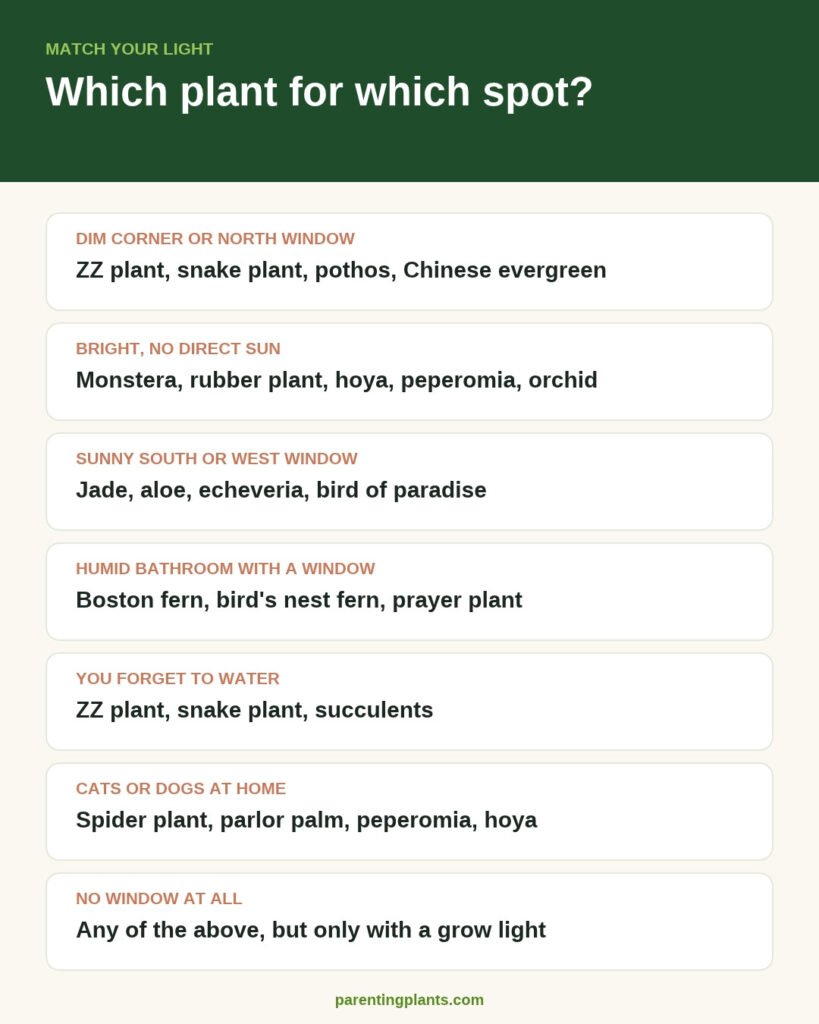
| If your spot is… | Good varieties |
|---|---|
| A dim corner or north window | ZZ plant, snake plant, pothos, heartleaf philodendron, Chinese evergreen, parlor palm |
| Bright, but no direct sun | Monstera, rubber plant, hoya, peperomia, moth orchid, anthurium, spider plant |
| A sunny south or west window | Jade, aloe, echeveria, bird of paradise, fiddle leaf fig, string of pearls |
| A humid bathroom with a window | Boston fern, bird’s nest fern, prayer plant, calathea, pothos |
New to plants? Start with our list of the best houseplants for beginners, or if your home is dark, our best low-light houseplants.
Common names vs botanical names
One plant can have several common names, and one common name can be used for completely different plants. ‘Zebra plant’, for example, is used for both a haworthia succulent and an aphelandra, which need very different care. That is why plant labels and this guide also give the botanical (Latin) name.
- When you search for care advice, use the botanical name for accurate results.
- Botanical names sometimes change as scientists reclassify plants. Snake plant moved from Sansevieria to Dracaena, and calatheas are now mostly Goeppertia, but shops still use the old names.
- Check pet safety by botanical name too, since lists such as the ASPCA’s use them.
What to check before you buy
- Leaves: firm, evenly colored and free of yellow patches, brown spots or holes.
- Pests: look under leaves and where leaves join stems for webbing, sticky residue, white cotton-like fluff or tiny moving dots.
- New growth: fresh leaves or buds are a sign of a healthy, actively growing plant.
- Soil: should not smell sour or be soggy, and should not have mushroom-like growths or a cloud of tiny flies (fungus gnats).
- Roots: a few roots poking out of the bottom is fine; a solid mat of roots means the plant needs repotting soon.
- Label: make sure it includes the plant’s name, so you can look up the right care.
Spotted something on a plant you already own? Our guides to houseplant pests and fungus gnats will help.
Your first week with a new plant
- Keep it apart from your other plants for a week or two and check for pests.
- Put it in its permanent spot straight away, and avoid moving it around.
- Don’t repot immediately. Let it settle for a few weeks first, unless it is badly root-bound or the soil is waterlogged. When the time comes, see our repotting guide.
- Water only when needed. Check the soil with your finger rather than watering on a schedule. Our watering guide explains how.
- Expect a leaf or two to yellow. Plants often drop an older leaf as they adjust to a new home. That is normal.
Quick action checklist
- Check the light where the plant will live before you buy
- Pick varieties that match that light and your watering habits
- Choose pet-safe plants if you have cats or dogs
- Note the botanical name so you can look up the right care
- Inspect leaves, soil and roots for pests and problems
- Start with two or three easy plants before trying fussier ones
- Let a new plant settle for a few weeks before repotting
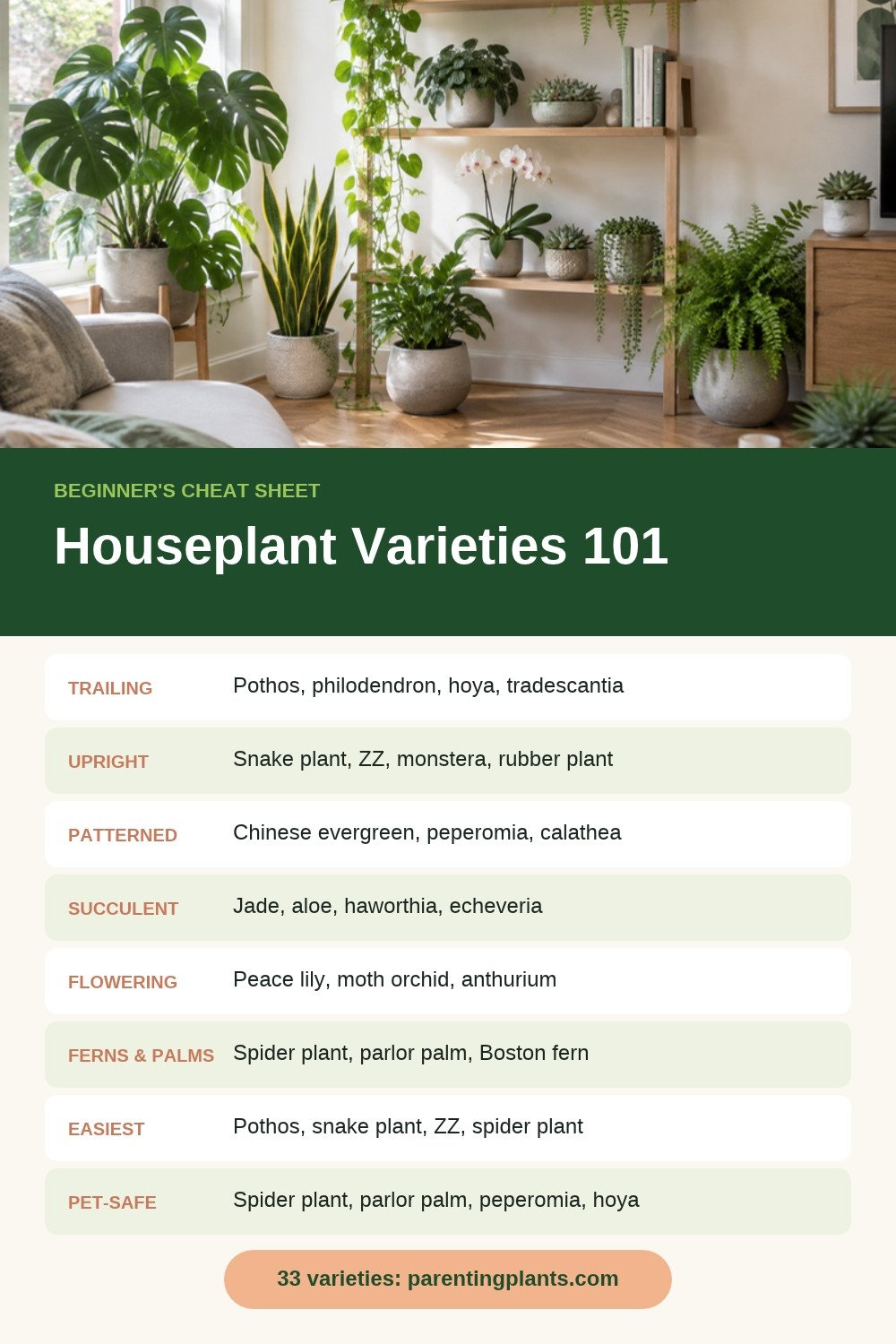
Save this for later: pin the infographic below to your Pinterest plant board.
New plant already looking unhappy?
The Houseplant Rescue Guide matches 26 common plant problems to a clear photo, then gives you simple steps to fix each one and stop it coming back. No jargon, 50 pages, with printable checklists.
Houseplant varieties FAQ
What are the main types of houseplants?
The main groups are trailing and climbing plants, upright statement plants, patterned-leaf plants, succulents and cacti, flowering plants, and palms and ferns. Plants in the same group usually need similar care.
What is the easiest houseplant variety for beginners?
Pothos, snake plant, ZZ plant, spider plant and heartleaf philodendron are the easiest. They tolerate a range of light and forgive missed waterings.
Which houseplant varieties are safe for cats and dogs?
Spider plant, parlor palm, Boston fern, bird’s nest fern, peperomia, hoya, prayer plant, calathea, African violet, moth orchid, bromeliad, haworthia and Christmas cactus are listed as non-toxic by the ASPCA.
Which houseplants grow well in low light?
ZZ plant, snake plant, pothos, heartleaf philodendron, Chinese evergreen and parlor palm all cope with low light. No plant can grow in complete darkness, though.
Which houseplants need the most sun?
Succulents and cacti such as jade, aloe and echeveria, plus bird of paradise and fiddle leaf fig, need your brightest window with some direct sun.
Why do some plants have more than one name?
Common names vary by region and shop, and the same name is sometimes used for different plants. The botanical (Latin) name identifies the exact plant.
How many houseplants should a beginner start with?
Two or three easy varieties is a good start. It is easier to learn watering and light with a few plants before adding more.
Sources and further reading
Want to go deeper? These university extension and expert resources cover the same topic:
- University of Illinois Extension: Houseplant varieties and light needs
- Clemson Cooperative Extension: Pet-safe indoor houseplants
- Clemson Cooperative Extension: Exciting houseplant selections for beginners
- University of Minnesota Extension: Lighting for indoor plants
- ASPCA: Toxic and non-toxic plants list