Special Offer: Use code ILOVEPLANTS for 25% off on all digital products! Shop Now →

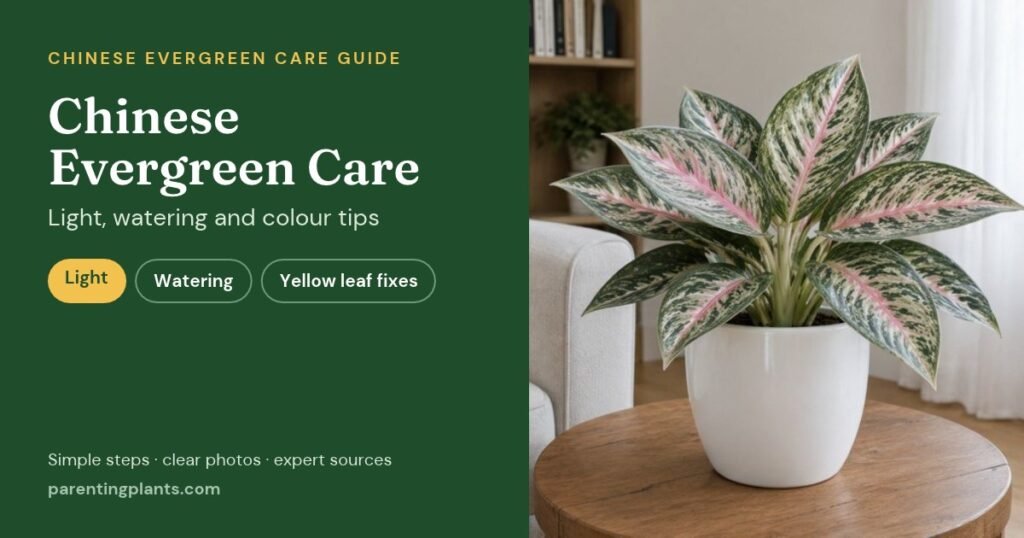
Chinese evergreen (Aglaonema) is one of the most forgiving houseplants you can buy. It copes with dim corners, dry office air and the odd missed watering, and the newer pink, red and silver varieties are some of the most colourful foliage plants around. Most problems come from just two things: too much water and too much cold. This guide shows you how to avoid both, and how to pick the right spot for the variety you own.
Short answer: Give Chinese evergreen medium, indirect light (dark green types cope with low light; pink and red types need brighter light). Water when the top 1 to 2 inches of soil are dry, usually every 7 to 14 days, and never let it sit in water. Keep it above 55°F (13°C) and away from cold windows and drafts. It is toxic to cats and dogs.
In this guide
Chinese evergreen care at a glance
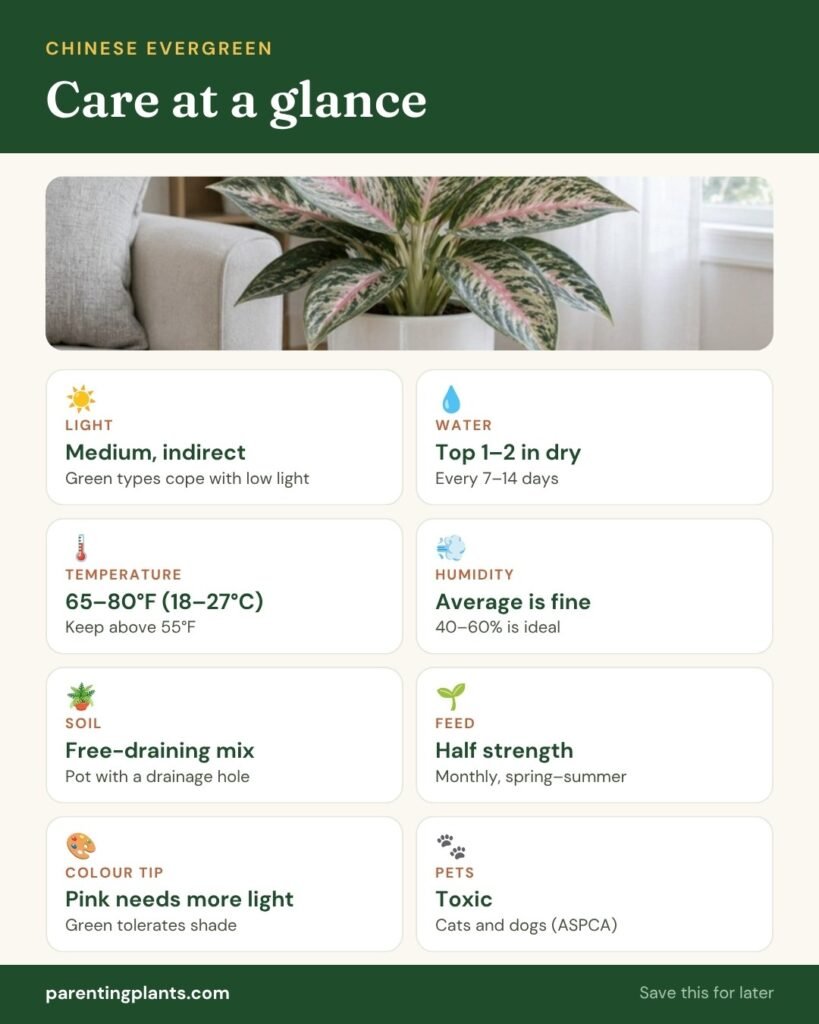
| Need | What it needs |
|---|---|
| Light | Medium, indirect light. Green types tolerate low light; colourful types need brighter light |
| Water | When the top 1 to 2 inches (2.5 to 5 cm) are dry |
| Humidity | Average room humidity is fine; 40 to 60% is ideal |
| Temperature | 65 to 80°F (18 to 27°C); keep above 55°F (13°C) |
| Soil | Free-draining indoor potting mix with perlite or bark |
| Fertilizer | Half-strength feed monthly in spring and summer |
| Growth | Slow to moderate; 1 to 3 ft (30 to 90 cm) tall indoors |
| Pets | Toxic to cats and dogs (ASPCA) |
Free Plant Care Tracker: Never forget to water your Chinese Evergreen again. Get it free →
Popular Chinese evergreen varieties (and the light each needs)
There are dozens of named Aglaonema varieties. The quickest way to care for yours is to look at the colour: the more green in the leaf, the less light it needs.
| Variety | Looks like | Light it needs |
|---|---|---|
| ‘Maria’ | Dark green leaves with grey-green feathering | Low to medium |
| ‘Silver Bay’ | Large leaves with silver centres | Low to medium |
| ‘Silver Queen’ | Narrow silver leaves edged in green | Medium |
| ‘Emerald Beauty’ | Deep green with pale green patches | Low to medium |
| ‘Siam Aurora’ / ‘Red Siam’ | Green leaves with red edges and veins | Medium to bright, indirect |
| ‘Pink Dalmatian’ / ‘Pink Star’ | Green leaves splashed or speckled pink | Medium to bright, indirect |
| ‘Red Valentine’ | Mostly pink-red leaves | Bright, indirect |
Buying for a dim room? Choose a mostly green or silver variety such as ‘Maria’ or ‘Silver Bay’. The pink and red ones lose colour and grow leggy in low light.
How much light does Chinese evergreen need?
In the wild, Aglaonema grows on shaded forest floors, so it never wants hot, direct sun. Indoors, the best spot is a few feet from an east or north window, or well back from a south or west window. Direct afternoon sun bleaches and scorches the leaves.
- Low light: fine for dark green varieties. Growth slows right down, so water less often.
- Medium light: the sweet spot for most varieties; enough light to read comfortably all day.
- Bright, indirect light: best for pink, red and orange varieties to keep their colour.
Signs it needs more light: new leaves come in smaller and greener, stems stretch and lean toward the window, and the soil stays wet for a long time. Rotate the pot a quarter turn every couple of weeks for even growth. Not sure how bright a spot is? Our houseplant lighting guide shows a simple shadow test.
How often to water Chinese evergreen
Water when the top 1 to 2 inches (2.5 to 5 cm) of soil feel dry. Push a finger into the soil to check, then water slowly until it runs from the drainage hole. Empty the saucer after 15 minutes. Chinese evergreen would rather be a little dry than a little soggy.
| Season and spot | Typical watering interval |
|---|---|
| Spring and summer, medium to bright light | Every 7 to 10 days |
| Spring and summer, low light | Every 10 to 14 days |
| Autumn and winter | Every 2 to 3 weeks |
| Just repotted in fresh, damp soil | Wait until the top inch dries, often 2 weeks |
These are starting points, not rules. A small pot in a warm, bright room dries out much faster than a big pot in a cool corner. If your tap water is very hard and you see brown leaf edges, try filtered or rain water. See our watering guide for more on reading your plant.
Humidity and temperature
Chinese evergreen is happy in normal home humidity, which is one reason it is such a popular office plant. If the air is very dry in winter (below about 30%), leaf tips may turn brown; a small humidifier or grouping plants together helps. Misting does little and is not needed.
Cold is the bigger risk. Keep the plant between 65 and 80°F (18 to 27°C). It tolerates brief dips to about 55°F (13°C), but below 50°F (10°C) it can get chilling injury: dull, grey-green or dark patches that later turn brown, often a few days after the cold event. Keep it away from single-glazed windows in winter, outside doors and air-conditioning vents, and never leave it in a cold car on the way home from the shop. More in our temperature guide.
Best soil and pot
Use a light, free-draining mix: 2 parts indoor potting mix to 1 part perlite or fine orchid bark works well. Always use a pot with a drainage hole. Chinese evergreen has a modest root system, so choose a pot only 1 to 2 inches (2.5 to 5 cm) wider than the root ball. Terracotta helps the soil dry faster if you tend to overwater. Our potting soil guide explains the ingredients.
Fertilizing
Feed with a balanced liquid houseplant fertilizer at half strength once a month in spring and summer. Stop in autumn and winter, when growth slows. Too much fertilizer causes brown, burnt leaf edges; if you see white crust on the soil, flush the pot with plain water. Details in our fertilizing guide.
Should you cut off Chinese evergreen flowers?
Mature plants sometimes send up a pale, arum-like flower (a spathe and spadix), followed by red berries. The flowers are harmless, but they use energy the plant could put into leaves. Most growers snip the flower stalk off at the base with clean scissors. Leave it if you enjoy it; it will not hurt the plant either way.
Repotting and pruning
Repot every 2 to 3 years in spring, or when roots circle the pot or poke out of the drainage hole. Move up just one pot size. Pruning is rarely needed: pull off yellow lower leaves at the base, and if an old plant has a long bare stem, cut the top off and root it (see below) to start a fresh, bushy plant. Wear gloves, because the sap can irritate skin. Step-by-step help: how to repot a houseplant.
How to propagate Chinese evergreen
Division is the easiest and most reliable method, because most pots already contain several separate plants.
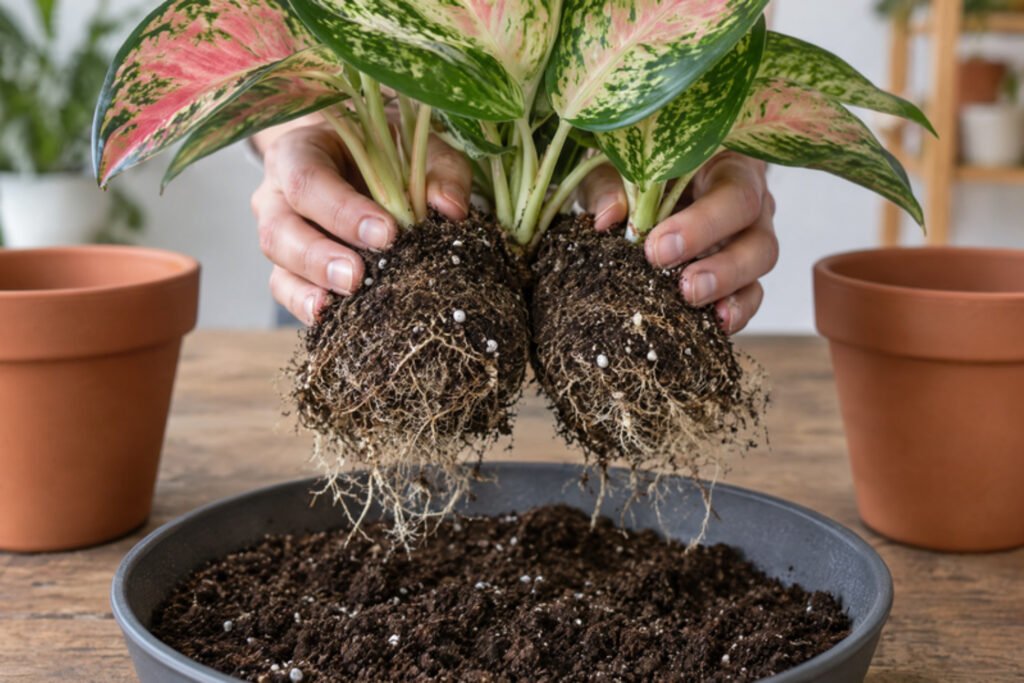
- Water the plant the day before so the root ball holds together.
- Slide the plant out of its pot and loosen the soil with your fingers.
- Gently pull or cut apart clumps that each have several leaves and their own roots.
- Pot each clump in fresh mix at the same depth it grew before.
- Water lightly and keep it out of direct sun for 2 weeks while it settles.
Stem cuttings also work: cut a 4 to 6 inch (10 to 15 cm) stem with a few leaves, let the cut end dry for an hour, then root it in water or moist mix. Roots usually appear in 4 to 8 weeks. Expect slow progress; this is not a fast-growing plant. More methods in our propagation guide.
Common Chinese evergreen problems and fixes
| What you see | Likely cause | What to do |
|---|---|---|
| Yellow lower leaves, soil wet | Overwatering | Let the top 2 inches dry before watering; check roots for rot |
| One old bottom leaf yellowing now and then | Normal ageing | Remove it at the base; nothing to fix |
| Grey-green or dark patches after a cold spell | Chilling injury | Move to a warmer spot; trim damaged leaves once new growth appears |
| Brown, crispy leaf tips | Very dry air, hard water or fertilizer build-up | Raise humidity, flush the soil, use filtered water |
| Pale, washed-out or scorched patches | Direct sun | Move back from the window or add a sheer curtain |
| Colourful variety fading to green, leggy stems | Not enough light | Move closer to a bright window |
| Mushy stems at soil level, sour smell | Root or stem rot | Cut away rotten parts, repot in fresh dry mix, water less |
| Drooping, curled leaves, dry soil | Underwatering | Water thoroughly; it should perk up in a day |
Yellow leaves have several causes; our guide to yellowing leaves walks you through them, and the free Plant Doctor can help you narrow it down.
Pests to watch for
Mealybugs (white, cottony fluff in leaf joints), scale (small brown bumps on stems), aphids and spider mites can all appear. Check leaf undersides and where leaves meet the stem when you water. Wipe off small outbreaks with a cotton bud dipped in rubbing alcohol, then treat with insecticidal soap every 5 to 7 days until clear. Our houseplant pests guide has photos of each one.
Is Chinese evergreen toxic to cats and dogs?
Yes. The ASPCA lists Chinese evergreen as toxic to cats, dogs and horses. Like pothos and peace lily, it contains insoluble calcium oxalate crystals. Chewing the leaves can cause mouth irritation, drooling, pawing at the mouth and vomiting. Serious poisoning is uncommon, but keep it out of reach of pets and small children, and call your vet if you think your pet has eaten some. Looking for a safer pick? Try our pet-friendly houseplants list or check any plant with the Plant Toxicity Checker.
Buying tips and the first two weeks
- Choose a plant with several stems and firm, upright leaves with no yellowing or brown patches.
- Check leaf undersides and stem joints for white fluff (mealybugs).
- In cold weather, ask the shop to wrap it; even a short trip in freezing air can damage the leaves.
- At home, put it in medium light and leave the watering until the top inch is dry. Do not repot for the first few weeks.
A leaf or two may yellow as it adjusts to your home. That is normal. See what to do with a new houseplant in the first two weeks.
Quick care checklist
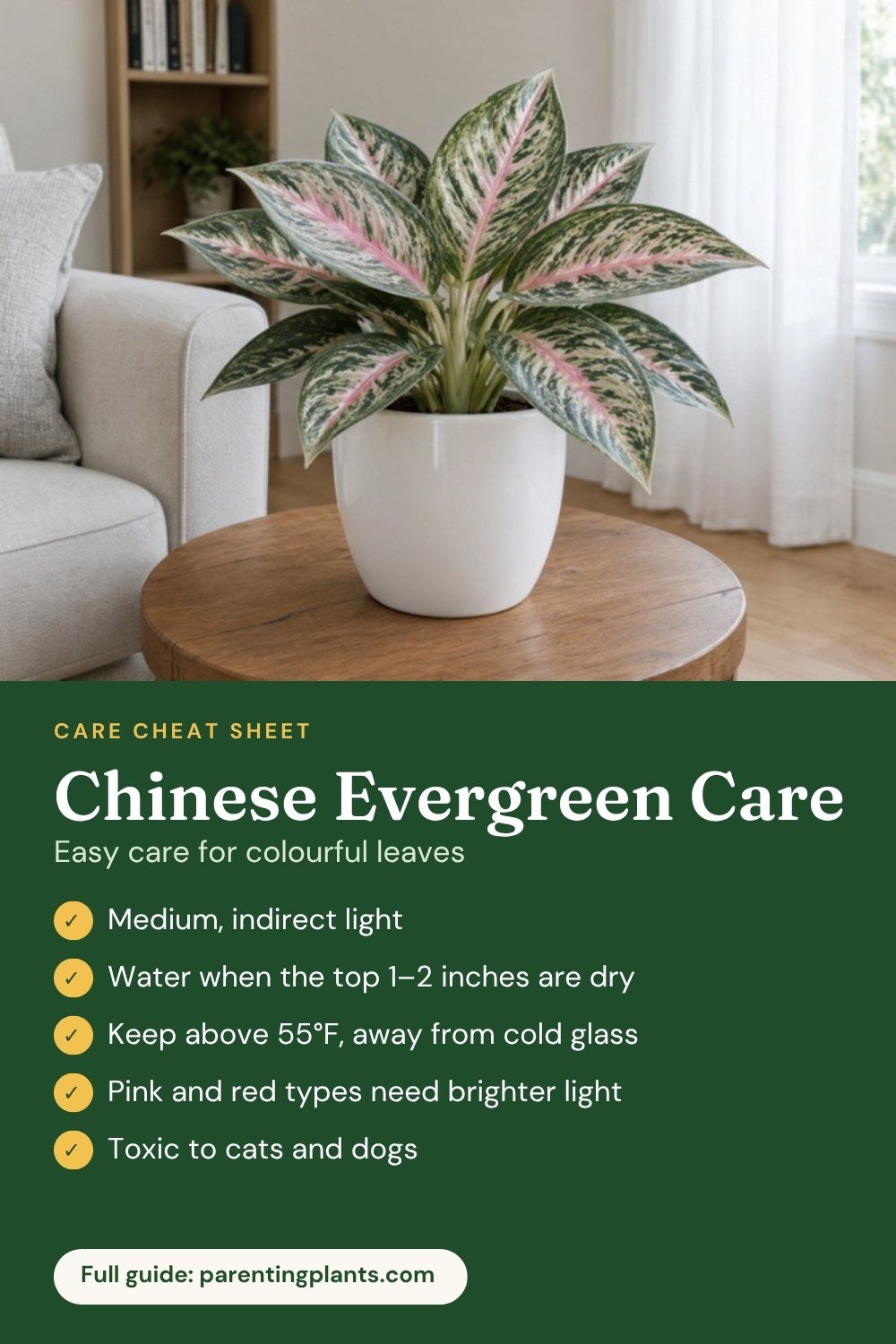
- Medium, indirect light (brighter for pink and red types)
- Water when the top 1 to 2 inches are dry
- Keep above 55°F and away from cold glass and drafts
- Feed at half strength monthly in spring and summer
- Remove old yellow leaves and spent flower stalks
- Keep away from pets that chew plants
Save this for later: pin the cheat sheet below to your Pinterest plant board.
Want every plant’s care on one page?
The Houseplant Care Cards give you 30 printable one-page guides for popular houseplants: light, water, pet safety and quick fixes at a glance.
Chinese evergreen care FAQ
Can Chinese evergreen live in low light?
Dark green varieties such as ‘Maria’ and ‘Silver Bay’ tolerate low light well. Pink and red varieties need medium to bright, indirect light to keep their colour.
How often should I water a Chinese evergreen?
When the top 1 to 2 inches of soil are dry, usually every 7 to 14 days in spring and summer and every 2 to 3 weeks in winter.
Why are my Chinese evergreen leaves turning yellow?
Most often overwatering. Let the soil dry more between waterings and check the roots. One old bottom leaf yellowing now and then is normal.
Is Chinese evergreen safe for cats?
No. The ASPCA lists Chinese evergreen as toxic to cats and dogs. It can cause mouth irritation, drooling and vomiting.
Why is my pink aglaonema turning green?
It is not getting enough light. Move it to a brighter spot with indirect light, out of direct sun.
Should I cut the flowers off my Chinese evergreen?
You can. Cutting the flower stalk at the base lets the plant put more energy into leaves, but leaving it does no harm.
What temperature is too cold for Chinese evergreen?
Keep it above 55°F (13°C). Below 50°F (10°C) it can suffer chilling injury. It grows best between 65 and 80°F (18 to 27°C).
Sources and further reading
This guide was written by Manik at Parenting Plants and checked against the university extension and expert resources below. Read how we research and update our guides in our editorial guidelines.
- Clemson Cooperative Extension (HGIC): Chinese evergreen care, cultivation and growing guide
- New York Botanical Garden: How do I care for my Chinese evergreen?
- ASPCA: Toxic and non-toxic plants list
Looking for another plant? Browse all our houseplant care guides A to Z.
Free tracker
Never forget to water your Chinese Evergreen again
Track your Chinese Evergreen and every other plant you own. A ready-made plant care tracker for Google Sheets and Notion that shows exactly which plants need water today, with 90 houseplants built in.
You're in!
Check your inbox, plant friend! 📩
Your free Plant Care Tracker is on its way. We've emailed you both versions, Google Sheets and Notion, plus a bonus printable 2027 plant calendar. It usually arrives within a few minutes.
Can't find it? Check your Promotions or Spam folder, and add manik@parentingplants.com to your contacts so you never miss a plant tip.