Special Offer: Use code ILOVEPLANTS for 25% off on all digital products! Shop Now →

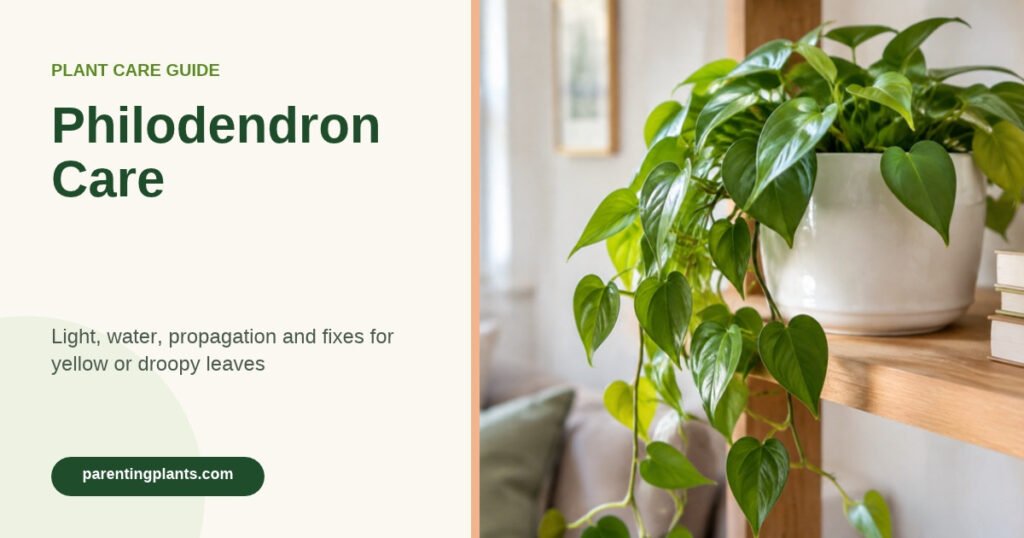
Philodendrons are some of the easiest houseplants you can grow. They forgive missed waterings, cope with less-than-perfect light and grow fast enough that you can actually watch them improve. Most problems come from just two things: soggy soil and a spot that is too dark. Get those right and a philodendron will happily trail, climb or fill a corner for years.
Short answer: Give a philodendron bright, indirect light, though most will tolerate medium or low light. Water when the top inch of soil is dry, usually every 1 to 2 weeks, and never let it sit in water. Keep it at 65 to 80°F (18 to 27°C), feed lightly in spring and summer, and use an all-purpose potting mix in a pot with a drainage hole.
In this guide
Philodendron care at a glance
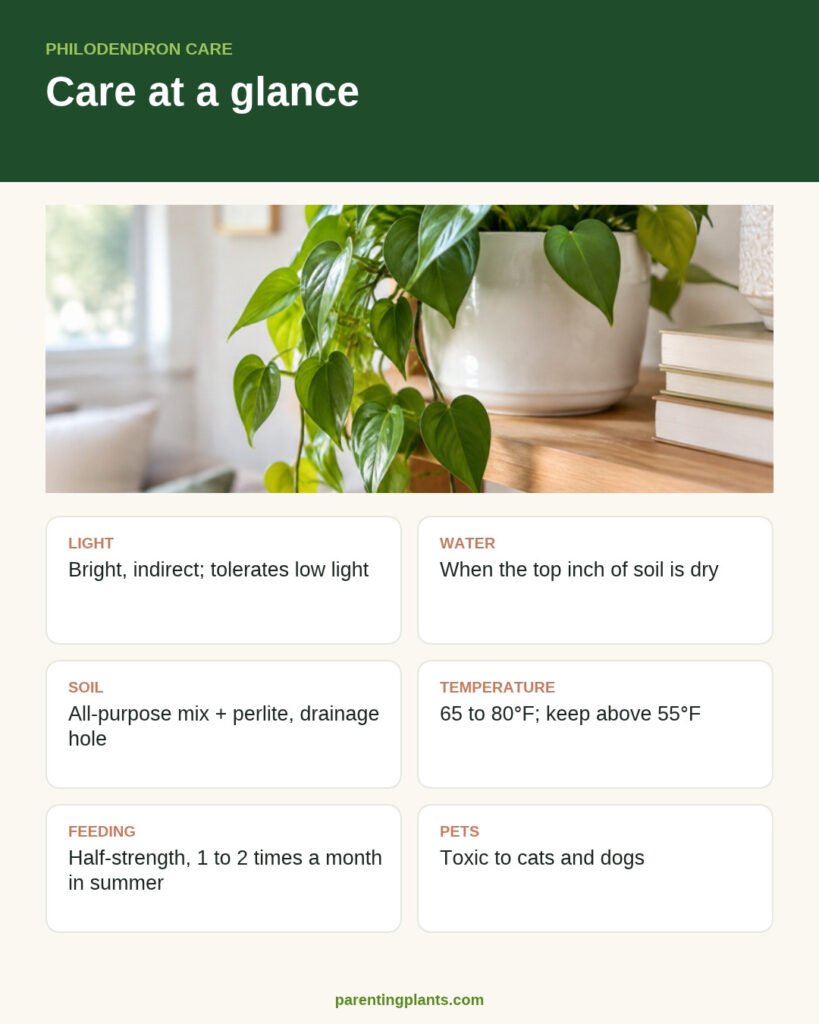
| Need | What a philodendron wants |
|---|---|
| Light | Bright, indirect light; tolerates medium to low light. No harsh direct sun |
| Water | When the top inch of soil is dry, usually every 1 to 2 weeks |
| Soil | All-purpose potting mix, ideally with some perlite or bark |
| Pot | Any pot with a drainage hole; a heavy one for big self-heading types |
| Temperature | 65 to 80°F (18 to 27°C); keep above 55°F (13°C) |
| Humidity | Likes it humid but copes with normal home air |
| Fertilizer | Balanced houseplant food at half strength, once or twice a month in spring and summer |
| Pets | Toxic to cats and dogs (calcium oxalate crystals) |
Climbing or self-heading: which philodendron do you have?
There are hundreds of philodendrons, but the ones sold as houseplants fall into two simple groups. Care is almost the same; the difference is how they grow.
- Climbing (vining) philodendrons send out long stems with leaves along them. They trail from a shelf or hanging basket, or climb a moss pole. Examples: heartleaf philodendron (Philodendron hederaceum), ‘Brasil’, ‘Micans’, ‘Pink Princess’ and the red-leaf types.
- Self-heading (upright) philodendrons grow leaves from a central crown and get wider rather than longer. Examples: ‘Birkin’, ‘Xanadu’, ‘Moonlight’ and the large split-leaf tree philodendron. Some grow twice as wide as they are tall, so give them room.
The heartleaf philodendron is the most common and the toughest. If you just bought a ‘philodendron’ with soft, heart-shaped green leaves on long stems, that is almost certainly what you have.
How much light does a philodendron need?
Philodendrons grow best in bright, indirect light: a few feet from an east or west window, or near a south window behind a sheer curtain. They come from the floor of tropical forests, so they are used to filtered light and will burn in hot, direct afternoon sun.
Heartleaf philodendron is one of the few plants that copes with genuinely low light, such as a north window or a spot well back from the glass. It will grow slower there, with smaller leaves spaced further apart, but it will live. Colorful types like ‘Pink Princess’, ‘Birkin’ and ‘Prince of Orange’ need brighter light to keep their color.
- Too little light: long bare stems, small leaves, big gaps between leaves, variegated leaves turning plain green.
- Too much sun: pale, bleached or yellow-white leaves and brown, crispy patches.
- Just right: steady new growth with leaves the same size as, or bigger than, the old ones.
Not sure what light you have? Our lighting guide shows how to check, and our list of the best low-light houseplants has more plants for dim rooms.
How often to water a philodendron
Water when the top inch of soil feels dry (about the first knuckle of your finger). In most homes that is every 1 to 2 weeks in spring and summer and every 2 to 3 weeks in winter. The plant, not the calendar, decides.
- Push a finger into the soil. If the top inch is dry, it is time to water.
- Water slowly and evenly until water flows out of the drainage hole.
- Let it drain, then empty the saucer or cachepot. Never let the pot stand in water.
- Check again in a week. Plants in brighter light and warm rooms dry out faster.
Read the leaves. Droopy, soft leaves with dry soil mean the plant is thirsty and will perk up within hours of watering. Droopy or yellow leaves with wet soil mean too much water, so hold off and check the roots.
More on getting the amount right in our watering guide.
Best soil and pot
A good all-purpose potting mix works for most philodendrons. To make it airier, mix in about one part perlite or orchid bark to three parts potting mix. That keeps roots moist but never waterlogged.
Always use a pot with a drainage hole. Plastic or glazed pots hold moisture longer; terracotta dries faster, which suits people who tend to overwater. Big self-heading philodendrons get top-heavy, so choose a sturdy, heavy pot. See our potting soil guide.
Temperature and humidity
Keep philodendrons between 65 and 80°F (18 to 27°C). They do not like cold: keep them above 55°F (13°C) and away from cold windows, doors and air-conditioning vents in summer.
They love humidity but handle ordinary indoor air well, which is part of why they are so easy. If the air is very dry in winter and new leaves come out brown at the edges, group plants together or use a humidifier. Thin-leaved types like ‘Micans’ appreciate extra humidity most. See our humidity guide.
Fertilizing a philodendron
Feed with a balanced liquid houseplant fertilizer at half strength once or twice a month in spring and summer, on damp soil. Stop feeding in autumn and winter when growth slows.
Slow growth and small, pale new leaves can mean the plant is hungry. Brown, curled leaf tips usually mean the opposite: too much fertilizer. If that happens, flush the pot with plenty of plain water and feed less often. More in our fertilizing guide.
Moss poles, trailing and pruning
Climbing philodendrons can trail or climb, and both are fine. Given something to climb, such as a moss pole or plank, many produce bigger leaves, because in nature they climb trees toward the light. Tie stems loosely to the pole and tuck the aerial roots against it.
Those brown, stringy aerial roots growing from the stems are normal. You can leave them, guide them into the soil or the pole, or trim them off; it will not hurt the plant.
To keep a trailing philodendron full rather than leggy, prune long stems in spring or summer. Cut just above a leaf node (the bump where a leaf joins the stem). New growth sprouts from the node below the cut, and the pieces you remove are perfect for propagating. See our pruning guide.
How to propagate a philodendron
Climbing philodendrons are among the easiest plants to propagate. Each piece of stem with a node can grow into a new plant.
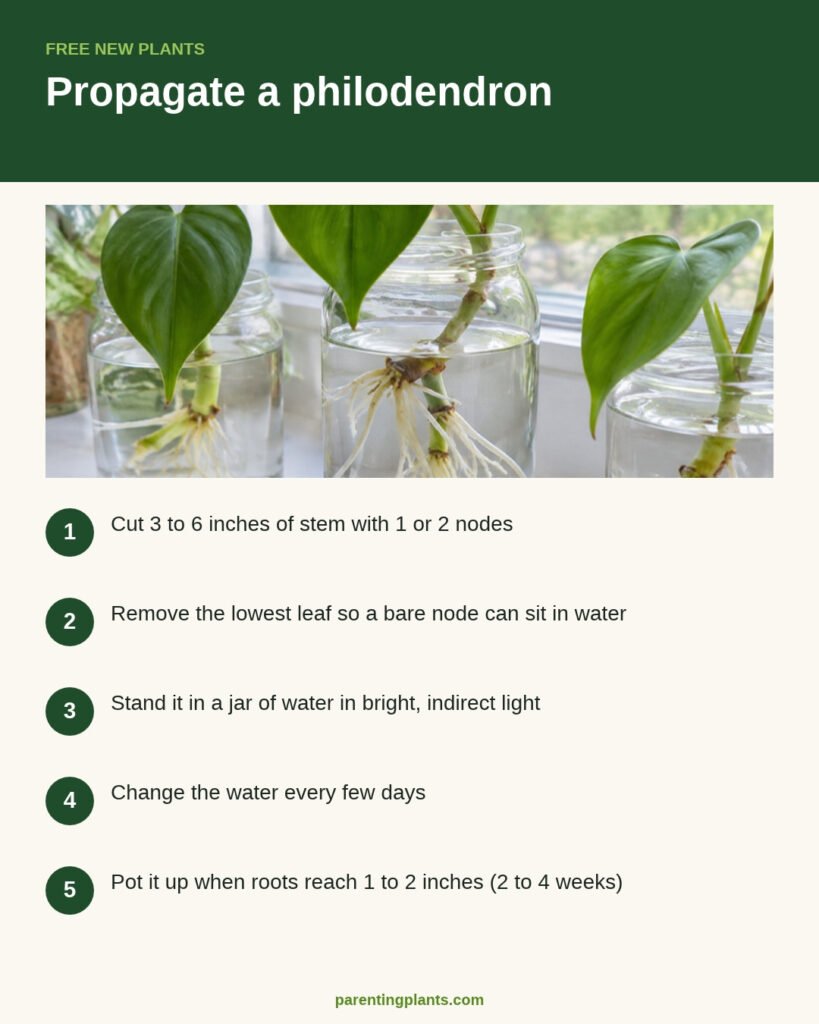
In water (easiest to watch)
- Cut a 3 to 6 inch piece of healthy stem with at least one or two nodes and a couple of leaves.
- Remove the leaf closest to the cut end so a bare node can sit in water.
- Stand the cutting in a jar of water in bright, indirect light, with the node under water and the leaves above it.
- Change the water every few days.
- When the roots are 1 to 2 inches long, usually after 2 to 4 weeks, pot the cutting in damp potting mix and keep the soil lightly moist for the first couple of weeks.
In soil
Push the same kind of cutting straight into damp potting mix with the node buried, and keep it lightly moist and warm. Rooting hormone speeds things up but is not essential. For a fuller plant, put three to five cuttings in one pot.
Self-heading types are different: you propagate them by separating the small offsets that grow at the base, each with its own roots. Our propagation guide covers more methods.
When to repot
Philodendrons like being a little snug in their pot. Repot every 1 to 2 years, ideally in spring, when roots circle the bottom or poke out of the drainage hole, or when the soil dries out within a couple of days. Move up just one pot size (1 to 2 inches wider) and use fresh mix. Our repotting guide walks you through it.
Common philodendron problems and fixes
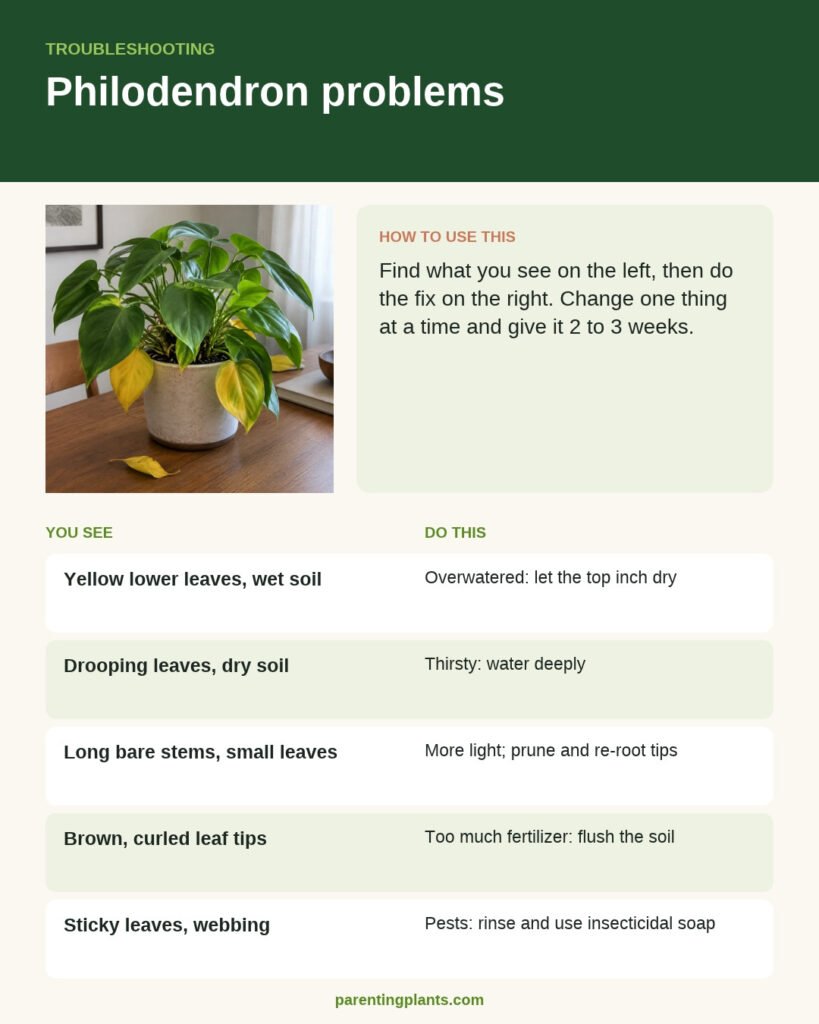
| What you see | Most likely cause | What to do |
|---|---|---|
| Yellow lower leaves, soil wet | Overwatering | Let the top inch dry before watering; check drainage |
| Yellow leaves, soil bone dry | Underwatering | Water deeply; check the soil more often |
| Drooping leaves | Too dry or too wet | Feel the soil: water if dry, let it dry if wet |
| Long bare stems, small leaves | Not enough light | Move closer to a window; prune and re-root the tips |
| Brown, crispy patches | Direct sun scorch | Move out of hot afternoon sun |
| Brown, curled leaf tips | Too much fertilizer or very dry air | Flush the soil; feed less; raise humidity |
| Mushy stems, sour smell from soil | Root rot | Cut away black roots, repot in fresh mix |
| Variegated leaves turning green | Not enough light | Give brighter, indirect light |
| Sticky leaves, webbing or white fluff | Aphids, spider mites or mealybugs | Rinse in the shower; wipe with insecticidal soap |
One or two old leaves yellowing now and then is just the plant replacing them. Lots at once is a sign to look at watering first. For more help see our guides to yellow leaves, root rot and houseplant pests.
Philodendron or pothos?
Heartleaf philodendron and pothos look so alike that they are often sold under the wrong name. Care is nearly identical, but here is how to tell them apart:
| Heartleaf philodendron | Pothos | |
|---|---|---|
| Leaves | Thin, soft, clearly heart-shaped | Thicker, waxier, slightly textured |
| Leaf stalk | Round all the way | Has a groove along the top |
| New leaves | Grow inside a small sheath (cataphyll) that dries up and falls off | Unfurl straight from the previous leaf |
| Aerial roots | Thin, several per node | Thicker, usually one per node |
Is philodendron toxic to pets?
Yes. Philodendrons contain insoluble calcium oxalate crystals, and the ASPCA lists them as toxic to cats and dogs. Chewing a leaf causes immediate mouth pain, drooling, pawing at the mouth, vomiting and difficulty swallowing. It is rarely life-threatening, but keep philodendrons in hanging baskets or on high shelves and call your vet or a pet poison helpline if your pet has eaten some. For safer options, see our pet-friendly houseplants.
Quick action checklist
- Bright, indirect light; no hot afternoon sun
- Water when the top inch of soil is dry
- Use a pot with a drainage hole and empty the saucer
- Keep it at 65 to 80°F and away from cold drafts
- Feed at half strength once or twice a month in spring and summer
- Prune leggy stems and root the cuttings for a fuller plant
- Keep it out of reach of cats and dogs
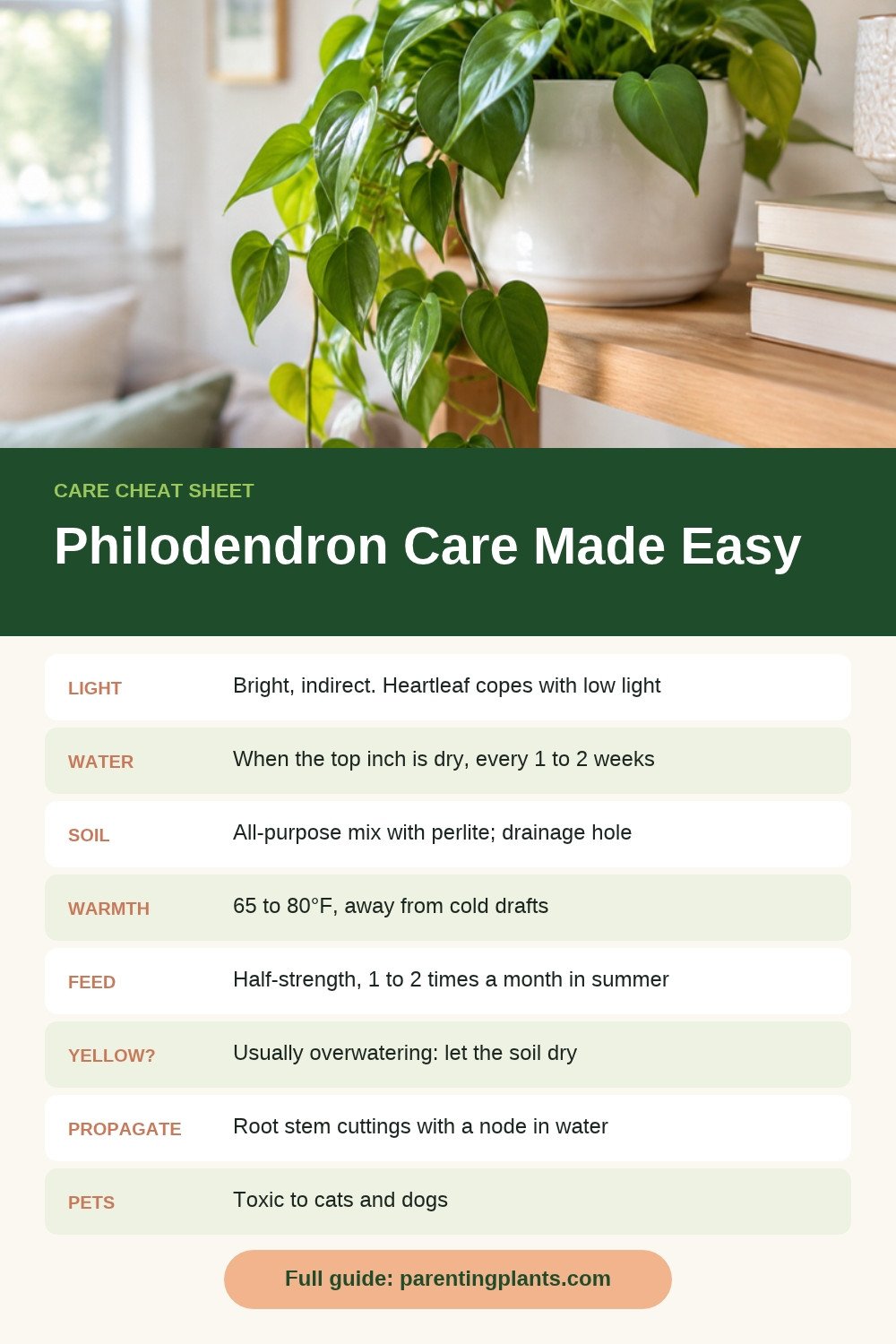
Save this for later: pin the cheat sheet below to your Pinterest plant board so it is there when you need it.
Philodendron leaves turning yellow, brown or droopy?
The Houseplant Rescue Guide matches 26 common plant problems to a clear photo, then gives you simple steps to fix each one and stop it coming back. No jargon, 50 pages, with printable checklists.
Philodendron care FAQ
How often should I water a philodendron?
Water when the top inch of soil is dry. That is usually every 1 to 2 weeks in spring and summer and every 2 to 3 weeks in winter. Always let excess water drain away.
Can a philodendron live in low light?
Heartleaf philodendron tolerates low light better than most houseplants, though it grows slower and leggier. Colorful and variegated types need bright, indirect light to keep their color.
Why are my philodendron leaves turning yellow?
The most common cause is overwatering, especially if the lower leaves yellow and the soil stays wet. Underwatering, too little light and an occasional old leaf dying off are other causes.
How do I make my philodendron fuller?
Give it more light, prune long stems just above a leaf node in spring, and plant the rooted cuttings back into the same pot.
Should I cut the aerial roots off my philodendron?
You do not need to. They are normal and harmless. You can leave them, guide them into the soil or a moss pole, or trim them if you do not like the look.
Do philodendrons need a moss pole?
No, but climbing types often grow bigger leaves when they have something to climb. They are just as happy trailing from a shelf or hanging basket.
Is philodendron safe for cats and dogs?
No. Philodendrons contain calcium oxalate crystals that irritate the mouth and stomach. Keep them out of reach of pets.
Sources and further reading
Want to go deeper? These university extension and expert resources cover the same topic:
- Iowa State University Extension: Growing philodendrons in the home
- Clemson Cooperative Extension: Philodendron (HGIC 1509)
- UF/IFAS Gardening Solutions: Hybrid philodendrons
- University of Illinois Extension: Philodendron
- ASPCA: Heartleaf philodendron toxicity
[…] Full care: see our philodendron care guide […]