Special Offer: Use code ILOVEPLANTS for 25% off on all digital products! Shop Now →

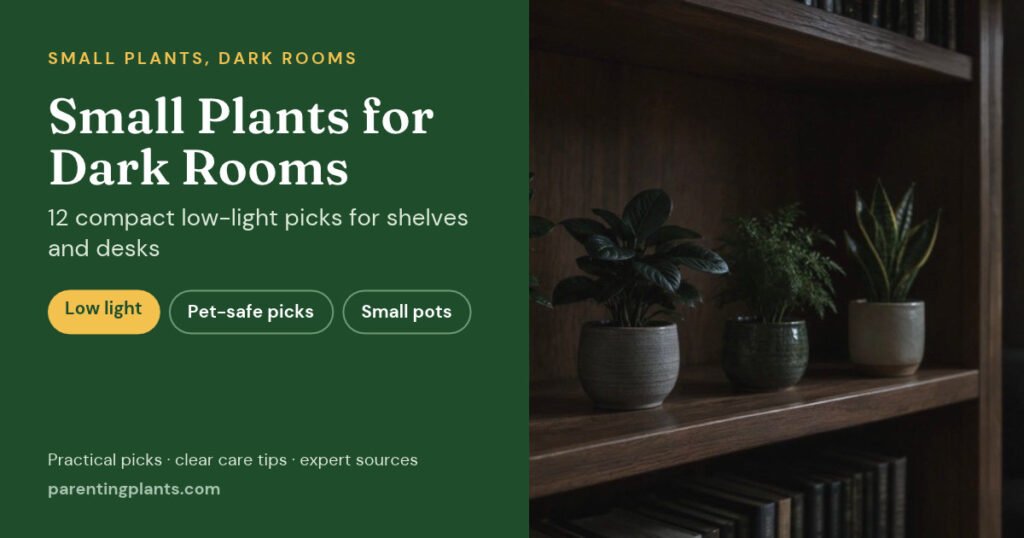
Small plants are perfect for dark rooms: they fit on bookshelves, desks, bathroom shelves and bedside tables, and a few compact plants can make a gloomy room feel alive. But small pots come with their own challenge. They hold less soil, so they dry out and get waterlogged faster than big pots, and many cute “desk plants” sold in shops actually need bright light.
This guide covers 12 compact plants that genuinely cope with low light, which ones are pet-safe, popular small plants to avoid for dark rooms, and how to water tiny pots without killing them.
Short answer: The best small plants for dark rooms are ZZ ‘Zenzi’, bird’s nest snake plant (‘Hahnii’), pothos, heartleaf philodendron, peperomia, small Chinese evergreens and parlor palm seedlings. For pet homes, choose peperomia, parlor palm, prayer plant, bird’s nest fern and nerve plant. Avoid succulents, cacti and string of pearls in dark rooms; they need bright light.
In this guide
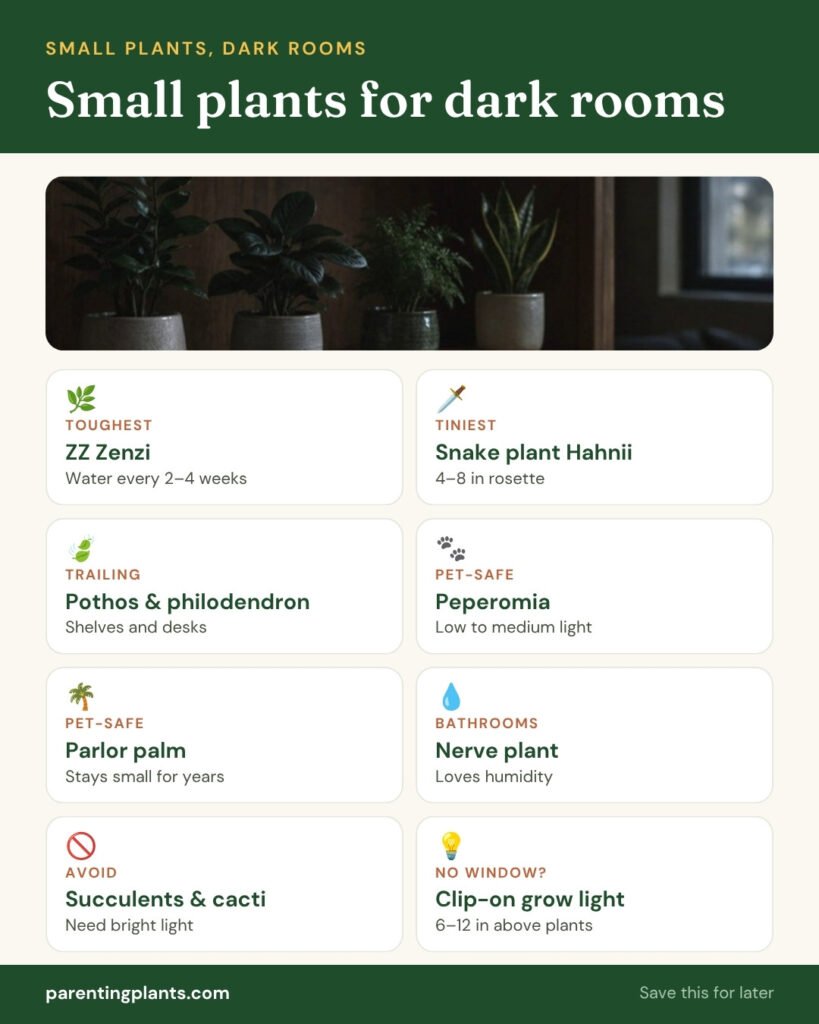
Small low-light plants at a glance
All of these stay under about 12 inches (30 cm) tall in a small pot, or can be kept that size with light trimming.
| Plant | Size | Lowest light | Water | Pets |
|---|---|---|---|---|
| ZZ ‘Zenzi’ / ‘Zamicro’ | 8–16 in | Low | Every 2–4 weeks | Toxic |
| Snake plant ‘Hahnii’ | 4–8 in | Low | Every 3–4 weeks | Toxic |
| Pothos (small pot) | Trailing | Low | Top inch dry | Toxic |
| Heartleaf philodendron | Trailing | Low | Top inch dry | Toxic |
| Peperomia | 6–12 in | Low to medium | Top half dry | Safe |
| Chinese evergreen (compact) | 8–14 in | Low | Top inch dry | Toxic |
| Parlor palm (young) | 8–16 in | Low to medium | Top inch dry | Safe |
| Prayer plant | 6–12 in | Medium | Top inch dry | Safe |
| Bird’s nest fern ‘Crispy Wave’ | 8–14 in | Low to medium | Top inch dry | Safe |
| Nerve plant (Fittonia) | 3–6 in | Medium | Keep lightly moist | Safe |
| Lucky bamboo | 6–24 in | Low to medium | Water topped up | Toxic |
| Cast iron plant ‘Milky Way’ | 12–18 in | Low | Top 2 inches dry | Safe |
Free Plant Care Tracker: Never forget a watering again. Get it free →
What counts as a dark room?
Most rooms people call “dark” still have some natural light: a north window, a window shaded by a building or tree, or a spot far from the glass. Those rooms can grow every plant on this list. A truly dark room, such as a windowless bathroom, office or basement, cannot support any plant for long without a grow light.
- Low light: you need a lamp to read comfortably most of the day. Small ZZ, snake plants, pothos and philodendron cope.
- Medium light: bright enough to read by day near the window. Peperomia, prayer plant and nerve plant prefer this.
- No natural light: use a small LED grow light (see below).
Not sure which you have? Try the shadow test in our houseplant lighting guide.
The 12 best small plants for dark rooms
1. Compact ZZ plant (Zamioculcas ‘Zenzi’ and ‘Zamicro’)
Light: Low to bright, indirect · Water: Every 2 to 4 weeks · Size: 8 to 16 in · Pets: Toxic to cats and dogs (ASPCA)
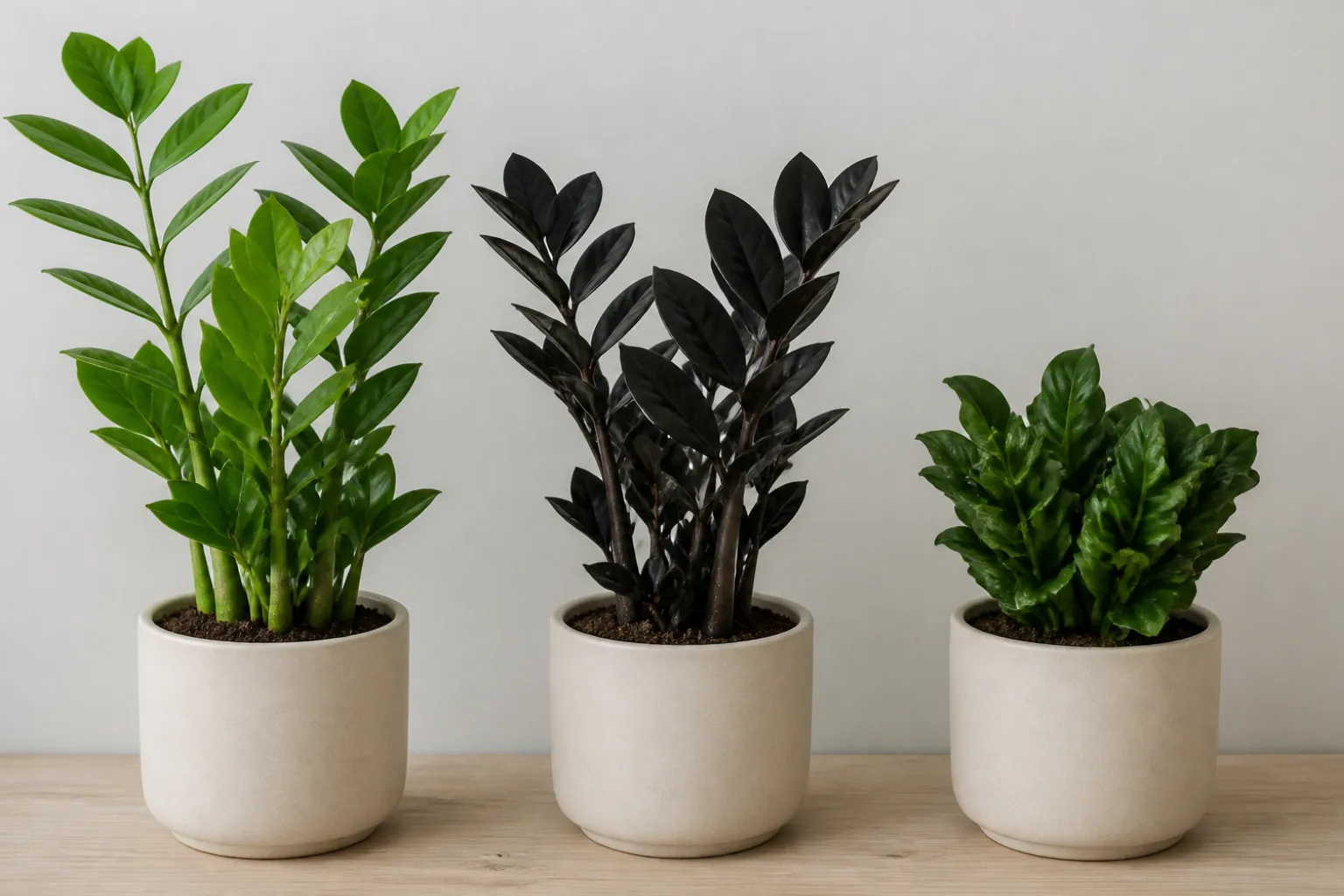
Dwarf ZZ varieties stay small and dense, with the same toughness as the full-size plant. ‘Zenzi’ has curly, tightly packed leaves; ‘Zamicro’ is a scaled-down classic ZZ. Perfect for a dark desk.
➜ Full care: Compact ZZ plant care guide
2. Bird’s nest snake plant (Dracaena trifasciata ‘Hahnii’)
Light: Low to bright, indirect · Water: Every 3 to 4 weeks · Size: 4 to 8 in · Pets: Toxic to cats and dogs (ASPCA)
A tiny rosette snake plant that grows sideways rather than up. It is about as close to unkillable as a small plant gets, provided you never overwater it. ‘Golden Hahnii’ adds yellow edges.
➜ Full care: Bird’s nest snake plant care guide
3. Pothos in a small pot (Epipremnum aureum)
Light: Low to medium, indirect · Water: When the top inch is dry · Size: Trailing; trim to any length · Pets: Toxic to cats and dogs (ASPCA)
Pothos is a vine, but in a 4-inch pot on a shelf it makes a neat small plant that you can trim whenever it gets long. Root the cuttings in water to fill more pots for free. Green ‘Jade’ and golden pothos manage low light best.
➜ Full care: Pothos in a small pot care guide
4. Heartleaf philodendron (Philodendron hederaceum)
Light: Low to medium, indirect · Water: When the top inch is dry · Size: Trailing · Pets: Toxic to cats and dogs (ASPCA)
Softer and slightly more shade-tolerant than pothos. A small pot spilling over a bookshelf is one of the easiest ways to bring a dark corner to life. The lime-green ‘Brasil’ variety brightens dim spaces.
➜ Full care: Heartleaf philodendron care guide
5. Peperomia (Peperomia obtusifolia, P. caperata and others)
Light: Low to medium, indirect · Water: When the top half of the soil is dry · Size: 6 to 12 in · Pets: Non-toxic to cats and dogs (ASPCA)
Peperomias are naturally small, come in dozens of leaf shapes and are safe for pets. Plain green baby rubber plant (P. obtusifolia) handles the lowest light; ripple and watermelon types prefer medium light. They store water in their leaves, so overwatering is the main risk.
➜ Full care: Peperomia care guide
6. Compact Chinese evergreen (Aglaonema)
Light: Low (green types) to medium · Water: When the top inch is dry · Size: 8 to 14 in · Pets: Toxic to cats and dogs (ASPCA)
Young Chinese evergreens in 4 to 5-inch pots make colourful small plants. Pick green or silver types for dark rooms; pink ones need brighter light. Keep them away from cold windowsills in winter.
➜ Full care: Compact Chinese evergreen care guide
7. Parlor palm (young plant) (Chamaedorea elegans)
Light: Low to medium, indirect · Water: When the top inch is dry · Size: 8 to 16 in for several years · Pets: Non-toxic to cats and dogs (ASPCA)
Small parlor palms are sold everywhere as “table palms” and stay compact for years in low light. Pet-safe, soft-looking and inexpensive.
➜ Full care: Parlor palm (young plant) care guide
8. Prayer plant (Maranta leuconeura)
Light: Medium, indirect · Water: When the top inch is dry · Size: 6 to 12 in · Pets: Non-toxic to cats and dogs (ASPCA)
Beautifully patterned and pet-safe, with leaves that fold up at night. It needs medium light, so place it nearer the window than the others, and it likes humidity, making it great for a bathroom with a window.
➜ Full care: Prayer plant care guide
9. Bird’s nest fern (Asplenium nidus ‘Crispy Wave’ and compact types)
Light: Low to medium, indirect · Water: When the top inch is dry · Size: 8 to 14 in · Pets: Non-toxic to cats and dogs (ASPCA)
Compact bird’s nest ferns such as ‘Crispy Wave’ and ‘Leslie’ bring a bright green, wavy texture to shelves. It is the most forgiving fern for low light. Water around the edge of the pot, not into the centre.
➜ Full care: Bird’s nest fern care guide
10. Nerve plant (Fittonia albivenis)
Light: Medium, indirect (no direct sun) · Water: Keep lightly moist · Size: 3 to 6 in · Pets: Non-toxic to cats and dogs (ASPCA)
A tiny plant with leaves netted in white, pink or red veins. It loves humidity and is ideal for a bathroom, terrarium or under a cloche. It faints dramatically when dry but recovers within hours of watering. Non-toxic to pets.
11. Lucky bamboo (Dracaena sanderiana)
Light: Low to medium, indirect · Water: Top up the water weekly; change it every 2 weeks · Size: 6 to 24 in · Pets: Toxic to cats and dogs (ASPCA)
Grown in water or pebbles, lucky bamboo is a clean, soil-free option for desks and bathrooms. Use filtered or rain water to prevent yellowing. It is toxic to cats and dogs.
➜ Full care: Lucky bamboo care guide
12. Compact cast iron plant (Aspidistra elatior ‘Milky Way’ or dwarf types)
Light: Low to medium, indirect · Water: When the top 2 inches are dry · Size: 12 to 18 in · Pets: Non-toxic to cats and dogs (ASPCA)
Speckled ‘Milky Way’ and dwarf cast iron plants stay smaller than the standard plant and are just as tough. The best pet-safe choice for a cold, dark hallway or landing.
➜ Full care: Compact cast iron plant care guide
Popular small plants that do not suit dark rooms
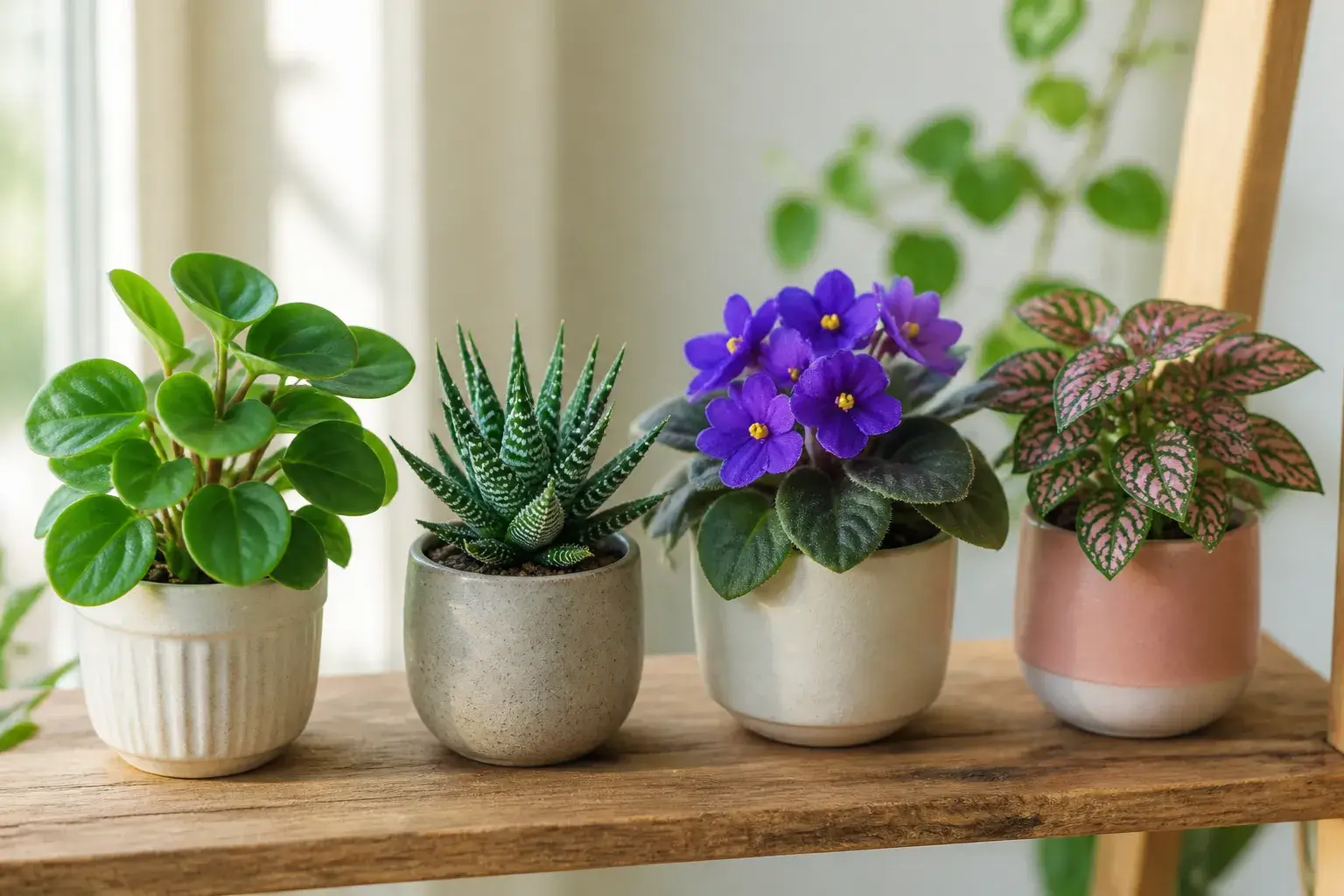
These are often sold as “easy desk plants” but need bright light to stay healthy. In a dark room they stretch, lose colour or rot:
| Plant | Why it struggles in low light |
|---|---|
| Succulents (echeveria, jade) and cacti | Need several hours of bright light or direct sun; stretch and rot in shade |
| String of pearls, string of hearts | Thin, sparse vines and rot in low light |
| Haworthia and aloe | Tolerate less sun than other succulents, but still need a bright window |
| African violet | Will not flower without bright, indirect light |
| Chinese money plant (Pilea) | Becomes leggy and floppy; needs bright, indirect light |
| Polka dot plant | Loses its pink colour and gets leggy |
If you love these, see our guide to the best low-light houseplants for more shade-loving swaps.
How to water small plants (the tricky part)
A 3 or 4-inch pot holds very little soil, so it swings from dry to soggy quickly. In a dark room the soil dries slowly, and in a small pot with no drainage hole water has nowhere to go. That is how most small plants die.
- Always use pots with drainage holes. Cute ceramic pots without holes are best used as a cover for a plastic nursery pot.
- Check with your finger every week, and water only when the soil is dry to the depth the plant needs (see the table above).
- Water thoroughly, then drain. Run water through the pot over a sink, let it drain completely, then return it to its spot.
- Do not use big pots to “save watering”. Too much wet soil around a small root ball causes root rot. Move up only one size when roots fill the pot.
- Lift the pot. A dry small pot feels noticeably light. This is the quickest check of all.
Keep a simple record. Small plants in dark rooms can go two to four weeks between waterings, which makes it easy to forget or water twice. Our free plant care tracker helps you log watering in seconds.
Small plants with no window: using a grow light
For a windowless bathroom, office or basement, a small LED grow light makes all of these plants possible. Clip-on grow lights and full-spectrum bulbs for a desk lamp are inexpensive and look like normal lamps.
- Place the light 6 to 12 inches above small plants.
- Run it 10 to 12 hours a day on a timer.
- Choose “full-spectrum” or white LEDs; they look natural and grow plants well.
- Bathroom plants also need some air movement; leave the door open after showers.
Without a grow light, swap your plants with ones from a brighter room every week or two so each gets time to recover.
Small pet-safe plants for dark rooms
From this list, peperomia, parlor palm, prayer plant, bird’s nest fern, nerve plant and cast iron plant are listed as non-toxic to cats and dogs by the ASPCA. Remember that small plants on low shelves and desks are within easy reach of pets. Read our full guides to cat-safe houseplants and dog-safe houseplants.
Quick checklist
- Pick shade-tolerant small plants, not succulents or cacti
- Use pots with drainage holes, always
- Check soil weekly and water only when it is dry
- Never pot a small plant into a much bigger pot
- Rotate pots and dust leaves monthly
- Add a small LED grow light if there is no window
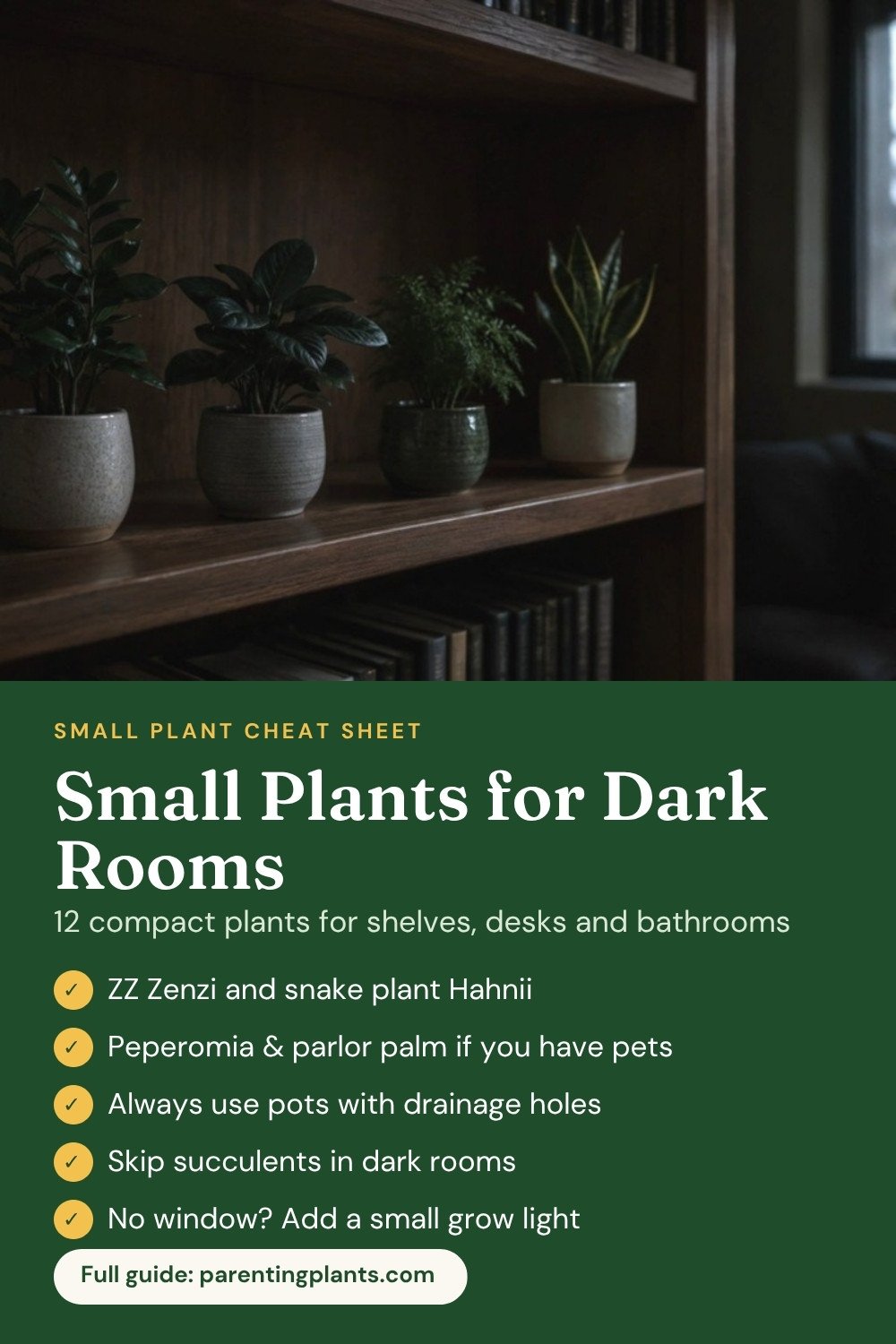
Save this for later: pin the cheat sheet below to your Pinterest plant board.
Want every plant’s care on one page?
The Houseplant Care Cards give you 30 printable one-page guides for popular houseplants: light, water, pet safety and quick fixes at a glance.
Small plants for dark rooms FAQ
What is the best small plant for a dark room?
A compact ZZ plant such as ‘Zenzi’ or a bird’s nest snake plant (‘Hahnii’). Both stay small, cope with low light and need water only every few weeks.
What small plants can live in a windowless bathroom?
None can survive long without light. With a small LED grow light on for 10 to 12 hours a day, pothos, heartleaf philodendron, peperomia, nerve plant and bird’s nest fern all do well in a bathroom.
Can succulents grow in a dark room?
No. Succulents and cacti need bright light and some direct sun. In a dark room they stretch, lose colour and often rot.
Which small low-light plants are safe for cats?
Peperomia, parlor palm, prayer plant, bird’s nest fern, nerve plant and cast iron plant are listed as non-toxic to cats and dogs by the ASPCA.
How often should I water a small plant in low light?
It depends on the plant, but often every 1 to 3 weeks. Check the soil with your finger and water only when the top inch or more is dry.
Why is my small plant getting leggy?
Long, stretched stems with small leaves mean it needs more light. Move it closer to a window or add a grow light, then trim the long stems.
Sources and further reading
This guide was written by Manik at Parenting Plants and checked against the expert and university resources below. Read how we research and update our guides in our editorial guidelines.
- Clemson Cooperative Extension (HGIC): Peperomia houseplants
- NC State Extension: Zamioculcas zamiifolia (ZZ plant)
- University of Florida IFAS Extension: Interior plants: selection and care
- Illinois Extension: Prayer plant
- ASPCA: Toxic and non-toxic plants list
Looking for a specific plant? Browse all our houseplant care guides A to Z.
Free tracker
Get the free Plant Care Tracker
A ready-made plant care tracker for Google Sheets and Notion that shows exactly which plants need water today, with 90 houseplants built in.
You're in!
Check your inbox, plant friend! 📩
Your free Plant Care Tracker is on its way. We've emailed you both versions, Google Sheets and Notion, plus a bonus printable 2027 plant calendar. It usually arrives within a few minutes.
Can't find it? Check your Promotions or Spam folder, and add manik@parentingplants.com to your contacts so you never miss a plant tip.