Special Offer: Use code ILOVEPLANTS for 25% off on all digital products! Shop Now →

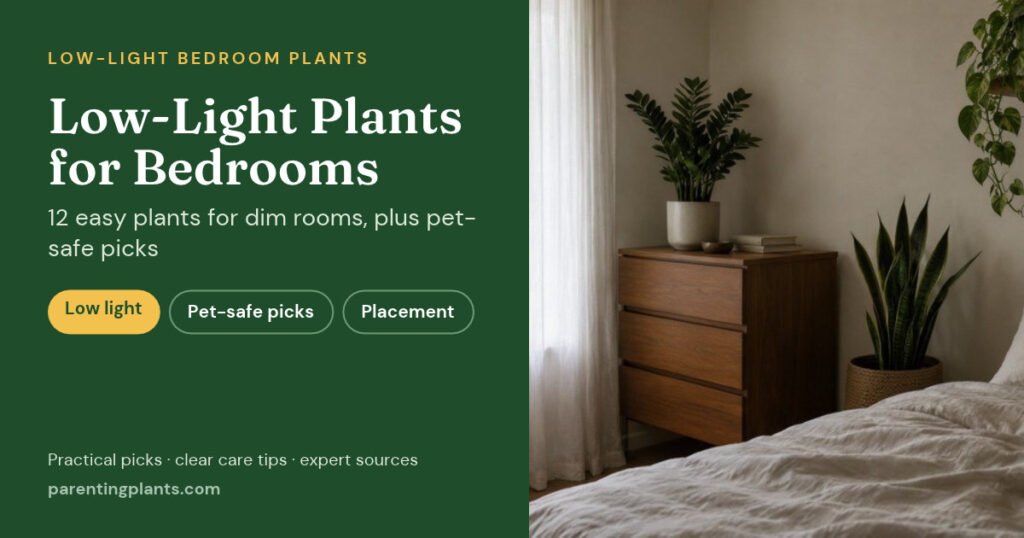
Bedrooms are tricky places for plants. Curtains stay closed for half the day, blinds come down at night, and the room is often the darkest and coolest in the house. Many bedrooms also face away from the sun. The good news is that a handful of tough, shade-loving plants are happy in exactly these conditions, and they need very little from you.
This guide lists the 12 plants we recommend most for dim bedrooms, how much light each one really needs, which are safe if your cat or dog sleeps with you, and where to put them so they thrive. We also clear up the common claims about plants, oxygen and sleep.
Short answer: The best low-light plants for bedrooms are the ZZ plant, snake plant, pothos, cast iron plant, parlor palm and Chinese evergreen. They cope with a north window or a spot several feet from any window, and need water only every 1 to 3 weeks. If pets share your bedroom, choose cast iron plant, parlor palm, prayer plant, bird’s nest fern or spider plant, which the ASPCA lists as non-toxic.
In this guide
Bedroom plants at a glance
Use this table to shortlist plants for your room. “Low” light means a spot where you can read only with a lamp for most of the day; “medium” means a few feet from a window with bright daylight.
| Plant | Lowest light | Water every | Size indoors | Pets |
|---|---|---|---|---|
| ZZ plant | Low | 2–4 weeks | 2–3 ft | Toxic |
| Snake plant | Low | 2–4 weeks | 1–4 ft | Toxic |
| Pothos | Low | 1–2 weeks | Trails 6 ft+ | Toxic |
| Cast iron plant | Low | 2–3 weeks | 2–3 ft | Safe |
| Parlor palm | Low to medium | 1–2 weeks | 2–4 ft | Safe |
| Chinese evergreen | Low (green types) | 1–2 weeks | 1–3 ft | Toxic |
| Heartleaf philodendron | Low to medium | 1–2 weeks | Trails 4 ft+ | Toxic |
| Peace lily | Low to medium | Weekly | 1–3 ft | Toxic |
| Prayer plant | Medium | Weekly | 6–12 in | Safe |
| Bird’s nest fern | Low to medium | Weekly | 1–2 ft | Safe |
| Dracaena | Low to medium | 1–2 weeks | 2–6 ft | Toxic |
| Spider plant | Medium | Weekly | 1–2 ft | Safe |
Free Plant Care Tracker: Never forget a watering again. Get it free →
How dark is your bedroom, really?
Before you buy, check what light your bedroom actually gets. Plants care about how bright it is during the day, not how dark it is at night. A bedroom with blackout curtains open from morning to evening can be a perfectly good spot. One that stays shut all day is effectively windowless.
| Your bedroom | Light level | What grows |
|---|---|---|
| North-facing window, curtains open by day | Low to medium | Everything on this list, placed within 3 to 5 ft of the window |
| East-facing window | Medium (gentle morning sun) | Everything here, plus prayer plant and spider plant near the glass |
| South or west window, sheer curtain | Bright, indirect | All of these; keep ferns and prayer plants out of direct sun |
| Plant 8+ ft from any window | Low | ZZ, snake plant, cast iron plant, pothos |
| Curtains closed all day or no window | Very low to none | Only with a grow light (see below) |
The quick shadow test: at midday, hold your hand a foot above where the plant will sit. A soft, blurry shadow means low to medium light. No shadow at all means the spot is too dark for any plant without a grow light. Our houseplant lighting guide explains light levels in more detail.
Do plants in the bedroom help you sleep or clean the air?
You will see many lists claiming bedroom plants “purify the air” or “release oxygen at night”. The honest answer is that a few houseplants do not change bedroom air in any way you could measure.
- Air cleaning: the famous 1989 NASA study tested plants in small sealed chambers. A 2019 review by Drexel University researchers worked out that you would need between 10 and 1,000 plants per square metre to match what normal ventilation already does. Opening a window does more.
- Oxygen at night: snake plants and some other succulents use a type of photosynthesis (CAM) that takes in carbon dioxide at night. The amount is tiny compared with what one sleeping person breathes out, so it will not change how you sleep.
- Are plants bad in a bedroom? No. The carbon dioxide plants release at night is also tiny. The old advice to remove plants from bedrooms at night is a myth.
What plants can do is make a bedroom feel calmer and more lived-in, and caring for them is a pleasant, low-effort routine. That is reason enough. The one real health point is mould: overwatered pots and constantly wet soil can grow mould and attract fungus gnats, which nobody wants next to their pillow. Water less in bedrooms, not more.
The 12 best low-light plants for bedrooms
1. ZZ plant (Zamioculcas zamiifolia)
Light: Low to bright, indirect · Water: Every 2 to 4 weeks · Size: 2 to 3 ft · Pets: Toxic to cats and dogs (ASPCA)
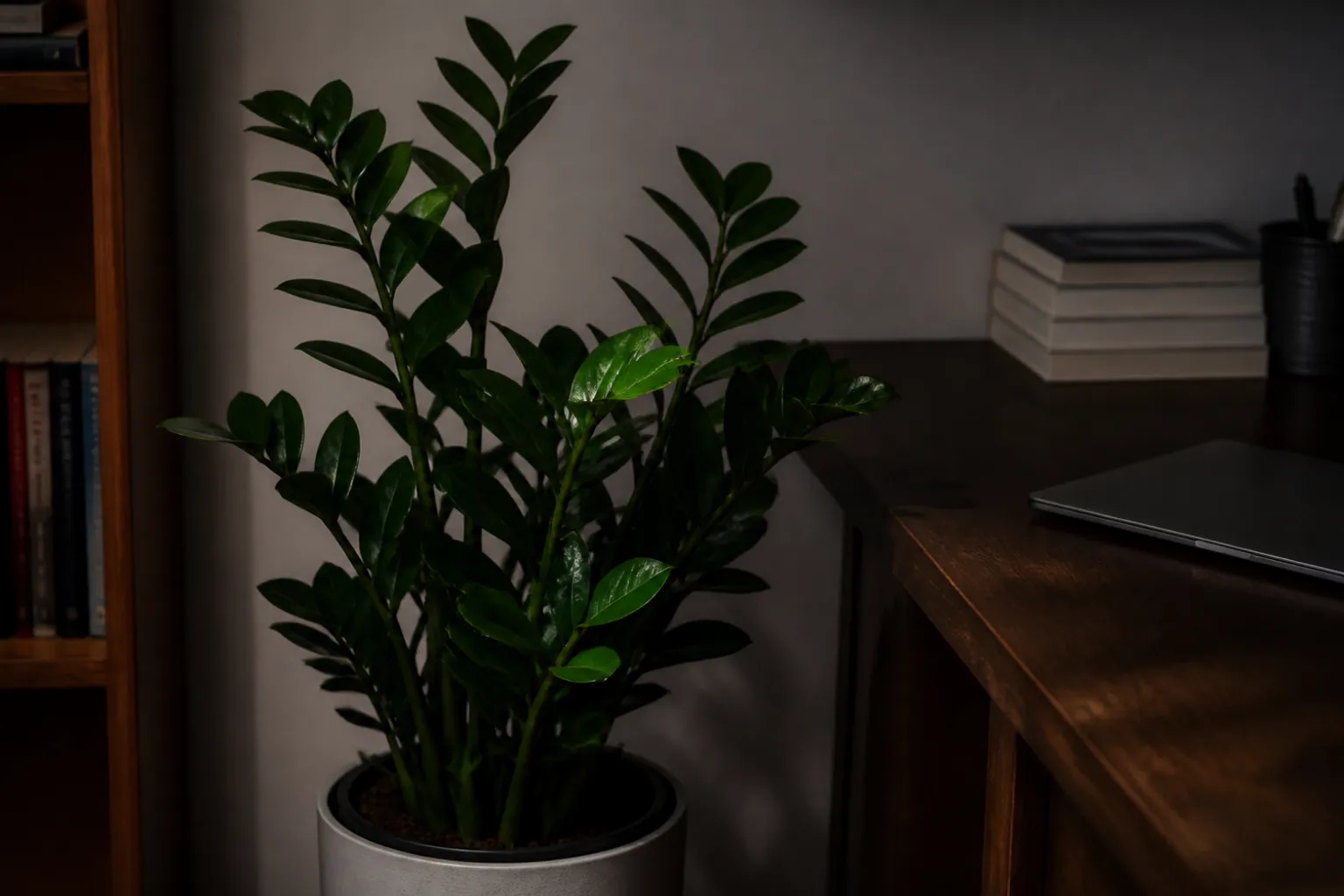
The ZZ plant is our first pick for a bedroom that gets little light and a busy owner. Its glossy leaves always look neat, it grows slowly so it will not outgrow a corner, and its thick underground rhizomes store water for weeks. In a dim bedroom you may only water it once a month.
Best spot: a dresser or the floor beside a north or east window. The dark ‘Raven’ variety looks striking against pale walls.
➜ Full care: ZZ plant care guide
2. Snake plant (Dracaena trifasciata)
Light: Low to bright, indirect · Water: Every 2 to 4 weeks · Size: 1 to 4 ft · Pets: Toxic to cats and dogs (ASPCA)
Upright, architectural and almost impossible to kill unless you overwater it. Snake plants fit narrow spaces beside a bed or wardrobe and come in sizes from 6-inch ‘Hahnii’ rosettes to 4-foot ‘Laurentii’. In low light, water only when the soil is completely dry.
Best spot: a floor pot in a corner or a small one on a bedside table.
➜ Full care: Snake plant care guide
3. Pothos (Epipremnum aureum)
Light: Low to medium, indirect · Water: When the top 2 inches are dry · Size: Trails 6 ft or more · Pets: Toxic to cats and dogs (ASPCA)
Pothos softens a bedroom with trailing vines from a shelf, wardrobe top or hanging planter. Plain green ‘Jade’ and golden pothos handle low light best; heavily white varieties such as ‘Marble Queen’ and ‘Snow Queen’ lose colour and grow slowly in dim rooms.
Best spot: on top of a tall dresser or bookcase, where the vines can hang and pets cannot reach.
➜ Full care: Pothos care guide
4. Cast iron plant (Aspidistra elatior)
Light: Low to medium, indirect · Water: When the top 2 inches are dry · Size: 2 to 3 ft · Pets: Non-toxic to cats and dogs (ASPCA)
The Victorians grew cast iron plants in gloomy, gas-lit parlours, which tells you how tough they are. They handle low light, cool rooms and some neglect, and they are safe for pets. Growth is slow, so buy the size you want.
Best spot: a cool corner away from radiators; it is happy in rooms kept at 50 to 65°F (10 to 18°C) overnight.
➜ Full care: Cast iron plant care guide
5. Parlor palm (Chamaedorea elegans)
Light: Low to medium, indirect · Water: When the top inch is dry · Size: 2 to 4 ft · Pets: Non-toxic to cats and dogs (ASPCA)
A soft, feathery palm that brings a relaxed feel to a bedroom without needing a sunny window. It is one of the best pet-safe options for low light. Keep the soil lightly moist but never soggy, and keep it away from heaters, which brown the tips.
Best spot: on the floor or a low stand near a north or east window.
➜ Full care: Parlor palm care guide
6. Chinese evergreen (Aglaonema)
Light: Low (green types) to medium · Water: When the top 1 to 2 inches are dry · Size: 1 to 3 ft · Pets: Toxic to cats and dogs (ASPCA)
Chinese evergreen adds colour and pattern to a dim room. Choose mostly green or silver varieties such as ‘Maria’ or ‘Silver Bay’ for low light; pink and red types need brighter light. It dislikes cold, so keep it away from draughty bedroom windows in winter.
➜ Full care: Chinese evergreen care guide
7. Heartleaf philodendron (Philodendron hederaceum)
Light: Low to medium, indirect · Water: When the top inch is dry · Size: Trails 4 ft or more · Pets: Toxic to cats and dogs (ASPCA)
Similar to pothos but with softer, heart-shaped leaves, and slightly more tolerant of lower light. It is a lovely choice for trailing over a headboard shelf or along a curtain rail with a few clear hooks.
➜ Full care: Heartleaf philodendron care guide
8. Peace lily (Spathiphyllum)
Light: Low to medium, indirect · Water: When the top inch is dry, roughly weekly · Size: 1 to 3 ft · Pets: Toxic to cats and dogs (ASPCA)
The only plant on this list that flowers reliably indoors, though it blooms more in medium light than in deep shade. It droops dramatically when thirsty, which makes it an easy plant to read. It is not a true lily, but it is still toxic to pets, causing mouth and stomach irritation.
Note for allergy sufferers: the flowers shed a little pollen. Snip off the white spathes if this bothers you.
➜ Full care: Peace lily care guide
9. Prayer plant (Maranta leuconeura)
Light: Medium, indirect · Water: When the top inch is dry · Size: 6 to 12 in · Pets: Non-toxic to cats and dogs (ASPCA)
A perfect bedroom plant in a fun way: its leaves fold upward every evening and open again in the morning, following the light. It needs more light than the plants above, so keep it within a few feet of a window, and it likes humidity, so it suits an en-suite bedroom.
➜ Full care: Prayer plant care guide
10. Bird’s nest fern (Asplenium nidus)
Light: Low to medium, indirect · Water: When the top inch is dry · Size: 1 to 2 ft · Pets: Non-toxic to cats and dogs (ASPCA)
The easiest fern for a bedroom. Unlike Boston ferns, it does not shed tiny leaflets everywhere, and it copes with average room humidity. Water around the edge of the pot, never into the central crown.
➜ Full care: Bird’s nest fern care guide
11. Dracaena (Dracaena fragrans ‘Janet Craig’ and others)
Light: Low to medium, indirect · Water: When the top 1 to 2 inches are dry · Size: 2 to 6 ft · Pets: Toxic to cats and dogs (ASPCA)
Dark green dracaenas such as ‘Janet Craig’ and ‘Lemon Lime’ are excellent for adding height to a dim bedroom. They are sensitive to fluoride and salts in tap water, which causes brown tips, so use filtered or rain water if you can. For more tall options, see our list of tall low-light indoor plants.
➜ Full care: Dracaena care guide
12. Spider plant (Chlorophytum comosum)
Light: Medium, indirect · Water: When the top inch is dry · Size: 1 to 2 ft · Pets: Non-toxic to cats and dogs (ASPCA)
Spider plants tolerate lower light but look their best in medium light, where they produce their trailing baby plants. They are non-toxic and cheerful, but cats love to chew them, so hang them up if your cat sleeps in your room.
➜ Full care: Spider plant care guide
Pet-safe bedroom plants (if your cat or dog sleeps with you)
If a pet shares your bedroom, especially at night when you are not watching, choose plants that are non-toxic. From this list, the ASPCA lists these as non-toxic to cats and dogs:
- Cast iron plant
- Parlor palm
- Prayer plant
- Bird’s nest fern
- Spider plant
Non-toxic does not mean edible: chewing any plant can cause mild vomiting. Keep toxic plants such as ZZ, snake plant and pothos on high shelves or in rooms your pet cannot enter. See our full guides to cat-safe houseplants and dog-safe houseplants, or check any plant in our plant toxicity checker.
Where to put plants in a bedroom
- Closest to the window: prayer plant, spider plant and peace lily, which need the most light.
- Mid-room (3 to 8 ft from the window): parlor palm, Chinese evergreen, bird’s nest fern, dracaena.
- Darkest corners: ZZ, snake plant and cast iron plant.
- Bedside table: small, slow plants with no pollen, such as a small snake plant or ZZ. Use a saucer to protect furniture.
- High shelves and wardrobe tops: trailing pothos and philodendron.
Avoid these spots: directly above or next to a radiator, in the cold gap between a closed curtain and the window glass on winter nights, and right under an air-conditioning vent. All three cause brown leaf tips and leaf drop.
How to care for plants in a dim bedroom
- Water less than you think. Plants in low light use water slowly. Always check the soil with your finger before watering. Overwatering is the number one way bedroom plants die. Our watering guide shows how to check.
- Use pots with drainage holes. Put a decorative pot over a plastic nursery pot and empty any water that collects.
- Open the curtains every day. Even an hour or two more daylight makes a real difference.
- Dust the leaves monthly. Dust blocks the little light the plant gets. Wipe with a damp cloth.
- Feed lightly. Half-strength fertilizer once a month in spring and summer only; none in winter.
- Rotate the pot a quarter turn every couple of weeks so it grows evenly.
Plants for a bedroom with no window
No plant can live long-term without light. In a windowless bedroom, or one where the blinds stay closed, you need a grow light. A simple full-spectrum LED bulb in a desk lamp or clip-on fixture, placed 12 to 24 inches above the plant and on a timer for 10 to 12 hours a day, will keep a ZZ, snake plant or pothos healthy. Set the timer to switch off well before bedtime so it does not disturb your sleep.
Rotating plants is another option: keep two plants and swap them between the bedroom and a brighter room every week or two.
Common mistakes with bedroom plants
| Problem | Likely cause | Fix |
|---|---|---|
| Yellow, soft leaves | Overwatering in low light | Let the soil dry more between waterings; check the roots |
| Leggy stems, small new leaves | Not enough light | Move closer to the window or add a grow light |
| Brown, crispy tips | Dry air from heating or cold draughts | Move away from radiators and cold glass |
| Tiny flies around the pot | Fungus gnats in wet soil | Let the top 2 inches dry fully; use sticky traps |
| No growth at all | Normal in winter and low light | Be patient; do not feed or overwater to “help” |
For other problems, try our free Plant Doctor.
Quick checklist
- Check your bedroom light with the shadow test before buying
- Pick ZZ, snake plant or cast iron plant for the darkest spots
- Choose pet-safe plants if your cat or dog sleeps in the room
- Use pots with drainage holes and water only when the soil is dry
- Open curtains every day and dust leaves monthly
- Add a grow light on a timer if the room has no window
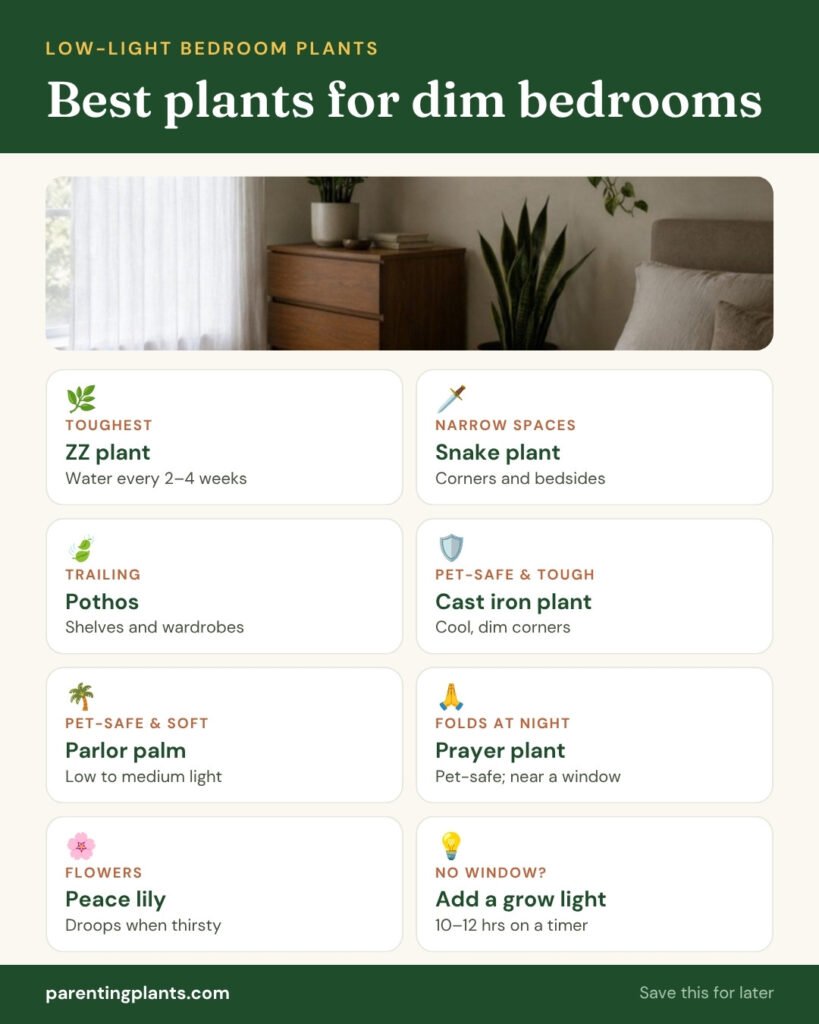
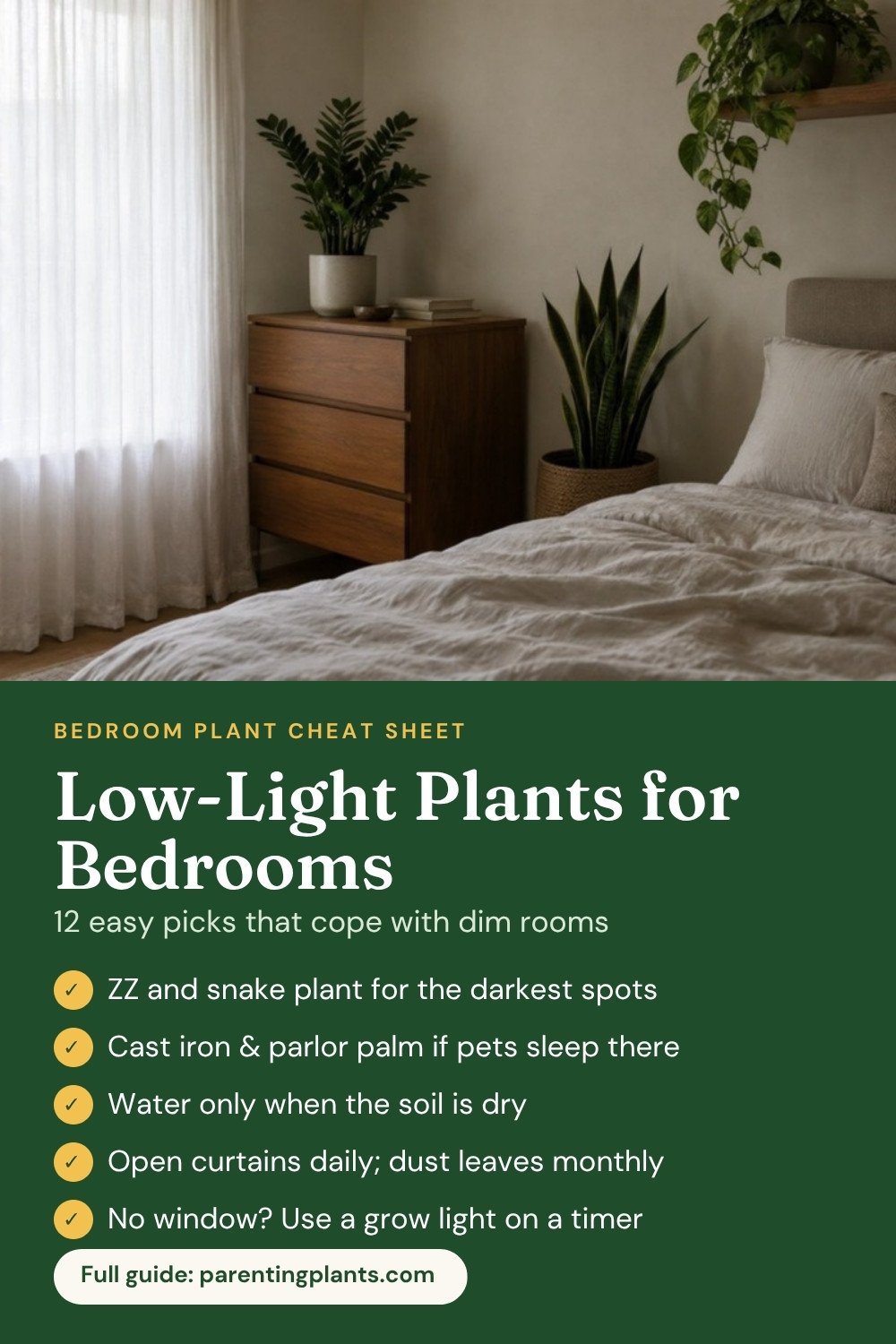
Save this for later: pin the cheat sheet below to your Pinterest plant board.
Want every plant’s care on one page?
The Houseplant Care Cards give you 30 printable one-page guides for popular houseplants: light, water, pet safety and quick fixes at a glance.
Bedroom plants FAQ
What is the best plant for a dark bedroom?
The ZZ plant and snake plant are the most forgiving. Both cope with low light and need water only every 2 to 4 weeks. If you have pets, the cast iron plant is the toughest non-toxic option.
Is it bad to have plants in your bedroom at night?
No. Plants release a tiny amount of carbon dioxide at night, far less than a person or a pet. It has no measurable effect on your sleep or the air in the room.
Do snake plants give off oxygen at night?
Snake plants take in carbon dioxide at night because they use CAM photosynthesis, but the amount is very small. One plant will not noticeably change the oxygen in a bedroom.
Which bedroom plants are safe for cats and dogs?
Cast iron plant, parlor palm, prayer plant, bird’s nest fern and spider plant are listed as non-toxic to cats and dogs by the ASPCA.
Can a plant survive in a bedroom with no windows?
Only with artificial light. A full-spectrum LED grow light on a timer for 10 to 12 hours a day can keep low-light plants such as ZZ, snake plant and pothos healthy.
How often should I water plants in a dark bedroom?
Less often than in a bright room, usually every 1 to 4 weeks depending on the plant. Always check that the top 1 to 2 inches of soil are dry first.
Can plants in the bedroom cause mould?
Constantly wet soil can grow mould and attract fungus gnats. Water only when the soil has dried, use pots with drainage holes, and empty saucers.
Sources and further reading
This guide was written by Manik at Parenting Plants and checked against the expert and university resources below. Read how we research and update our guides in our editorial guidelines.
- Drexel University: Study: potted plants don’t improve indoor air quality (2019)
- ASPCA: Toxic and non-toxic plants list
- University of Florida IFAS Extension: Interior plants: selection and care
- NC State Extension: Zamioculcas zamiifolia (ZZ plant)
- NC State Extension: Aspidistra elatior (cast iron plant)
Looking for a specific plant? Browse all our houseplant care guides A to Z.
Free tracker
Get the free Plant Care Tracker
A ready-made plant care tracker for Google Sheets and Notion that shows exactly which plants need water today, with 90 houseplants built in.
You're in!
Check your inbox, plant friend! 📩
Your free Plant Care Tracker is on its way. We've emailed you both versions, Google Sheets and Notion, plus a bonus printable 2027 plant calendar. It usually arrives within a few minutes.
Can't find it? Check your Promotions or Spam folder, and add manik@parentingplants.com to your contacts so you never miss a plant tip.