Special Offer: Use code ILOVEPLANTS for 25% off on all digital products! Shop Now →

12 min read Fact-checked against ASPCA & university extension sources · How we research
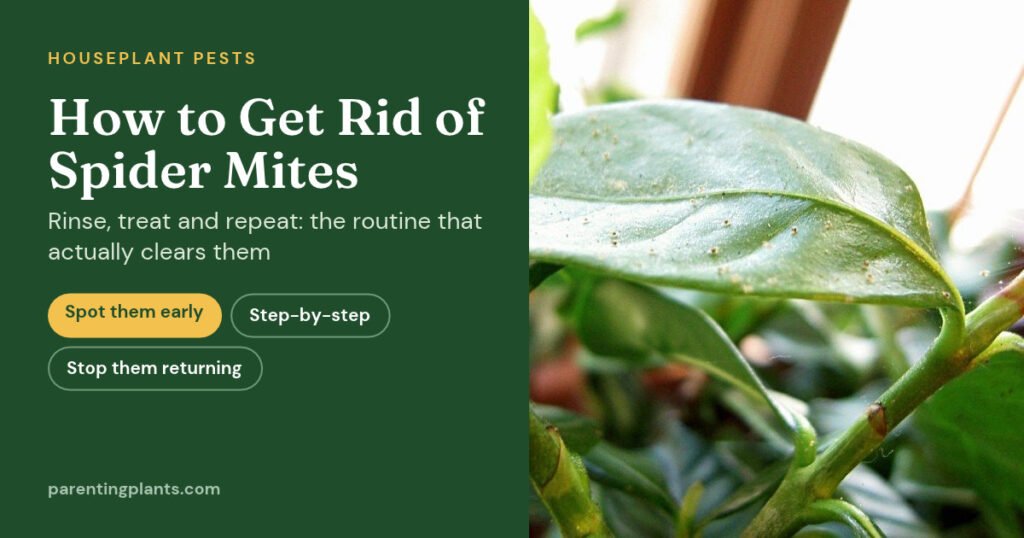
You notice the leaves on your calathea or ivy look dull and faintly speckled, almost dusty. A week later there is fine webbing between the stems. That is the classic sign of spider mites, one of the most common houseplant pests, and one of the fastest to get out of hand.
The good news is that spider mites are very treatable at home without harsh chemicals. The catch is that they breed fast and their eggs survive most sprays, so the treatment that works is a routine, not a single spray. This guide shows you how to confirm you have spider mites, the exact steps to clear them, the treatment schedule that actually breaks their life cycle, and how to keep them from coming back.
Short answer: Isolate the plant, then rinse it thoroughly in the shower (tops and undersides of every leaf) to knock off most mites and webbing. Remove badly damaged leaves. Then spray every leaf surface, especially the undersides, with insecticidal soap or horticultural oil (follow the label). Repeat every 5 to 7 days for at least 3 to 4 weeks, because sprays do not kill eggs and new mites keep hatching. Raise humidity and keep the plant out of hot, dry air from heaters, which is what lets mites explode indoors. Check neighbouring plants, and keep the plant isolated until you have seen no mites for two weeks.
In this guide
How to get rid of spider mites: the quick version
| Step | What to do | Why it matters |
|---|---|---|
| 1 | Isolate the plant | Mites walk and drift between touching plants |
| 2 | Rinse in the shower, leaf by leaf | Physically removes most mites, eggs and webbing |
| 3 | Prune the worst leaves | Heavily speckled leaves will not recover and hold eggs |
| 4 | Spray soap or horticultural oil, undersides first | Kills mites by contact; it must touch them |
| 5 | Repeat every 5–7 days for 3–4 weeks | Catches mites that hatch after each spray |
| 6 | Raise humidity, move away from heaters | Dry, warm air is what lets mites multiply |
| 7 | Check weekly for 2 weeks after the last mite | Confirms they are really gone before regrouping plants |
Free Plant Care Tracker: Never forget a watering again. Get it free →
What are spider mites?
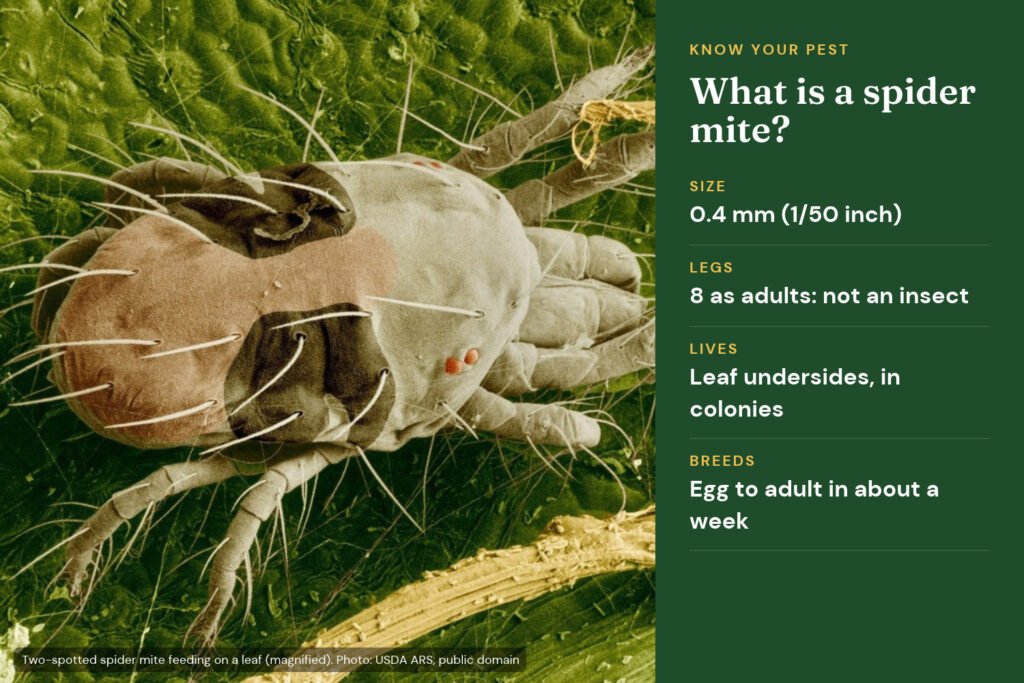
Spider mites are not insects. They are tiny arachnids, relatives of spiders and ticks, with eight legs as adults. The species found on houseplants is almost always the two-spotted spider mite (Tetranychus urticae), so named for the two dark patches on its body. Adults are only about 1/50 inch (0.4 mm) long, roughly the size of a full stop on this page, and can be pale yellow-green, reddish or orange.
They feed by piercing individual leaf cells and sucking out the contents, which is what creates the speckled, bleached look. They live mostly on the undersides of leaves, and spin fine silk that protects their colonies.
Why they spread so fast indoors: In warm, dry conditions a spider mite can go from egg to egg-laying adult in about a week, and each female can lay around 100 eggs over her 3 to 4 week life. Heated homes in winter, with low humidity and no natural predators, are close to ideal for them. That is why an infestation can seem to appear overnight.
Signs of spider mites on houseplants
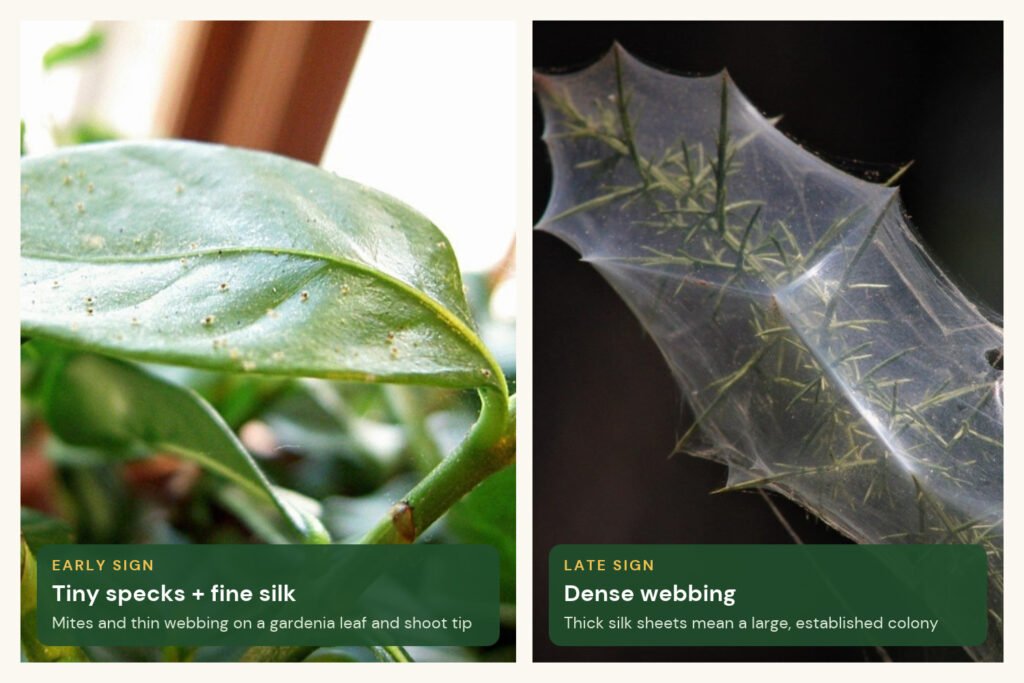
- Tiny pale dots (stippling) on the top of leaves, as if the leaf has been pricked with a pin. This is usually the first sign.
- Dull, dusty, bronzed or silvery leaves that look faded rather than yellowed in one patch.
- Fine webbing between leaves, stems and leaf joints, or at the tips of new growth. Webbing means the population is already large.
- Moving specks on the leaf undersides, often near the main vein. A magnifier or phone camera zoom makes them easy to see.
- Yellowing, curling and dropping leaves as damage spreads, usually starting on the oldest leaves or the side facing a heater.
- Gritty dust on leaf undersides that does not wipe away cleanly: shed skins, eggs and droppings.
Spider mite damage is easy to confuse with thrips (silvery streaks with black dots of droppings) or with dry-air crisping (brown edges but no speckling). Our plant problem decoder and Plant Doctor tool can help you rule other causes in or out.
How to confirm it is spider mites (the paper test)
- Hold a sheet of white paper under a leaf or branch.
- Tap the leaf sharply a few times.
- Wait a few seconds and watch the paper. Specks that start to move are spider mites. Smear one: spider mites usually leave a reddish or green streak, while predatory mites (the good guys) are faster and leave little colour.
- Check the undersides of several leaves with a magnifier, looking for mites, round translucent eggs and silk.
Tip: Wipe the underside of a leaf with a white tissue or cotton pad. Rusty-red or greenish smears are another quick giveaway.
Step-by-step: how to get rid of spider mites
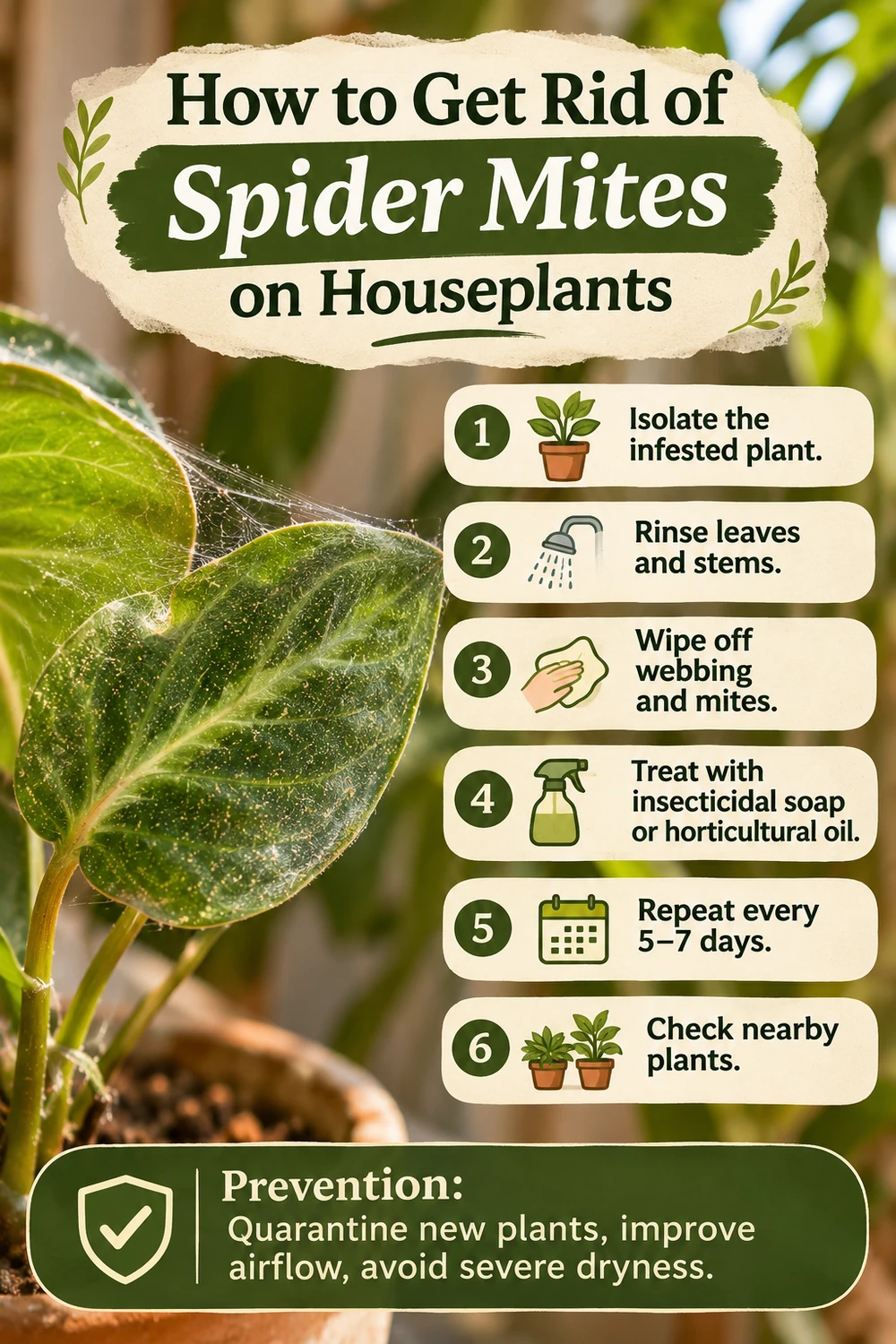
1. Isolate the plant straight away
Move the plant to another room, or at least well away from other plants, so leaves are not touching. Spider mites crawl from plant to plant and can also hitch a ride on your hands, clothes and pruners. Check every plant that was nearby; the most likely to be affected are those listed further down.
2. Rinse it thoroughly
This is the single most effective first step. Put the plant in the shower or sink and rinse every leaf, tops and undersides, with a firm spray of lukewarm water. Wipe larger leaves with a soft damp cloth to remove webbing. Cover the soil with a plastic bag or cling film first so you do not wash mites into the pot or flood the roots. For small plants, you can turn the pot upside down (holding the soil in) and swish the foliage in a bowl of water.
3. Prune the worst growth
Cut off leaves that are heavily speckled, yellow or covered in webbing. They will not recover, and they carry the most eggs. Seal the clippings in a bag and put them in the bin, not the compost. Do not remove more than about a third of the plant at once; a weak plant recovers more slowly. Clean your scissors afterwards. See our guide to pruning houseplants.
4. Spray every leaf surface
Once the plant has dried, spray it with insecticidal soap or a horticultural oil labelled for spider mites and houseplants. Both work by contact: they must physically coat the mites to kill them, so thoroughness matters more than strength.
- Undersides first: that is where most mites live. Tilt the plant or turn leaves over as you go.
- Spray to the point of runoff, covering stems, leaf joints and new growth.
- Spray out of direct sun and in normal room temperatures, and do not use oil on a plant that is very dry or wilted. Both can scorch leaves in heat or bright sun.
- Test first on a few leaves and wait 24 to 48 hours if you have a sensitive plant such as a fern, calathea or a hairy-leaved plant.
- Follow the label dilution exactly. Stronger mixes damage leaves without killing more mites.
5. Fix the conditions that let mites thrive
Spider mites love warm, dry, still air. Move the plant away from radiators, heating vents and sunny windowsills that bake in the afternoon. Raise humidity with a humidifier nearby or by grouping (clean) plants together, and keep the plant well watered: drought-stressed plants are more attractive to mites. Our houseplant humidity guide explains the options.
6. Repeat on schedule
This is where most people go wrong. See the schedule below.
Treatment schedule: why one spray is never enough
Soap and oil sprays kill mites they touch, but they do not reliably kill eggs, and mites in hidden corners survive. New mites hatch within days. If you spray once and stop, the population rebounds in a week or two. Repeating every 5 to 7 days catches each new wave before it can lay eggs.
| Day | What to do |
|---|---|
| Day 1 | Isolate, rinse, prune, then spray every leaf surface |
| Day 5–7 | Rinse (optional) and spray again; check leaf undersides with a magnifier |
| Day 10–14 | Spray again; webbing should be gone and new leaves unspeckled |
| Day 15–21 | Spray again; do the paper tap test |
| Day 22–28 | Final spray if you still see any mites; otherwise just inspect |
| Weeks 5–6 | Inspect weekly. If you find no mites for 2 weeks, return the plant to its spot |
Do not judge success by old leaves. Speckled leaves stay speckled even after every mite is dead. Judge by clean new growth, no webbing and no moving specks in the paper test.
Which treatment works best? Soap, oil, neem and more
| Treatment | How well it works | Best for | Watch out for |
|---|---|---|---|
| Water rinse | Good first step; not enough alone | Every infestation, light ones especially | Cover the soil; do not soak the pot |
| Insecticidal soap | Good on contact; must be repeated | Most houseplants | Can mark sensitive leaves; no residual effect |
| Horticultural oil (light, refined) | Good on contact; smothers mites and some eggs | Tougher-leaved plants: ivy, palms, rubber plant, citrus | Do not use in heat or sun, or on stressed plants; do not mix with soap |
| Neem oil products | Moderate; works mainly as an oil spray | Those who prefer a botanical option | Strong smell; same scorch cautions as oil |
| Predatory mites (e.g. Phytoseiulus persimilis) | Very good when released early | Large collections, conservatories, repeat problems | Need humidity; do not combine with sprays that kill them |
| Rubbing alcohol wipe | Spot treatment only | A few leaves on a small plant | Can burn leaves; test first |
| Systemic insecticides (e.g. imidacloprid) | Do not work on spider mites | Not recommended | Mites are not insects; these can even make mite problems worse by killing their predators |
Which should you choose? For most homes: a thorough rinse plus insecticidal soap or a light horticultural oil, repeated on schedule, clears spider mites. If you have many plants and mites keep returning, predatory mites are worth considering. They are sold online, feed only on mites, cannot bite people and die out once their food is gone. Avoid home recipes with washing-up liquid at high concentrations: dish soaps vary a lot and can damage leaves.
Pets and children: Insecticidal soap and horticultural oil are among the lowest-toxicity options, but keep pets and children away from treated plants until the spray has dried, and store products out of reach. Always follow the product label. For pet-safe plant choices, see our pet-friendly houseplants guide.
Plants that get spider mites most often
Spider mites can attack almost any houseplant, but they strongly prefer some, especially in dry winter air. If one of these has mites, check its neighbours first.
| Plant | Why it is prone | Our care guide |
|---|---|---|
| English ivy | Thin leaves, often kept somewhere warm and dry | English ivy care |
| Calathea and prayer plant | Need high humidity; dry air stresses them | Calathea care, prayer plant care |
| Parlor palm and other palms | Large leaf surface, mites hide in fronds | Parlor palm care |
| Dracaena | Mites gather where leaves meet the stem | Dracaena care |
| Fiddle leaf fig and rubber plant | Dusty leaves near sunny windows | Fiddle leaf fig care, rubber plant care |
| Boston fern | Dense fronds, dislikes dry air | Boston fern care |
| Spider plant, peace lily, pothos | Common, often grouped with infested plants | Spider plant care, peace lily care |
| Norfolk Island pine, rosemary, herbs | Winter favourites kept in warm rooms | Winter houseplant care |
How to stop spider mites coming back
- Check leaf undersides every week, especially from autumn to spring. Make it part of your weekly care routine.
- Quarantine new plants for two to three weeks before putting them with the rest. Our guide to the first two weeks with a new plant covers what to check, and how to buy a healthy houseplant shows the warning signs in the shop.
- Raise humidity in winter with a humidifier and keep plants away from radiators and heating vents.
- Shower or wipe leaves monthly. Dust-free leaves are less hospitable to mites, and you will spot problems early.
- Keep plants well watered and healthy. Stressed, thirsty plants are hit hardest.
- Space plants so leaves are not touching, which slows any spread.
- Bring outdoor plants in carefully. Rinse and inspect pots that spent summer outside before they come back inside.
Common mistakes that make spider mites worse
- Spraying once and stopping. Eggs hatch after the spray; you need a 3 to 4 week routine.
- Spraying only the tops of leaves. Most mites are underneath.
- Misting as a cure. Misting raises humidity for minutes only; it does not control an infestation.
- Using systemic insect killers. They do not affect mites.
- Mixing products or doubling the strength. This burns leaves and stresses the plant further.
- Returning the plant too soon. Wait for two clean weeks before it rejoins your other plants.
Spider mite checklist
- Isolate the plant and check its neighbours
- Confirm with the white paper tap test
- Rinse tops and undersides of every leaf, soil covered
- Prune and bin the worst leaves
- Spray insecticidal soap or horticultural oil, undersides first
- Repeat every 5–7 days for 3–4 weeks
- Raise humidity; move away from heaters
- Inspect weekly; return the plant after 2 clean weeks
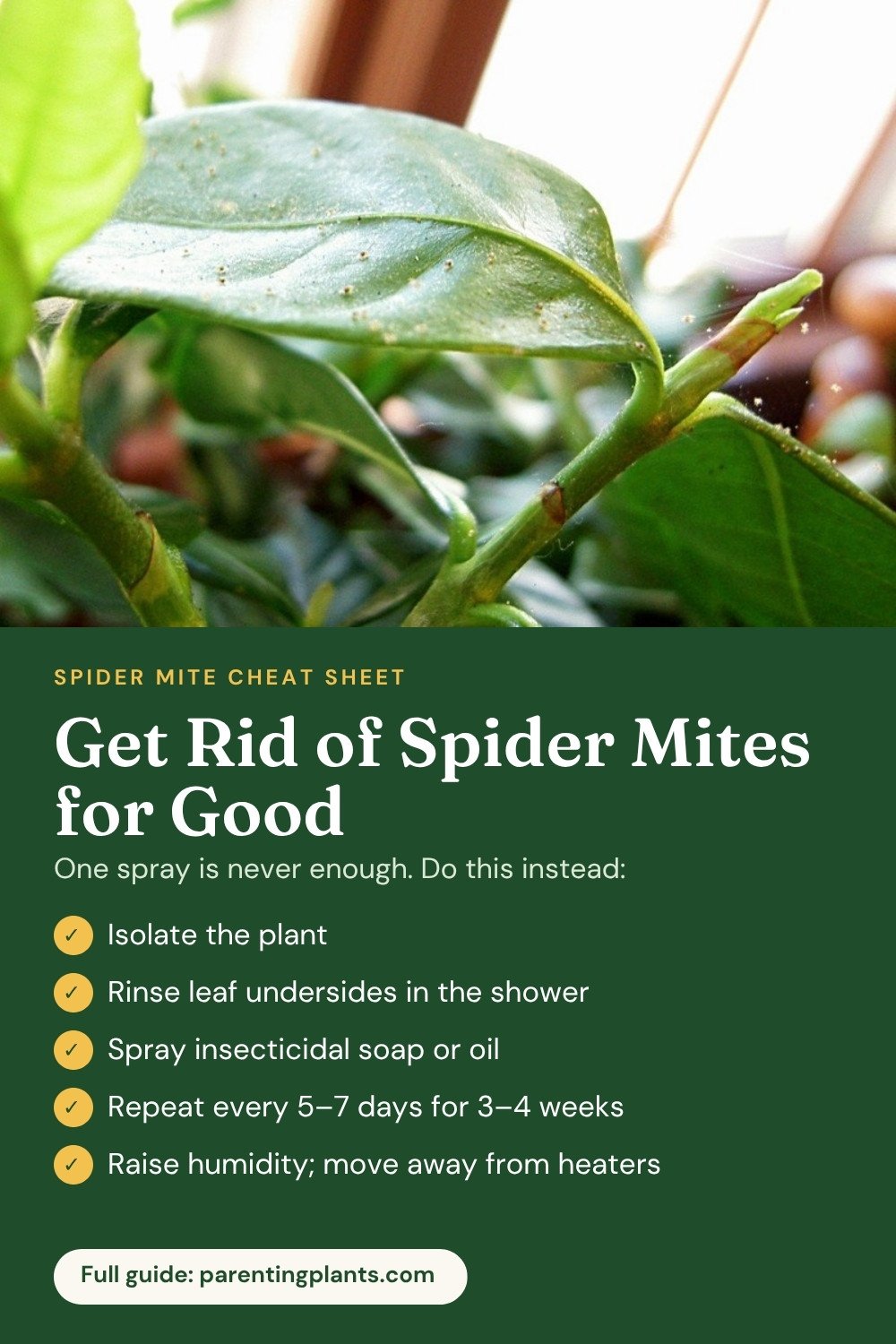
Save this for later: pin the cheat sheet below to your Pinterest plant board.
Leaves turning brown, crispy or yellow?
The Houseplant Rescue Guide matches 26 common plant problems to a clear photo, then gives you simple steps to fix each one and stop it coming back. No jargon, 50 pages, with printable checklists.
Spider mites FAQ
How do I know if my plant has spider mites?
Look for tiny pale speckles on the leaves, a dull or dusty look, and fine webbing between leaves and stems. Tap a leaf over white paper: moving specks that leave a reddish or green smear when crushed are spider mites.
What kills spider mites instantly?
Nothing kills every mite and egg in one go. A strong rinse removes most of them immediately, and insecticidal soap or horticultural oil kills mites they touch. You still need to repeat the treatment every 5 to 7 days for 3 to 4 weeks to catch new hatchlings.
How long does it take to get rid of spider mites?
Usually 3 to 4 weeks of treatment, then 2 weeks of checking. Mites can complete their life cycle in about a week in warm, dry conditions, so treatment has to cover several generations.
Can a plant recover from spider mites?
Yes, if you catch it before most leaves are damaged. Speckled leaves will not turn green again, but clean new growth means the plant is recovering. Badly infested, heavily webbed plants with few healthy leaves are often better discarded.
Does neem oil kill spider mites?
Neem oil sprays can control spider mites, mainly by smothering them like other horticultural oils. Use a product labelled for houseplants and mites, test it on a few leaves first and never spray in direct sun or heat.
Does misting stop spider mites?
Not on its own. Misting only raises humidity for a few minutes. A humidifier, keeping plants away from heaters and regular rinsing are much more effective at discouraging mites.
Are spider mites harmful to people or pets?
No. Spider mites feed only on plants and do not bite people or pets. They can, however, spread to your other houseplants.
Where do spider mites come from indoors?
Most arrive on new plants, cut flowers or plants brought back in from outside, and can drift on air currents or travel on clothing. Warm, dry indoor air then lets a few mites multiply quickly.
Sources and further reading
This guide was written by Manik at Parenting Plants and checked against the university extension resources below. Read how we research and update our guides in our editorial guidelines. For other pests, see our full guide to houseplant pests and how to get rid of fungus gnats.
- University of California IPM: Spider mites: Pest Notes for home and landscape
- Colorado State University Extension: Managing houseplant pests
- University of Missouri Extension: Least-toxic control methods to manage indoor plant pests
- UMass Extension: Twospotted spider mites (greenhouse fact sheet)
- UC IPM: Phytoseiulus predatory mites (natural enemies gallery)
Photo credits: indoor gardenia with spider mites, public domain (Wikimedia Commons); dense spider mite webbing, Murielle Desrois, CC0 (Wikimedia Commons); magnified spider mite, Eric Erbe and Chris Pooley, USDA Agricultural Research Service.
Looking for a specific plant? Browse all our houseplant care guides A to Z.
Free tracker
Get the free Plant Care Tracker
A ready-made plant care tracker for Google Sheets and Notion that shows exactly which plants need water today, with 90 houseplants built in.
You're in!
Check your inbox, plant friend! 📩
Your free Plant Care Tracker is on its way. We've emailed you both versions, Google Sheets and Notion, plus a bonus printable 2027 plant calendar. It usually arrives within a few minutes.
Can't find it? Check your Promotions or Spam folder, and add manik@parentingplants.com to your contacts so you never miss a plant tip.