Special Offer: Use code ILOVEPLANTS for 25% off on all digital products! Shop Now →

12 min read Fact-checked against ASPCA & university extension sources · How we research
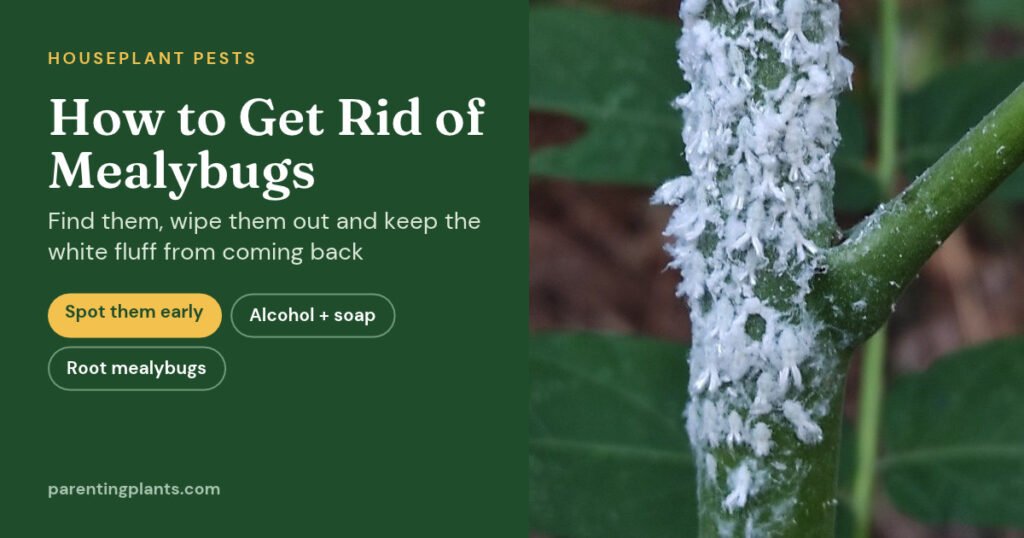
You notice a little tuft of white “cotton” where a leaf meets the stem of your jade plant or hoya. Then another. Then the leaves feel sticky. Those white tufts are mealybugs, one of the most common houseplant pests and one of the most stubborn, because their waxy coat sheds water and many sprays.
The good news is that mealybugs move slowly and are easy to see once you know where to look, so a careful, patient routine clears them from most plants. This guide shows you how to recognise them, the exact steps to remove them, how long treatment takes, what to do about root mealybugs, and how to stop them coming back.
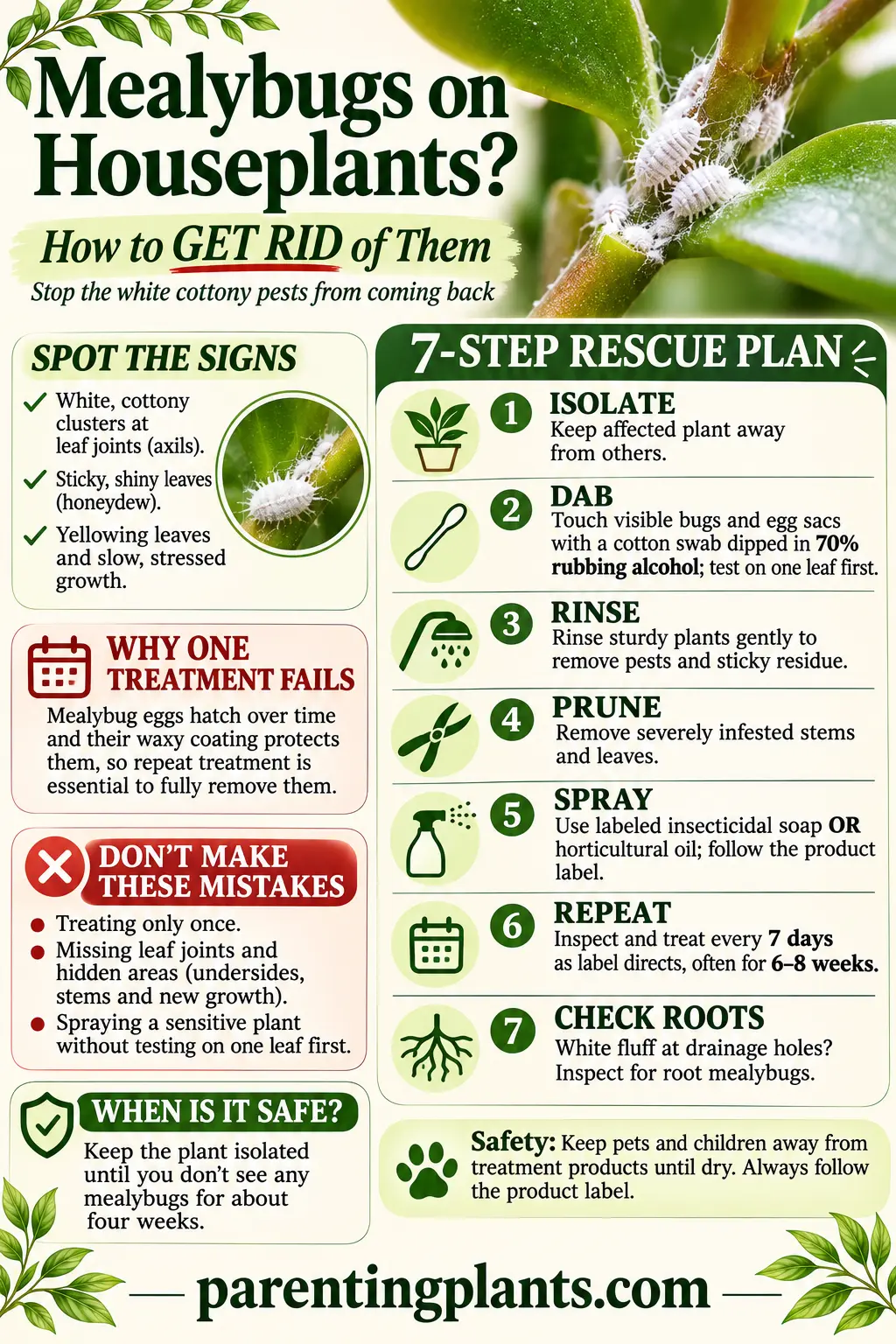
Short answer: Isolate the plant. Dab every mealybug and cottony egg sac with a cotton swab dipped in 70% rubbing alcohol (test on one leaf first), paying special attention to leaf joints, leaf undersides and stem crevices. Rinse the plant with a firm spray of water, then spray it thoroughly with insecticidal soap or horticultural oil. Repeat every 7 days and keep checking until you have seen no mealybugs for about a month; this usually takes 6 to 8 weeks. If you see white fluff in the soil or at the drainage holes, check the roots for root mealybugs. Badly infested plants are often best thrown away.
In this guide
How to get rid of mealybugs: the quick version
| Step | What to do | Why it matters |
|---|---|---|
| 1 | Isolate the plant and check its neighbours | Crawlers spread to touching plants and on hands and tools |
| 2 | Dab every bug and egg sac with 70% alcohol | Dissolves the waxy coat that sprays struggle to get through |
| 3 | Rinse with a firm spray of water | Knocks off the ones you missed and cleans off sticky honeydew |
| 4 | Prune heavily infested stems | Removes the biggest colonies and egg masses |
| 5 | Spray insecticidal soap or horticultural oil | Kills young crawlers hiding in crevices |
| 6 | Repeat weekly for 6–8 weeks | Eggs hatch over time; you must catch each new wave |
| 7 | Check the roots and soil | Root mealybugs survive leaf treatments |
Free Plant Care Tracker: Never forget a watering again. Get it free →
What are mealybugs?
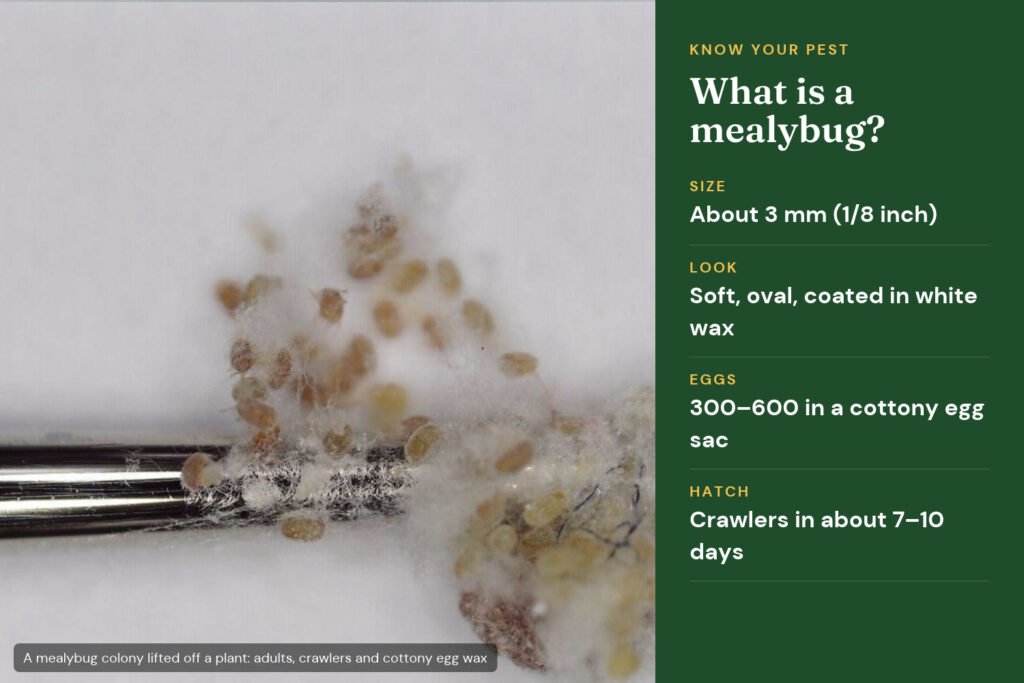
Mealybugs are small, soft-bodied, oval insects covered in a white, powdery wax that makes them look as if they have been rolled in flour. Adult females of the common citrus mealybug (Planococcus citri) are about 3 mm (1/8 inch) long, with short waxy filaments around the edge. The longtailed mealybug has two long “tails”. Males are tiny winged insects you will rarely notice.
They feed by sucking sap from stems and leaves, which weakens the plant and can cause yellowing, distorted growth and leaf drop. As they feed they excrete sticky honeydew, which can grow black sooty mould and attract ants.
Why they are hard to get rid of: each female lays roughly 300 to 600 eggs inside a fluffy, waxy egg sac. The eggs hatch in about 7 to 10 days into tiny yellowish “crawlers” that wander to new feeding spots. The wax protects both the adults and the eggs from many sprays, and a full life cycle takes around six weeks to two months, so treatment has to cover several overlapping generations.
Signs of mealybugs (and where they hide)
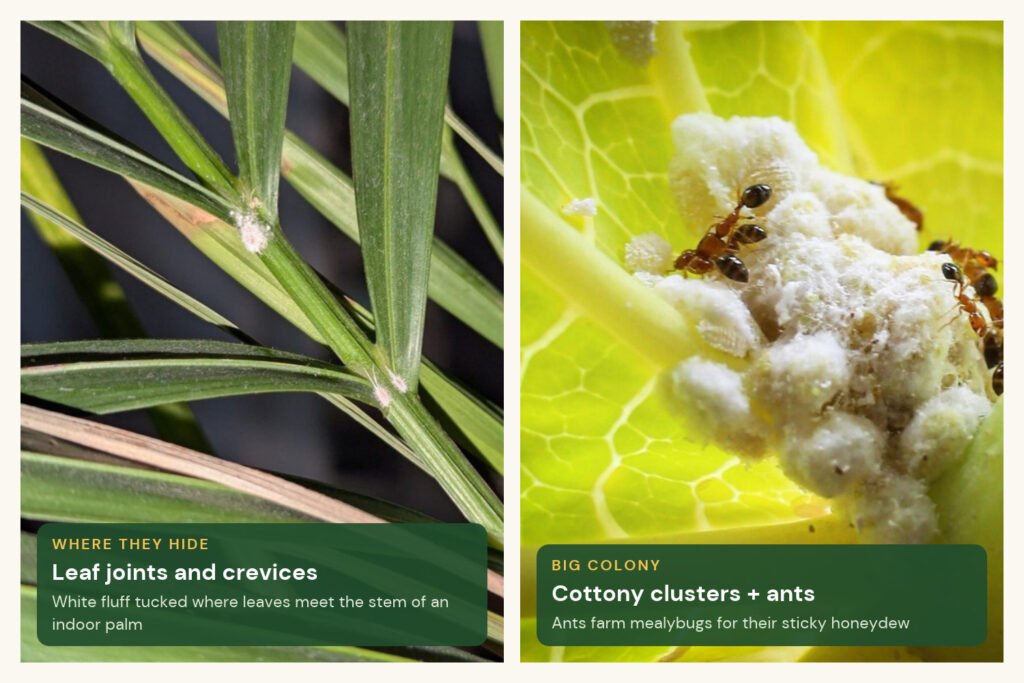
- White, cottony tufts in leaf joints (where the leaf stalk meets the stem), along stems and in the folds of new leaves. These are the egg sacs.
- Small, white, oval “fuzzy” bugs that move very slowly when you nudge them.
- Sticky leaves or a shiny film on leaves and the surface below the plant: honeydew.
- Black, sooty patches on leaves where mould has grown on the honeydew.
- Ants walking up and down the plant. Ants farm mealybugs for honeydew and even protect them.
- Yellowing, wilting, stunted or distorted growth and leaves dropping for no obvious reason.
- White fluff around the drainage holes or on the soil surface, which points to root mealybugs.
Where to look: leaf joints and stem crevices first, then the undersides of leaves, the centre of rosette plants, between succulent leaves, under cactus spines, inside the sheaths of orchid leaves and along palm fronds. Use a torch and a magnifier for spiny or tightly packed plants.
Is it mealybugs or mould?
| Clue | Mealybugs | Mould or mildew |
|---|---|---|
| Where it is | On stems, leaf joints, leaf undersides | On the soil surface, or as a flat film on leaves |
| Touch it with a toothpick | A soft, oval body underneath that may slowly move | Smears or wipes away; no body |
| Sticky leaves | Often | No |
| Pattern | Separate tufts and clusters | Even, fuzzy or powdery layer |
White fuzz on top of the soil is usually harmless mould from soil that stays damp; let the top dry out more between waterings (see our watering guide). White powder spread evenly across leaves is more likely powdery mildew. Still unsure? Try our Plant Doctor tool or the plant problem decoder.
Step-by-step: how to get rid of mealybugs
1. Isolate the plant and check its neighbours
Move the plant away from your other plants straight away. Crawlers walk to nearby plants, and you can carry them on your hands, sleeves and tools. Check every plant that was close by, especially succulents, hoyas and palms.
2. Dab every mealybug with rubbing alcohol
Dip a cotton swab in 70% isopropyl (rubbing) alcohol and touch it to each mealybug and egg sac. The alcohol dissolves their protective wax and kills them; treated mealybugs turn light brown. Wipe them off as you go. University extension services recommend this as the first step for light to moderate infestations.
- Test first: dab one leaf, wait a day or two and check for damage. Some plants, especially those with thin or hairy leaves, are sensitive to alcohol.
- Avoid soaking the leaves; treat the bugs, not the whole plant.
- Go slowly: look into every leaf joint and crevice. Mealybugs you miss will restart the colony.
3. Rinse and clean
Take the plant to the shower or sink and rinse it with a moderately strong spray of lukewarm water to knock off the remaining mealybugs and wash away sticky honeydew. Cover the soil with a plastic bag first. Skip this for succulents and cacti that dislike wet leaves; use a dry soft brush instead.
4. Prune the worst areas
Cut off stems or leaves that are thickly covered in white fluff. Bag them and put them in the bin. Clean your scissors with alcohol afterwards. See our guide to pruning houseplants for where to cut.
5. Spray to catch the hidden crawlers
Once the plant is dry, spray every surface with insecticidal soap or a light horticultural oil (including neem-based products) labelled for houseplants. These work by contact and are most effective on young crawlers that have little wax, so be thorough: undersides, leaf joints, stems and the top of the soil. Spray out of direct sun and follow the label dilution exactly.
6. Repeat weekly and keep checking
Mealybug eggs are well protected, and new crawlers keep appearing for weeks. Repeat the alcohol dabbing and spray every 7 days. Keep the plant isolated until you have seen no mealybugs for about a month.
Treatment schedule: how long it takes
| When | What to do |
|---|---|
| Week 1 | Isolate, alcohol-dab every bug and egg sac, rinse, prune, spray |
| Weeks 2–4 | Inspect every leaf joint weekly; dab any new bugs; spray again |
| Weeks 5–6 | Keep inspecting and spraying; check the roots if fluff keeps reappearing low down |
| Weeks 7–8 | Spot-treat only. If you see nothing for 4 weeks, the plant can rejoin the others |
Be patient. Most mealybug problems take 6 to 8 weeks to clear because of their long, overlapping life cycle. Iowa State Extension suggests setting aside time every week to check each plant and remove any mealybugs you find. Consistency matters more than strong products.
Which treatment works best?
| Treatment | How well it works | Best for | Watch out for |
|---|---|---|---|
| Rubbing alcohol (70%) on a swab | Very good on visible bugs and egg sacs | Light to moderate infestations, succulents, hoyas, orchids | Test first; can burn sensitive leaves |
| Water spray | Good for knocking bugs off | Leafy plants, palms | Not for succulents and cacti; cover the soil |
| Insecticidal soap | Good on crawlers; less on waxy adults | Most houseplants, follow-up sprays | Must coat the bugs; repeat weekly |
| Horticultural or neem oil | Good on crawlers; smothers them | Tougher-leaved plants | Not in heat or sun; do not mix with soap |
| Dilute alcohol spray | Useful for heavy infestations | Robust plants | Colorado State suggests about 10% alcohol in water; test first |
| Biological control | Good in large collections | Conservatories, many plants | Mealybug destroyer beetles and parasitic wasps need warmth |
| Throwing the plant away | Sometimes the best option | Cheap, heavily infested or root-infested plants | Bag it and clean the area and pot |
Pets and children: keep them away from treated plants until sprays have dried, and store alcohol and pest products out of reach. Avoid home recipes with washing-up liquid, which can damage leaves; use products made for plants and follow the label. Looking for safer plants overall? See our pet-friendly houseplants.
Root mealybugs: the hidden kind
Some mealybugs live underground on the roots, especially on African violets, succulents and cacti. Root mealybugs cause yellowing, wilting, slow growth and fewer flowers, even when the leaves look clean. The clues are small white, cottony patches around the drainage holes or on the outside of the root ball. Often the only way to confirm them is to slide the plant out of its pot and look.
- Remove the plant from its pot and shake or gently wash off the old soil over a bin bag.
- Cut away roots that are heavily coated in white fluff.
- Rinse the remaining roots in lukewarm water.
- Repot into fresh potting mix and a clean or new pot. Throw the old soil away. Our repotting guide shows how.
- Keep it isolated and check the drainage holes weekly for a couple of months.
Root infestations are hard to clear completely. For a small or inexpensive plant, University of Wisconsin Extension notes that discarding it is often the most practical solution. For a favourite plant, you can take healthy cuttings and start again in fresh mix.
Plants that get mealybugs most often
| Plant | Where mealybugs hide | Our care guide |
|---|---|---|
| Jade plant and other succulents | Between leaves and in stem joints | Jade plant care |
| Aloe vera | At the base of leaves | Aloe vera care |
| Hoya | Leaf joints and flower spurs | Hoya care |
| Christmas cactus | Between stem segments | Christmas cactus care |
| Orchids | Inside leaf sheaths and on flower spikes | Orchid care |
| Palms | Where fronds meet the stem | Parlor palm care |
| Money tree and rubber plant | Leaf joints and new growth | Money tree care, rubber plant care |
| African violet | Roots (root mealybugs) and leaf crowns | African violet care |
| Prayer plant, poinsettia, gardenia | Leaf undersides and stems | Prayer plant care, poinsettia care |
How to stop mealybugs coming back
- Inspect new plants carefully before you buy, and quarantine them for two to three weeks at home. See how to buy a healthy houseplant and our guide to the first two weeks with a new plant.
- Check leaf joints and drainage holes weekly as part of your weekly care routine.
- Do not overfeed. Soft, lush growth from too much nitrogen fertiliser is especially attractive to mealybugs.
- Use fresh potting mix when repotting, never soil from an infested plant.
- Clean pots, saucers and tools before reusing them.
- Rinse and inspect plants that spent summer outdoors before bringing them back inside.
- Space plants so leaves do not touch, which slows spread.
Common mistakes
- Treating once and stopping. Eggs hatch over weeks; keep going weekly.
- Missing the hiding places. Most survivors are in leaf joints, sheaths and roots.
- Spraying only. Sprays struggle to penetrate the wax; remove visible bugs and egg sacs first.
- Ignoring the soil. Root mealybugs will not be touched by leaf treatments.
- Putting the plant back too soon. Wait for about a month with no mealybugs.
Mealybug checklist
- Isolate the plant and check its neighbours
- Dab every bug and egg sac with 70% alcohol (test first)
- Rinse with water (not for succulents)
- Prune and bin heavily infested stems
- Spray insecticidal soap or horticultural oil
- Repeat every 7 days for 6–8 weeks
- Check the roots if fluff appears near the soil
- Return the plant after about a month with no mealybugs
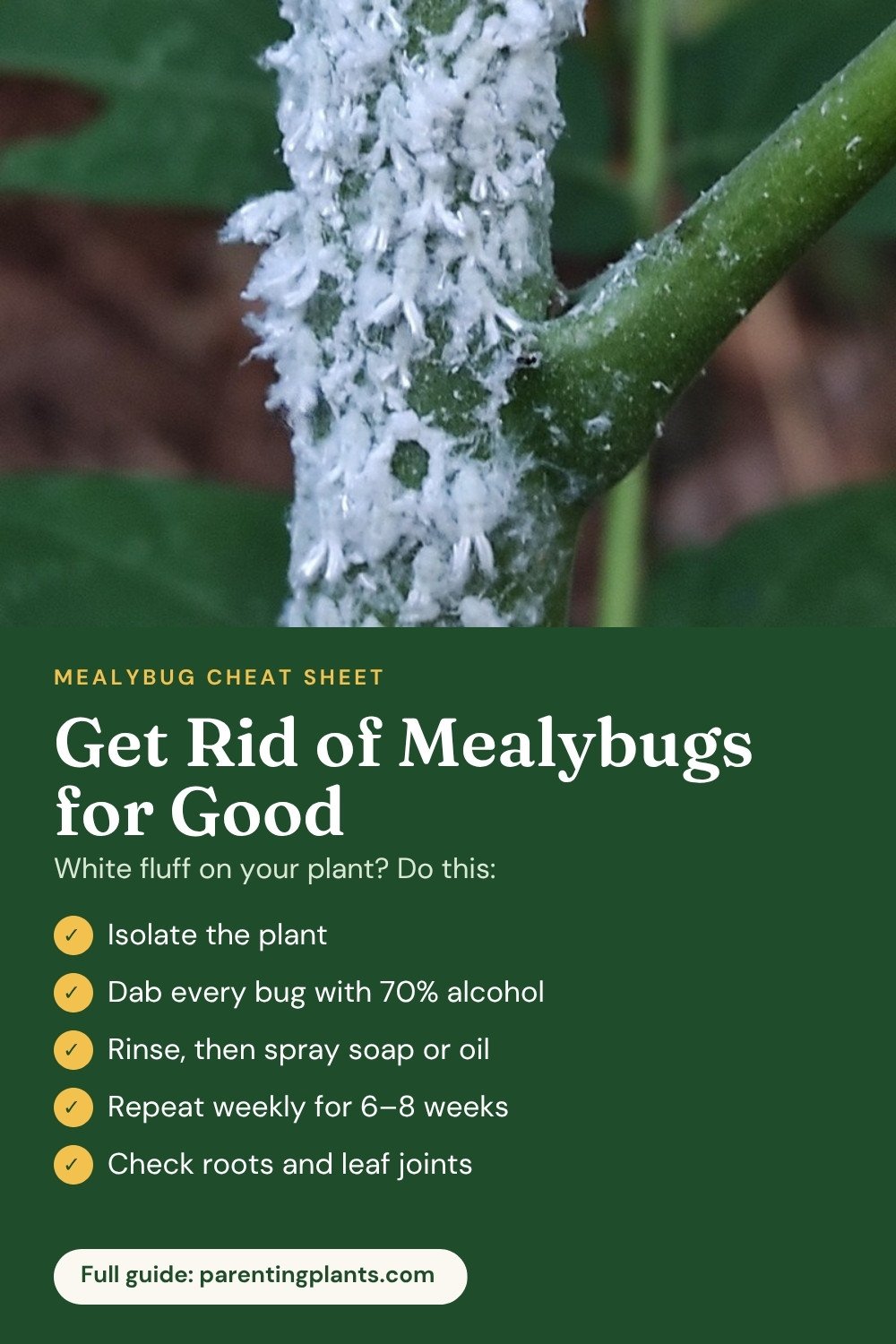
Save this for later: pin the cheat sheet below to your Pinterest plant board.
Leaves turning brown, crispy or yellow?
The Houseplant Rescue Guide matches 26 common plant problems to a clear photo, then gives you simple steps to fix each one and stop it coming back. No jargon, 50 pages, with printable checklists.
Mealybugs FAQ
What kills mealybugs instantly?
Rubbing alcohol (70% isopropyl) applied directly with a cotton swab kills mealybugs on contact by dissolving their waxy coating. It only kills the ones you touch, so follow up with weekly checks and sprays of insecticidal soap or horticultural oil.
Where do mealybugs come from?
They usually arrive on new plants, cuttings or plants brought in from outdoors. Crawlers can also move between plants that touch and travel on hands, tools and pots.
How long does it take to get rid of mealybugs?
Usually 6 to 8 weeks. Mealybugs have a long life cycle with overlapping generations and well-protected eggs, so you need to treat and inspect weekly until you have seen none for about a month.
Can mealybugs live in soil?
Yes. Root mealybugs live on roots and in the soil, especially of African violets, succulents and cacti. Look for white cottony patches at the drainage holes or on the root ball, then wash the roots and repot in fresh mix.
Should I throw away a plant with mealybugs?
Not necessarily. Light infestations clear with alcohol and repeated sprays. But for a cheap plant with a heavy or root infestation, throwing it away is often the most practical choice and protects your other plants.
Are mealybugs harmful to humans or pets?
No. Mealybugs only feed on plants and do not bite people or pets. The main risk to pets comes from treatment products, so keep animals away until sprays have dried.
Does neem oil kill mealybugs?
Neem oil and other horticultural oils smother mealybugs and work best on young crawlers. They are less effective on adults protected by thick wax, so combine them with alcohol dabbing and repeat weekly.
Why do mealybugs keep coming back?
Usually because eggs or crawlers survived in leaf joints, leaf sheaths, the soil or on a neighbouring plant, or because treatment stopped too soon. Check hidden spots and the roots, and continue weekly for at least a month after the last sighting.
Sources and further reading
This guide was written by Manik at Parenting Plants and checked against the university extension resources below. Read how we research and update our guides in our editorial guidelines. For other pests, see our full guide to houseplant pests, how to get rid of spider mites and how to get rid of fungus gnats.
- Iowa State University Extension: How do I control mealybugs on a houseplant?
- Iowa State University Extension: Mealybugs (encyclopedia)
- University of Wisconsin–Madison Extension: Mealybugs
- University of Maryland Extension: Mealybugs on indoor plants
- Colorado State University Extension (PlantTalk): Mealy bugs on houseplants
- NC State Extension: Mealybugs
- UConn IPM: Mealybugs fact sheet (PDF)
Photo credits (all CC0, via Wikimedia Commons): mealybugs on a stem, Valeriia Matvieieva; mealybugs in the leaf joints of an indoor palm, Hantskan; mealybug colony with ants, MJN2000; mealybug colony with eggs and crawlers, Olga.
Looking for a specific plant? Browse all our houseplant care guides A to Z.
Free tracker
Get the free Plant Care Tracker
A ready-made plant care tracker for Google Sheets and Notion that shows exactly which plants need water today, with 90 houseplants built in.
You're in!
Check your inbox, plant friend! 📩
Your free Plant Care Tracker is on its way. We've emailed you both versions, Google Sheets and Notion, plus a bonus printable 2027 plant calendar. It usually arrives within a few minutes.
Can't find it? Check your Promotions or Spam folder, and add manik@parentingplants.com to your contacts so you never miss a plant tip.